

Gold is closing out the month of March on the front foot. After Fed Chair Powell’s speech on Monday evening struck a more balanced tone than markets feared — acknowledging softening growth data while maintaining the inflation focus — XAU/USD surged to $4,620 before pulling back to the current level of $4,560. The 15-minute chart shows the dip is being absorbed within the green demand zone between $4,529.770 and $4,541.544, and the projected path points toward a continuation above $4,588.083 — the session high resistance — into the afternoon session. Today’s calendar is the busiest of the week: China PMI beats overnight, Eurozone CPI Flash at noon, JOLTS and CB Consumer Confidence at 5:00pm, and three FOMC members in the evening.
The Chart: Post-Powell Consolidation, Continuation Projected
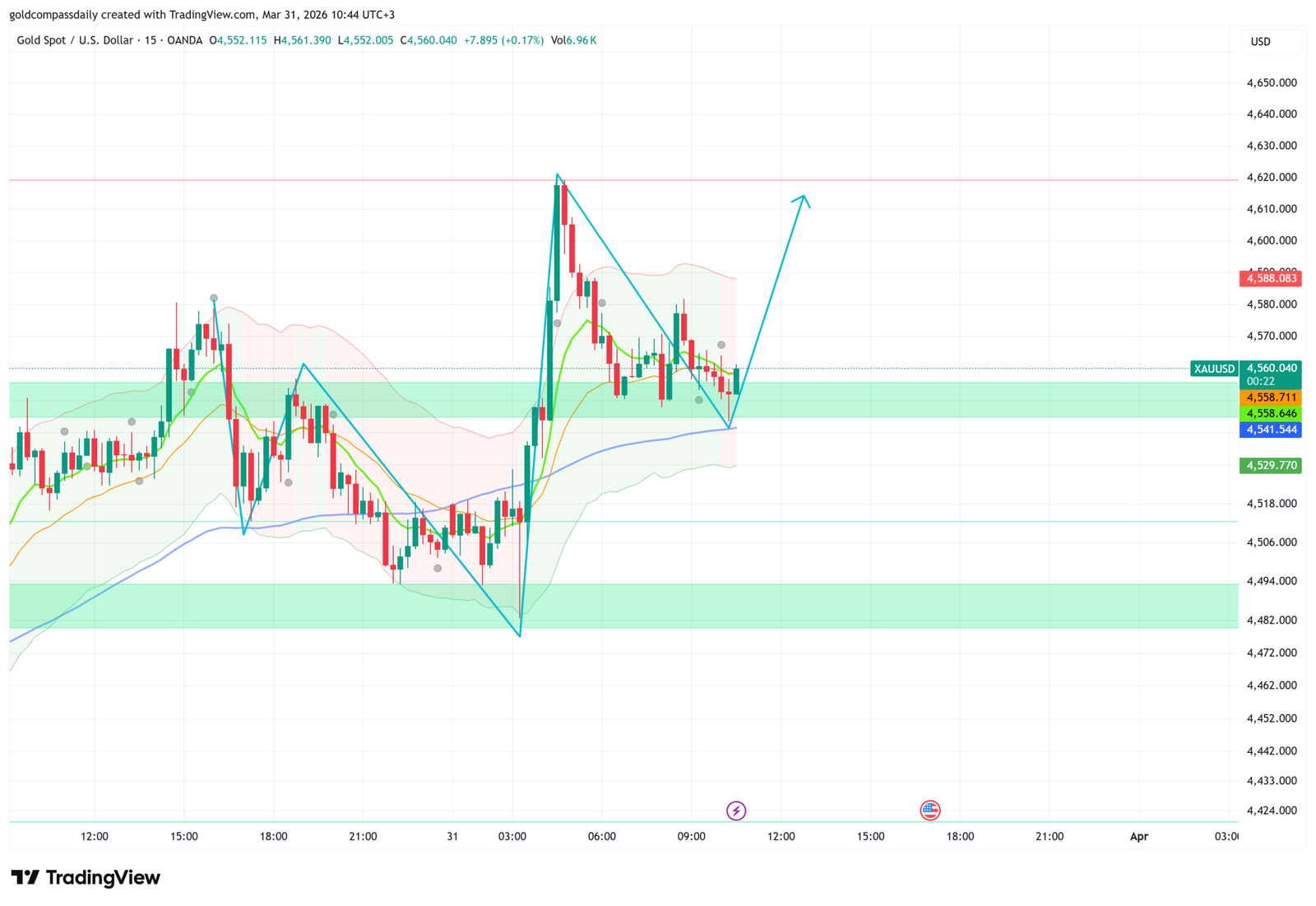
The structure of the recovery from the $4,100 low is entering a new phase. The surge to $4,620 following Monday’s Powell speech confirmed that the market had been positioned too bearishly — and that even a modest softening in Fed rhetoric is enough to drive significant short covering in gold. The pullback from $4,620 to the current $4,560 is orderly: price has respected the green demand zone on every test this morning, and each low is marginally higher than the last.
The immediate resistance is $4,588.083 — the overnight high that has capped price since the initial Powell-driven spike. A clean close above that level opens the path toward $4,610–$4,620 and beyond. The projected move on the chart targets a continuation through these levels into the afternoon session, driven by today’s US data and FOMC speakers.
The green demand zone at $4,529.770–$4,541.544 is the floor to hold. A close below $4,529 would indicate the post-Powell bounce is fading and would bring the $4,482–$4,500 area back into focus. Above $4,529, the bullish recovery structure remains intact and the month-end close sets up a strong foundation for April.
Overnight: China PMI Beats — Global Growth Signal
The session opened with a significant positive surprise from China. The Manufacturing PMI printed at 50.4 against a forecast of 50.1 and a prior of 49.0 — moving back above the 50 expansion threshold for the first time in several months. The Non-Manufacturing PMI came in at 50.1, above the forecast of 49.9 and the prior 49.5. Both readings beat expectations and both are back in expansion territory.
This is a meaningful data point for global markets. China’s manufacturing sector returning to expansion signals that factory activity is recovering — relevant for industrial metals, commodity currencies, and global supply chain dynamics. For gold specifically, a stronger Chinese economy supports physical demand for the metal, particularly from the world’s largest gold consumer.
AUD/USD: China PMI beat is the most directly positive catalyst for the Australian dollar — Australia’s largest export market improving drives commodity demand and supports AUD. The pair should outperform in the Asian and early European session.
Copper and industrial metals: Manufacturing expansion in China is the primary fundamental driver for base metals. Copper in particular benefits from improved Chinese factory output expectations.
EUR/USD and risk sentiment broadly: A China recovery reduces global recession fears and improves risk appetite — mildly positive for risk assets and EUR through improved global trade expectations.
Japan’s data was more mixed. Tokyo Core CPI y/y printed at 1.7% — above the forecast of 1.8%… wait, actually below: forecast 1.8%, actual 1.7%. A miss on Japanese inflation that reduces BOJ rate hike urgency. Prelim Industrial Production m/m came in at -2.1% against a prior of 4.3% — a sharp reversal after last month’s strong reading. Retail Sales y/y at -0.2% against a prior of 1.8% — a significant deterioration. Japan’s domestic economy is sending mixed signals: services sector resilient, but manufacturing and retail softening.
New Zealand’s ANZ Business Confidence printed at 32.5, down sharply from the prior 59.2 — a dramatic deterioration in NZD business sentiment. The NZD faces downside pressure on this release.
9:00am — European Data Sequence: Germany and UK
German Import Prices m/m at 9:00am printed at 0.3%, below the forecast of 0.7% and the prior 1.1% — a significant deceleration in imported inflation. This is a disinflationary signal for Germany: goods entering the country are getting less expensive, which will feed through to consumer prices in coming months. For the ECB, lower import prices reduce the urgency of keeping rates elevated and add to the case for continued easing.
German Retail Sales m/m came in at -0.6% against a forecast of 0.3% and a prior of -1.1% — a miss. German consumers are still not spending, and the retail sector remains under pressure. Combined with yesterday’s preliminary CPI and this week’s weak ifo and GfK data, the picture of a German economy struggling to find traction is consistent and clear.
UK Final GDP q/q confirmed at 0.1% — in line with forecast and prior. No revision, no surprise. The UK economy grew marginally in the last quarter — not strong enough to remove rate cut expectations, not weak enough to alarm. UK Nationwide HPI m/m at 0.9% beat the forecast of 0.0% — UK house prices rose more than expected, a positive signal for consumer wealth and housing market sentiment.
UK Revised Business Investment q/q at -2.5% — confirmed at the prior level, no revision. Business investment contracting in the UK reflects the uncertainty around BOE policy and the global trade environment.
GBP/USD impact: GDP in line + HPI beat = broadly neutral to mildly positive for sterling. The pound is range-bound ahead of today’s key US data releases.
9:45am — French Data: Consumer and Inflation
French Consumer Spending m/m printed at -1.4% against a forecast of -0.3% and a prior of 0.4% — a significant miss. French consumers pulled back sharply in February, the largest monthly decline in spending in several months. This adds to the picture of a Eurozone economy where domestic demand remains weak despite the ECB’s easing cycle.
French Prelim CPI m/m at 0.9% — in line with the forecast of 0.9% and slightly above the prior 0.6%. French producer prices are firming, which is a mild inflationary signal at the European level heading into the noon Eurozone Flash CPI release.
12:00pm — Eurozone CPI Flash: The Morning’s Most Important Release
The Eurozone CPI Flash Estimate y/y is forecast at 2.6% — a significant jump from the prior confirmed reading of 1.9%. The Core CPI Flash Estimate y/y is forecast unchanged at 2.4%.
If the headline CPI flash comes in at or above 2.6%, it would represent a reversal of the disinflation trend that pushed the prior reading below the ECB’s 2% target. That outcome would significantly complicate the ECB’s dovish narrative and could trigger a meaningful EUR/USD recovery — the pair has been sold heavily on the assumption that ECB cuts are coming quickly. A flash CPI at 2.6% removes that certainty.
A reading below 2.2% — a miss to the downside — would confirm that the 1.9% print was not an anomaly and that disinflation is entrenched. That outcome is EUR-negative and adds urgency to ECB easing, potentially pushing the pair toward 1.07 and below.
EUR/USD: This is the binary event of the European session. Beat = EUR squeeze higher. Miss = EUR breaks support. The range of outcomes is wide — Spanish CPI came in at 3.6% forecast last Friday, while German data has been uniformly weak. The internal dispersion makes the aggregate reading genuinely uncertain.
Gold: A hot Eurozone CPI that strengthens EUR/USD weakens the dollar at the margin — gold-positive heading into the US session. A miss that extends EUR/USD weakness adds a short-term headwind as gold approaches the $4,588 resistance.
German Unemployment Change at 10:55am is forecast to show 2K more unemployed (prior 1K) — a mild deterioration in the German labour market, consistent with the broader weak domestic picture.
3:30pm — Canadian GDP: Month-End Data Point
Canadian GDP m/m is forecast at 0.0% (prior 0.2%) — stagnation. The Canadian economy is expected to have flatlined in the latest month, reflecting the impact of elevated rates and trade policy uncertainty from US tariff threats. A flat reading keeps the Bank of Canada’s cautious dovish stance intact.
USD/CAD: Flat GDP is CAD-negative at the margin. A surprise contraction (negative GDP) would be more significant and could push USD/CAD higher. A beat (above 0.2%) would provide brief CAD support.
5:00pm — JOLTS and CB Consumer Confidence: The US Afternoon Double
Two significant US releases arrive simultaneously at 5:00pm. JOLTS Job Openings are forecast at 6.89M, down from the prior 6.95M. Job openings have been declining gradually from their post-pandemic peak of over 12M — a reading below 6.8M would be a meaningful signal of labour market softening and would reinforce the case for Fed cuts sooner than the dot plot suggests. A reading above 7.0M would be a surprise beat that validates the Fed’s hawkish confidence.
CB Consumer Confidence is forecast at 87.8, down from the prior 91.2 — a significant expected deterioration. This follows Friday’s UoM sentiment miss and paints a consistent picture of American consumers becoming more pessimistic. A reading below 85 would be alarming — it would match some of the weakest readings since the 2020 pandemic period and would force a serious reassessment of the Fed’s “resilient consumer” narrative.
USD impact: Weak JOLTS + weak CB Confidence = dollar under pressure = gold accelerates through $4,588. Strong both = dollar holds = gold faces resistance. Given the trajectory of sentiment data this month, the risk is skewed toward a miss on both.
S&P 500 / Nasdaq: A JOLTS miss combined with confidence deterioration below 85 would be the strongest single catalyst for a rate-cut rally in equities since the post-FOMC selloff began. The Nasdaq leads on this outcome.
Evening: Three FOMC Members
Goolsbee at 7:00pm, Schmid at 8:10pm, and Barr at 10:00pm close the session. Goolsbee (Chicago Fed) is historically one of the more data-sensitive FOMC members — his reaction to today’s consumer confidence and JOLTS data will be the most telling. If confidence drops below 85 and JOLTS misses, and Goolsbee acknowledges the deterioration, that combination is the most gold-positive sequence of events available today.
Key Levels and Full Market Summary
- Gold (XAU/USD): $4,560 · Resistance $4,588 · Target $4,610–$4,620 · Floor $4,529 · Key: Eurozone CPI 12:00pm + JOLTS/CB Confidence 5:00pm
- EUR/USD: Eurozone CPI Flash at 12:00pm is the morning binary · Beat = squeeze toward 1.09 · Miss = breaks 1.07 support · French spending miss adds to weak domestic picture
- GBP/USD: UK GDP in line, HPI beat = modest GBP support · Range-bound ahead of US data · Moves with broader risk sentiment from JOLTS and CB Confidence
- AUD/USD: China PMI double-beat is the session’s strongest AUD catalyst · RBA Meeting Minutes at 3:30am provide rate path context · Outperforming on China optimism
- NZD/USD: ANZ Business Confidence collapse to 32.5 from 59.2 is NZD-negative · Pair underperforms AUD today
- USD/JPY: Japan retail and IP misses = mild yen support · Tokyo CPI miss reduces BOJ urgency = yen negative offset · US data at 5:00pm drives afternoon direction
- USD/CAD: Canadian GDP flat at 0.0% = CAD under pressure · BOC dovish stance reinforced · JOLTS/Confidence from US drives the pair in the afternoon
- S&P 500 / Nasdaq: China PMI beat supports risk-on open · Eurozone CPI at noon adds European context · JOLTS miss + CB Confidence below 85 = strongest bullish catalyst · Nasdaq leads on rate-cut repricing
- DAX: German retail miss and import price deceleration reinforce ECB cut case · Eurozone CPI Flash at noon is the defining European event · China PMI beat supports industrial names
- Copper / Industrial Metals: China manufacturing back in expansion = primary bullish driver · Outperforms other commodities today
- WTI Crude: China demand recovery is supportive · Risk-on from Powell + PMI beats adds to upside · API data at 11:30pm shapes overnight direction
March ends where it began for gold — in a zone of uncertainty, but with the structure leaning bullish. The month opened above $5,200, collapsed to $4,100, and is closing near $4,560 — a net decline of over $600 driven entirely by the FOMC’s hawkish pivot. Whether April reverses that trend depends on the data. Today’s Eurozone CPI and US consumer confidence releases are the first inputs. If they confirm the softening narrative, gold enters April with momentum. If they surprise to the hawkish side, the $4,588 ceiling holds and the recovery stalls.
Analysis based on the XAU/USD 15-minute chart as of March 31, 2026, 10:44 UTC+3. Economic data sourced from the daily macro calendar. This article is for informational and educational purposes only and does not constitute financial advice.