

Gold is treading water. After five consecutive sessions of post-Liberation Day volatility — ranging from the $4,800 high on April 1 to the $4,515 tariff-shock low and back to the current $4,654 — XAU/USD is consolidating in a narrow band as European markets reopen for the first time since Trump’s sweeping tariff announcement. Today’s session is the first genuine test of how institutional investors across the continent are positioning in response to the most significant shift in US trade policy in decades. The Sentix Investor Confidence at 11:30am, Durable Goods Orders at 3:30pm, and FOMC Member Goolsbee at 7:35pm define the day’s event risk — but the market is also watching for any retaliation announcements from China, the EU, or other major trading partners in response to Liberation Day.
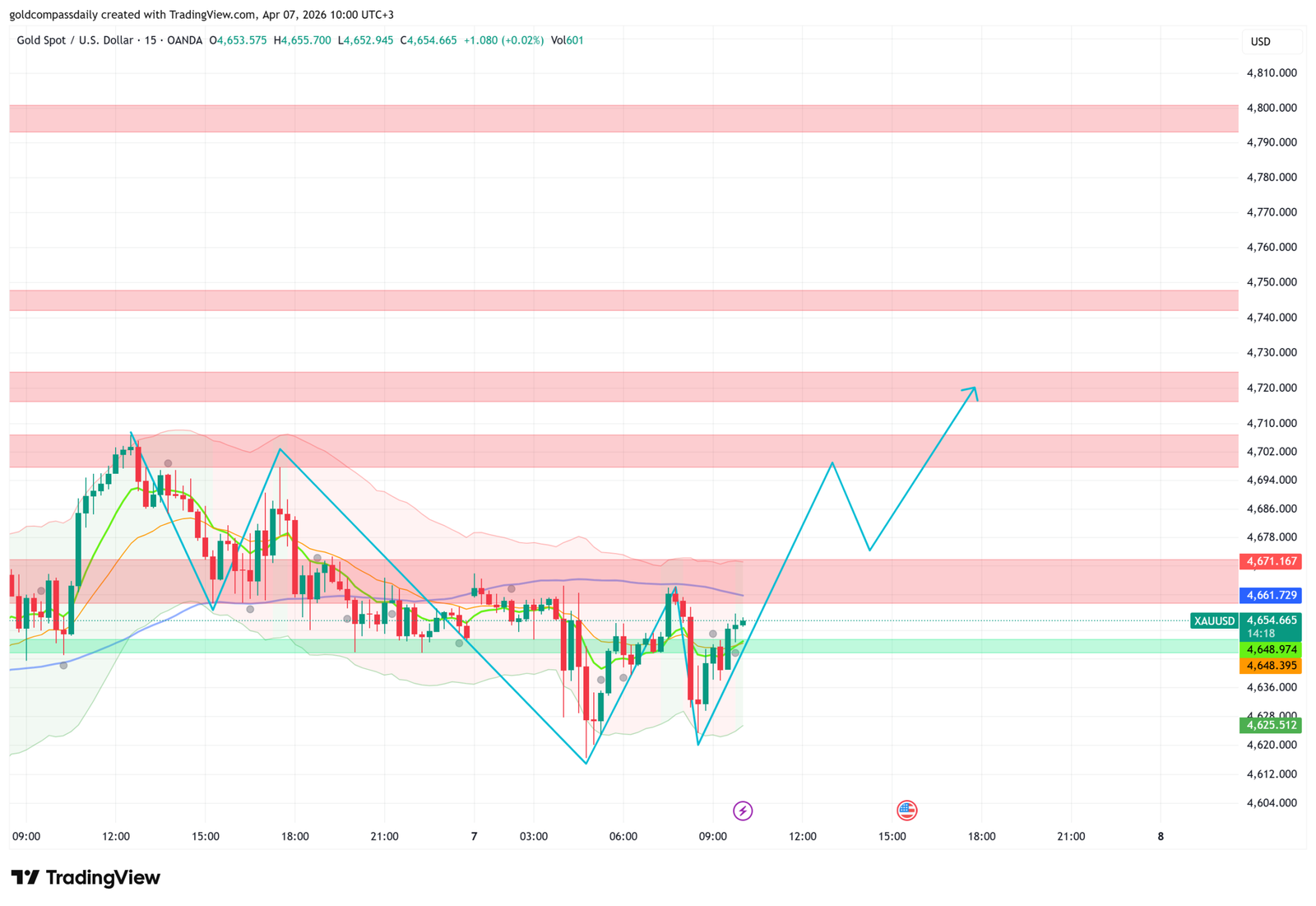
The Chart: Sideways Compression, Dip Then Break Higher
The 15-minute chart shows gold in a tight consolidation between $4,625.512 and $4,671.167. After the sharp post-Liberation Day moves of last week, this compression is natural — the market needs to establish a new equilibrium before the next directional move. The moving averages have flattened, the Bollinger Bands have contracted, and volume is at its lowest levels since before the tariff announcement.
The projected path on the chart shows a dip into the $4,625–$4,628 green demand zone before a sharp recovery through the pink resistance bands toward $4,720. That would be the first meaningful break above the post-Liberation Day range and would signal that buyers have fully absorbed the tariff shock and are ready to push for a retest of the $4,800 area. The pink resistance levels at $4,671, $4,702, and $4,720 are the sequential hurdles on that path.
The floor is $4,625.512. A close below that level opens the path toward $4,576 and then $4,542 — the lower green demand zone that held on the Liberation Day spike low. Above $4,671, the recovery is back on track.
Already Published: Asia Delivers Mixed Signals
The overnight session produced several notable data points. Japan’s Household Spending y/y printed at -1.8% — significantly worse than the forecast of -0.8% and the prior -1.0%. Japanese consumers are retrenching sharply, and the data adds to concerns that the global consumer slowdown being signalled by US CB Confidence and UK retail data is not limited to Western economies. The yen is mildly supported on growth concerns but faces counterpressure from the risk-off environment.
The 30-year Japanese Bond Auction showed a yield of 3.70% against the prior 3.40% — a significant jump in long-term Japanese borrowing costs. Rising JGB yields at the long end reflect two forces: the BOJ’s ongoing normalisation of monetary policy, and global bond market volatility driven by tariff-related inflation concerns. A 30-year yield at 3.70% in Japan is historically elevated and signals that the era of near-zero rates is firmly behind us even in the world’s most persistently deflationary major economy.
USD/JPY impact: Rising JGB yields support the yen through the interest rate differential channel. Combined with the safe-haven demand from tariff uncertainty, the yen is one of the stronger G10 currencies this morning.
Australia’s ANZ Job Advertisements m/m at -3.1% (prior +3.2%) is a sharp reversal — job ads falling 3.1% in a single month after rising 3.2% the prior month. This is an early leading indicator of labour market deterioration in Australia, consistent with last week’s services PMI collapse to 46.6 and the overall picture of an Australian economy feeling the first effects of global trade uncertainty. The MI Inflation Gauge m/m at 1.3% (prior -0.2%) — a sharp jump in Australian consumer prices — creates the same stagflation dynamic visible in US ISM Prices data.
Switzerland’s Foreign Currency Reserves at 721B CHF (prior 710B CHF) — a CHF 11B increase in SNB reserves. This is a signal that the SNB may have been intervening to weaken the franc, which has been strengthening on safe-haven flows since Liberation Day. A larger-than-expected reserve increase would confirm active SNB intervention — franc-negative at the margin.
European Services PMIs: The First Post-Liberation Day Business Survey
Today’s European Services PMI readings are the first business surveys conducted after Liberation Day — making them the most timely read available on how European businesses are reacting to the new US tariff environment. The forecasts were set before the announcement and may already be stale.
Spanish Services PMI at 10:15am is forecast at 50.7 (prior 51.9). Spain’s services sector has been one of the Eurozone’s strongest — a reading that holds above 50 despite tariff uncertainty would be a genuine positive signal. A miss below 50 would be significant given Spain’s services-driven economy.
Italian Services PMI at 10:45am forecast at 51.0 (prior 52.3). Italy’s services sector decelerating from 52.3 to 51.0 is a meaningful step down — still in expansion but losing momentum. Watch for any language in the accompanying survey commentary about tariff-related uncertainty in export orders or tourism bookings.
French Final Services PMI at 10:50am at 48.3 (prior 48.3) — confirmed in contraction, no change expected. France’s services sector has been contracting for several months and the tariff environment adds a new headwind.
German Final Services PMI at 10:55am at 51.2 (prior 51.2) — in expansion, no revision expected. Germany’s services sector holding above 50 is the one bright spot in an otherwise mixed European picture.
Eurozone Final Services PMI at 11:00am at 50.1 (prior 50.1) — barely in expansion. The composite picture is an economy growing at the absolute minimum threshold. Any downward revision from the preliminary reading would push the index below 50 — technically into contraction — and would be a significant EUR-negative signal.
UK Final Services PMI at 11:30am at 51.1 (prior 51.2) — in line expected. The UK services sector is marginally in expansion, consistent with the broader picture of a softening but not collapsing economy.
EUR/USD impact: Services PMI misses across the board — particularly a Eurozone composite below 50 — would be the most bearish European data outcome available today. Combined with Sentix Investor Confidence at 11:30am, the European session could be a significant EUR-negative sequence if the data confirms that the tariff shock is already feeding through into business surveys.
11:30am — Sentix Investor Confidence: The Liberation Day Barometer
The Sentix Investor Confidence index at 11:30am is forecast at -7.8, down sharply from the prior -3.1. This survey is conducted after Liberation Day — making it the most direct measure of how European institutional investors are assessing the tariff shock’s impact on the Eurozone outlook. A reading of -7.8 would be the lowest since early 2025 and would signal a dramatic deterioration in investor sentiment driven primarily by the tariff uncertainty.
A reading below -10 would be a significant negative surprise and would confirm that the Liberation Day tariffs are already causing meaningful shifts in investment intentions across Europe. That outcome is EUR-negative, equity-negative for the DAX and CAC, and paradoxically gold-positive through the safe-haven channel.
A surprise beat — anything above -3 — would signal that European investors are taking the tariff shock in stride and would provide a brief EUR recovery and equity bounce. Given the magnitude of the Liberation Day measures, a beat of that scale seems unlikely but cannot be ruled out if Trump’s speech Monday evening included any de-escalation signals.
3:30pm — Durable Goods Orders: The Investment Signal
Durable Goods Orders m/m is forecast at -1.1% (prior 0.0%) — a meaningful expected decline in orders for long-lasting manufactured goods. Core Durable Goods Orders m/m (excluding transportation, the more stable measure) is forecast at 0.5% (prior 0.4%) — a modest improvement. The divergence between the headline and core readings reflects the volatility in aircraft and defence orders that distorts the headline figure.
Core Durable Goods at 0.5% would be a mildly positive signal — businesses are still investing in equipment despite the uncertainty. A miss on core (below 0.2%) would be a more significant concern, suggesting that the tariff environment is already causing businesses to pause capital expenditure decisions.
USD impact: Core beat = dollar mildly supported. Core miss = dollar weakens, particularly against safe-haven currencies. Gold reacts inversely to the dollar move.
The ADP Weekly Employment Change at 3:15pm (prior 10.0K) is an early read on labour market conditions heading into Thursday’s weekly claims. A reading below 10K — near zero — would be a signal that hiring has stalled in the week following Liberation Day. A negative reading (net job losses) would be the most alarming outcome and would accelerate the Fed cut repricing narrative.
7:35pm — FOMC Member Goolsbee: The Fed’s First Post-Tariff Word
FOMC Member Goolsbee speaks at 7:35pm — the Chicago Fed President and one of the most data-sensitive members of the committee. This is the Fed’s first scheduled public communication since Liberation Day, and Goolsbee’s comments will be scrutinised for any indication of how the FOMC is thinking about the tariff impact on monetary policy.
The tension is acute: tariffs are simultaneously inflationary (higher import prices) and growth-negative (slower activity, reduced consumer spending). That creates the classic central bank dilemma — do you fight the inflation (keep rates high or raise) or support growth (cut rates)? Goolsbee’s framing of this question will reveal whether the Fed is leaning toward acknowledging the growth risk (dovish, gold-positive) or emphasising the inflation concern (hawkish, gold-negative).
Any language suggesting the Fed is “monitoring the tariff situation carefully” or that “downside risks to growth have increased” would be interpreted as a pivot toward dovishness — significant for gold given the current consolidation at $4,654.
Key Levels and Full Market Summary
- Gold (XAU/USD): $4,654 · Dip target $4,625 · Key resistance $4,671 → $4,702 → $4,720 · Target $4,720 · Floor $4,576 · Sentix 11:30am + Goolsbee 7:35pm are the catalysts
- EUR/USD: Services PMI sequence 10:15–11:00am + Sentix 11:30am = European session defined · Miss across the board = EUR breaks lower · Beat = brief EUR recovery · Durable Goods at 3:30pm drives USD in afternoon
- GBP/USD: UK Services PMI at 11:30am · Broadly in line expected · Moves with EUR/USD direction · Liberation Day tariff impact on UK trade flows is the medium-term concern
- USD/JPY: JGB yield spike to 3.70% + safe-haven yen demand · Pair under downward pressure · Goolsbee dovish at 7:35pm = sharp pair decline
- AUD/USD: Job ads collapse + MI Inflation spike = stagflation signal · China tariff retaliations risk = AUD most exposed G10 currency · Pair under pressure
- S&P 500 / Nasdaq: European reopen with Liberation Day reaction · Sentix miss = equity pressure · Durable Goods core beat = mildly supportive · Goolsbee dovish = tech rally
- DAX: First full day post-Liberation Day · Sentix is the key domestic input · German Services PMI holding at 51.2 = one positive · Tariff impact on German exports = primary risk
- WTI Crude: API Weekly Statistical Bulletin at 11:30pm shapes overnight direction · Global growth slowdown from tariffs = demand headwind · Liberation Day tariff retaliation risk adds supply uncertainty
- Gold medium-term: Tariff inflation + growth slowdown + Fed cut repricing = structural bull case · $4,720 first target · $4,800 retest is April objective · Today’s dip to $4,625 is the entry zone
Today is the day Europe prices in Liberation Day. The Sentix survey, the services PMIs, and the equity market open will collectively reveal whether the post-tariff reaction is contained or cascading. Gold’s consolidation at $4,654 is the calm before that verdict. The dip to $4,625 is the technical setup. Goolsbee at 7:35pm is the fundamental catalyst. Between those two events, the direction of April’s gold trade will become clear.
Analysis based on the XAU/USD 15-minute chart as of April 7, 2026, 10:00 UTC+3. Economic data sourced from the daily macro calendar. This article is for informational and educational purposes only and does not constitute financial advice.