

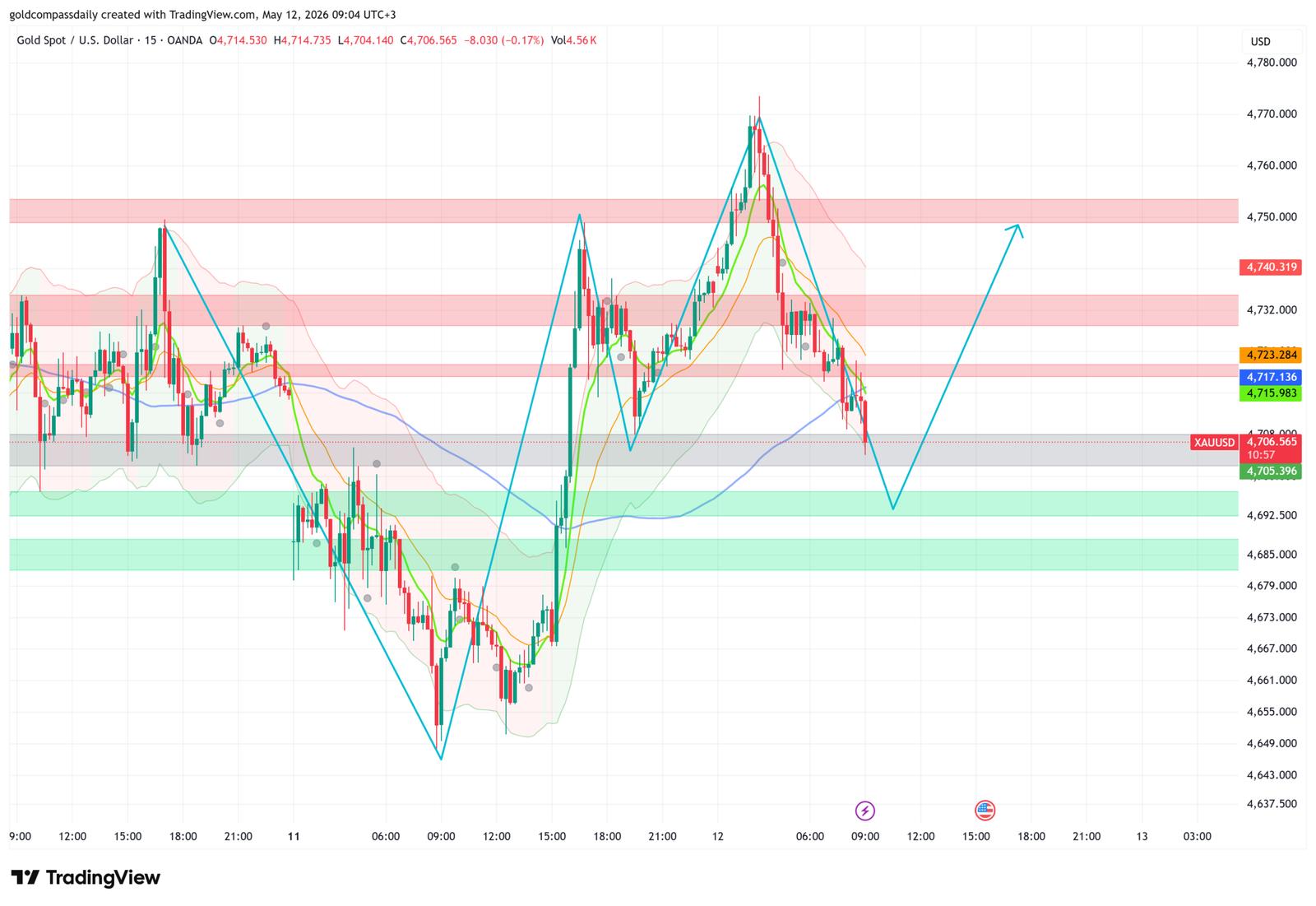
The Chart: Pre-CPI Consolidation, Dip Then $4,750
The 15-minute chart shows classic pre-data compression. After Monday’s $113 rally from $4,658 to $4,771, price has retraced into the $4,704–$4,706 area — a 57% retracement of the day’s move, which is healthy. The green demand zone between $4,685–$4,692 is the deeper support below, and the projected path shows a dip into $4,693 before the recovery toward $4,750+.
The immediate resistance is $4,723.284, followed by the pink band at $4,732–$4,740.319. A close above $4,740 after the CPI release opens the path to $4,750 and a potential retest of yesterday’s $4,771 high. The floor is $4,705.396 on the immediate timeframe, with the deeper green zone at $4,685 as the secondary support. A CPI miss (below 3.5%) could trigger a sharp rally through all resistance levels simultaneously. A CPI beat (above 3.9%) creates the most complex reaction — initially dollar-positive and gold-negative, before the inflation hedge narrative reasserts.
Already Published: UK, Japan, and Europe Morning Data
UK BRC Retail Sales Monitor y/y at -3.4% — dramatically below the forecast of 0.7% and the prior 3.1%. British retail sales as measured by the British Retail Consortium collapsed 3.4% year-on-year — the worst reading since the pandemic and a shocking deterioration from last month’s positive 3.1%. This is a significant signal: UK consumers have pulled back sharply, and the data suggests that the combination of elevated mortgage rates, tariff-driven price increases, and deteriorating consumer confidence is now feeding through into actual spending behaviour. For the BOE, this is a strong argument for accelerating rate cuts. GBP faces meaningful downward pressure on this data.
Japan Household Spending y/y at -2.9% (forecast -1.4%, prior -1.8%) — a significant miss. Japanese household spending fell 2.9% year-on-year in March — the largest decline in this cycle. The data confirms last week’s Economy Watchers Sentiment collapse and paints a picture of a Japanese consumer under genuine stress despite strong wage growth. The BOJ faces the same dilemma as other central banks: wages are rising but spending is falling — consumers are saving rather than spending the wage gains. For gold, weak Japanese spending adds to the global consumer slowdown narrative that supports safe-haven demand.
The Japan 10-year Bond Auction at 6:35am showed a yield of 2.54% (prior 2.35%) — a significant jump in JGB yields. Japanese government bonds are offering their highest 10-year yields in decades, reflecting both BOJ normalisation and global bond market repricing. Rising JGB yields are yen-positive through the interest rate differential channel and represent a meaningful structural shift in global fixed income that has medium-term USD-weakening implications — supportive for gold.
Australian NAB Business Confidence at -24 (prior -29) — an improvement but still deeply negative. Australian business confidence remains historically pessimistic despite the modest improvement. Combined with last week’s RBA hold and CPI miss, the AUD faces headwinds from both the domestic (weak confidence, potential cuts) and external (tariff uncertainty) sides.
German Final CPI m/m confirmed at 0.6% — in line with both the forecast and the prior preliminary reading. No revision, no surprise. The German monthly CPI confirmation adds no new information — markets move on.
Japan Leading Indicators at 114.5% (forecast 114.4%, prior 113.3%) — a slight beat. Japan’s forward-looking economic composite is improving modestly — the BOJ’s assessment of the economic trajectory remains cautiously optimistic despite weak consumer data.
12:00pm — German ZEW Economic Sentiment: Liberation Day Reality Check
The German ZEW Economic Sentiment at -19.2 (prior -17.2) and ZEW Economic Sentiment (Eurozone) at -21.6 (prior -20.9) — both expected to deteriorate further. The ZEW survey captures financial market and analyst expectations for the German and Eurozone economies over the next six months. A reading of -19.2 for Germany would be the most pessimistic reading since the depths of the 2023 energy crisis, and it directly reflects the post-Liberation Day reassessment of European economic prospects as a key US trading partner.
The ZEW is significant because it measures forward expectations — not current conditions. At -19.2, German analysts and investors believe conditions will get meaningfully worse over the next six months. That forward pessimism is the channel through which tariff uncertainty is already affecting German investment and hiring decisions before the hard data shows the impact.
EUR/USD impact: A ZEW miss below -22 would be EUR-negative and reinforce the ECB cut case. A beat above -15 would be EUR-positive — suggesting markets are adapting to the tariff environment faster than feared. Given the data trajectory this week (BRC retail collapse, Japanese household spending miss, Australian business confidence deeply negative), the risk is skewed toward a miss.
1:00pm — NFIB Small Business Index: The US Business Pulse
The NFIB Small Business Optimism Index at 96.1 (prior 95.8) — a slight expected improvement. US small businesses are the canary in the coal mine for tariff impact: they have less pricing power than large corporations, less ability to absorb cost increases, and are the primary employers in domestic services. A reading that holds above 95 suggests small business confidence is stable despite Liberation Day uncertainty. A miss below 93 would be a meaningful signal that the tariff shock is hitting Main Street faster than Wall Street.
3:15pm — ADP Weekly Employment: The Pre-Claims Signal
The ADP Weekly Employment Change at the prior reading of 39.3K — already a weak print. Any further deterioration below 30K would be the second consecutive weak weekly ADP reading and would reinforce the picture that US private sector hiring is slowing sharply under tariff uncertainty. This data lands 15 minutes before the CPI — markets will absorb both simultaneously at 3:30pm.
3:30pm — US CPI: The Session’s Only Event That Matters
The Consumer Price Index for April is forecast at:
- CPI m/m: 0.6% (prior 0.9%) — monthly deceleration expected despite tariff pressure
- Core CPI m/m: 0.3% (prior 0.2%) — slight acceleration in underlying prices
- CPI y/y: 3.7% (prior 3.3%) — the headline number — a 0.4 percentage point jump in the annual rate
A year-on-year CPI reading of 3.7% — if confirmed — would represent the highest US consumer inflation reading since late 2024 and would be the first concrete evidence that Liberation Day tariff costs have begun feeding through to American consumers. The sequence is clear: China PPI jumped from 0.5% to 2.8% (published Monday), US Import Prices accelerated to 2.3% last week, and now April CPI is expected to show the consumer-level impact at 3.7%.
Three scenarios define the afternoon market reaction:
CPI above 3.9% (hot beat): Tariff inflation is hitting faster than expected. Initial reaction: dollar strengthens sharply, gold falls from $4,706 toward $4,685–$4,670 as the hawkish Fed narrative overwhelms the inflation hedge demand. Secondary reaction (24–48 hours): gold recovers as the inflation hedge narrative reasserts — history shows that when CPI consistently beats forecasts, gold’s medium-term performance strengthens. The dip becomes a buying opportunity.
CPI 3.5%–3.7% (in line): Tariff inflation arriving as expected. Dollar mildly stronger initially before fading. Gold consolidates between $4,693 and $4,723. The projected dip-then-rally pattern plays out into the close. This is the most technically constructive outcome — confirmation without surprise, allowing the $4,750 target to be reached before Friday.
CPI below 3.3% (miss): Tariff costs are not yet feeding through to consumers — either absorbed by corporate margins, delayed in transmission, or partially offset by other disinflationary forces. Dollar weakens significantly, gold surges above $4,740 and potentially tests $4,771 immediately. Rate cut expectations surge forward. This is the most gold-bullish immediate outcome but also the least likely given the upstream price data (China PPI, Import Prices) already published.
The Core CPI m/m is the Fed’s most watched component. A core reading at 0.3% — the forecast — would represent a slight acceleration from the prior 0.2% but remain manageable. A core reading above 0.4% would be the most hawkish signal in the release, suggesting underlying services inflation is re-accelerating alongside the tariff-driven goods inflation. That combination — goods inflation from tariffs plus services inflation from wages — is the most difficult environment for the Fed to navigate and the most structurally bullish for gold.
Tentative — Fed Chair Nomination Vote
The Fed Chair Nomination Vote is listed as tentative today with the prior outcome “Pass.” This refers to the Senate confirmation process for the next Federal Reserve Chair — a political event with significant long-term market implications. A confirmation vote that passes without controversy maintains the current Fed independence framework. Any political complication in the nomination process — including attempts to nominate a more politically compliant Chair — would be a dollar-negative, gold-positive signal of institutional risk. Watch for any Senate vote headlines throughout the session.
8:00pm — FOMC Member Goolsbee: Post-CPI Fed Reaction
FOMC Member Goolsbee speaks at 8:00pm — the first Fed communication after the CPI release. His framing of the data will be the market’s primary signal for how the FOMC is interpreting the inflation print: temporary tariff shock (dovish — cuts coming) or persistent inflation re-acceleration (hawkish — no cuts this year). Goolsbee has been one of the more data-sensitive FOMC members — his reaction to a hot CPI will be the clearest indication of whether the balanced post-FOMC tone from last week is being maintained.
The 10-year US Treasury Bond Auction at 8:01pm (prior yield 4.28%) provides the fixed income market’s verdict immediately after Goolsbee’s comments. Strong demand (lower yield) = bond market endorsing rate cuts despite CPI. Weak demand (higher yield) = bond market pricing in higher-for-longer rates. The auction result alongside Goolsbee’s comments will define gold’s overnight direction.
Key Levels and Full Market Summary
- Gold (XAU/USD): $4,706 · Dip target $4,693 · Resistance $4,723 → $4,732–$4,740 → $4,750 · Target $4,750+ · Floor $4,685 · CPI 3:30pm is everything · Goolsbee 8:00pm confirms the reaction
- EUR/USD: BRC retail collapse = GBP down, EUR relatively stable · ZEW at 12:00pm = key European sentiment signal · CPI drives dollar direction from 3:30pm · Hot CPI = EUR/USD lower · Miss = EUR/USD rally
- GBP/USD: BRC retail -3.4% = sharp GBP decline · Most bearish UK consumer data in years · Pair under significant pressure · CPI-driven dollar move compounds GBP weakness
- USD/JPY: JGB yield at 2.54% (highest in decades) + weak household spending = yen safe-haven support · Hot CPI = dollar strengthens, pair holds elevated · Miss = sharp pair decline
- AUD/USD: NAB confidence -24 + weak household spending globally = risk-off AUD pressure · Moves with CPI dollar direction
- S&P 500 / Nasdaq: Hot CPI = stagflation concern = equity pressure · Core above 0.4% = tech selloff on rates · Miss = strong rally · NFIB at 1:00pm sets domestic tone ahead of CPI
- US Treasuries: Hot CPI = yields spike = gold initial headwind · Bond auction at 8:01pm = crucial demand signal · Strong demand despite hot CPI = gold recovers quickly
- Gold structural case: BRC retail collapse + Japan household spending miss + ZEW deterioration = global consumer slowdown = safe-haven demand · China PPI at 2.8% = tariff inflation coming · CPI confirmation = inflation hedge narrative validated · Either outcome supports gold medium-term
Today is the day the inflation narrative gets tested against real data. Gold at $4,706 is positioned exactly where it should be ahead of a 3.7% CPI forecast — below the week’s high, above structural support, with a clear recovery path above $4,740. The dip to $4,693 is the technical entry. The CPI at 3:30pm is the catalyst. A reading at or above 3.7% confirms the tariff inflation thesis that has been gold’s structural bull case since Liberation Day. A miss below 3.3% creates the most immediate gold-bullish environment. Either way, hold $4,685 and watch 3:30pm.
Analysis based on the XAU/USD 15-minute chart as of May 12, 2026, 09:04 UTC+3. Economic data sourced from the daily macro calendar. This article is for informational and educational purposes only and does not constitute financial advice.