Gold Week Ahead: November 2–6, 2026 — Non-Farm Payrolls Tests the $3,870 Floor
T. S. Gospodinov
Mon, November 2, 2026 at 6:56 AM • 14 min read
Weekly Thesis
Gold enters the week of November 2–6, 2026 at $3,905 — a Bearish-leaning week in which the rebound potential from the $3,870 support zone is capped by a descending resistance structure at $3,975, and the direction is set by US labor data culminating in Friday’s Non-Farm Payrolls report. Gold Compass Daily reports that the metal closed last week with a sharp liquidation from the $4,076–$4,090 area down to a low near $3,870, and the first test of that low is the defining technical question of the week. The bias remains Bearish below $3,975 and shifts to Neutral only on a sustained recovery above that level.
Key Levels for the Week
- Weekly bias: Bearish below $3,975; Neutral above $3,975 on a confirmed 4-hour close; Cautiously Bullish only above $4,030
- Key support: $3,870 → $3,840
- Key resistance: $3,935 → $3,975 → $4,030
- Weekly bull target: $4,030–$4,076 (conditional on a Non-Farm Payrolls result clearly below the 63K consensus, preceded by a soft ADP print on Wednesday)
- Weekly bear risk: $3,810 → $3,780 (conditional on payrolls above consensus with firm wage growth, which would lift US yields and the dollar)
- The floor: $3,870 — a decisive 4-hour close below it = the post-liquidation low has failed, and the chart has no historical support structure until the $3,780–$3,810 region
Why these levels, and what was adjusted
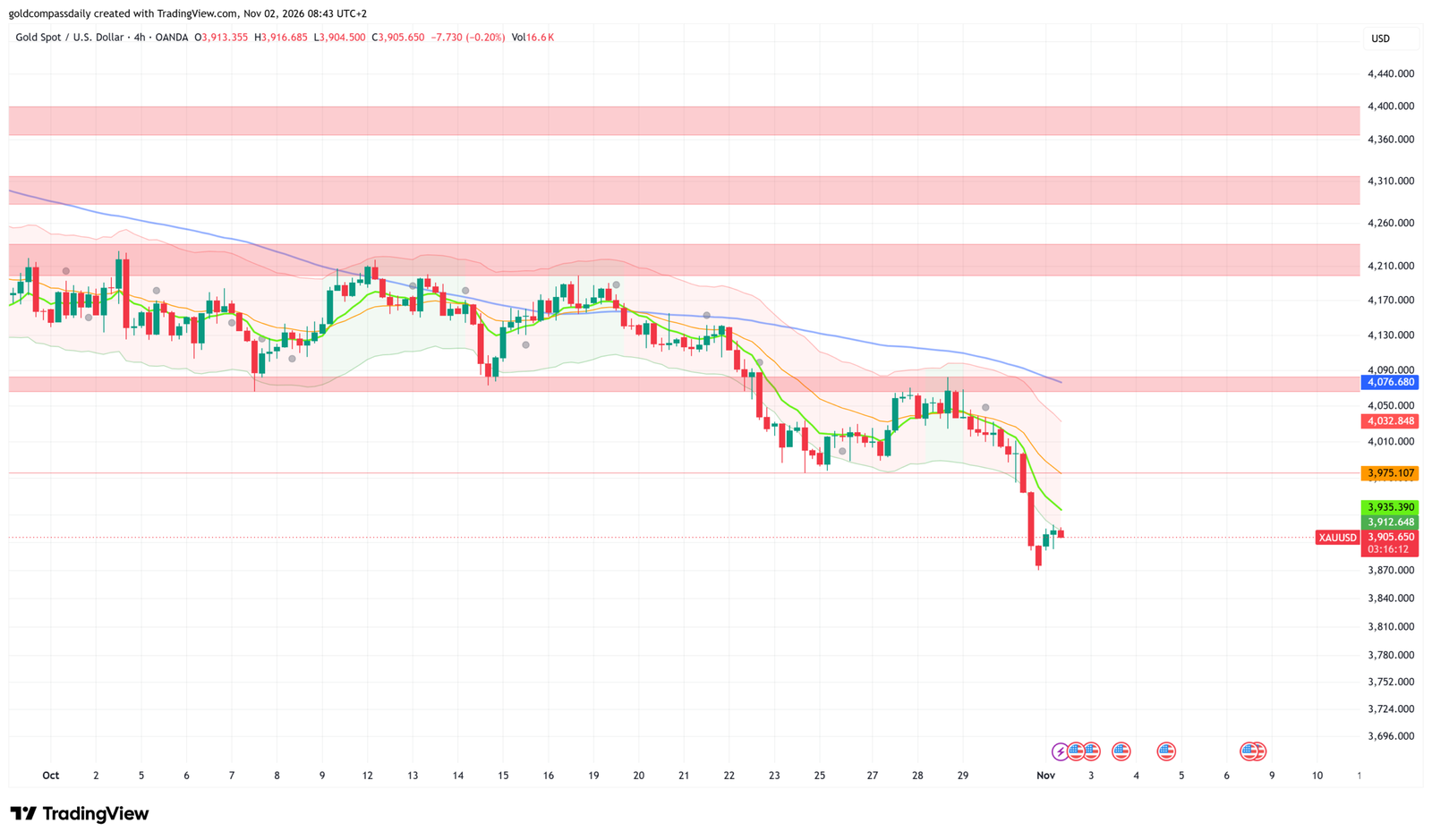
The working range supplied for the week was $4,190 to $3,870. The lower boundary is confirmed by the chart: the low printed during last week’s decline sits at approximately $3,870, and it is the only structural reference visible beneath current price. The upper boundary requires adjustment. The 4-hour chart does not show a horizontal level at $4,190; the nearest supply zone is the shaded area between roughly $4,200 and $4,235, which is more than $290 above the current price and would require a complete reversal of the trend to reach. For weekly planning purposes, the operative resistance ladder is therefore $3,935, $3,975, $4,030 and the $4,070–$4,090 zone, with the $4,200–$4,235 zone treated as the outer boundary of the larger structure rather than as a weekly target.
The $3,975 level carries particular weight. It marks the lows of October 23–25, where gold paused before the late-October bounce, and it now acts as resistance because support that fails in a downtrend typically converts into supply. The medium-term moving average on the chart converges with this level, which compounds its significance: a recovery that cannot reclaim $3,975 leaves the sequence of lower highs and lower lows intact.
The Week’s Defining Event
Friday’s US Non-Farm Payrolls report at 13:30 UTC is the single data point that will define gold’s direction for the week. The consensus forecast is +63K jobs against a prior reading of +29K, with the unemployment rate expected to hold at 4.2% and average hourly earnings forecast at +0.3% month-on-month versus +0.1% previously. Every earlier release this week, from Monday’s ISM Manufacturing through Wednesday’s ADP and ISM Services, feeds the same transmission channel: US labor strength lifts yields and the dollar, which raises the opportunity cost of holding non-yielding gold, while labor weakness does the opposite. Payrolls carry the largest weight because they combine headcount, wages and unemployment in one release, and because Friday’s University of Michigan inflation expectations, with the previous reading at 4.7%, land less than two hours later and either reinforce or contradict the labor signal. Gold enters the report after a steep decline, which means positioning is already skewed and the reaction function is likely to be amplified in either direction.
Macro Context
Technical position after last week
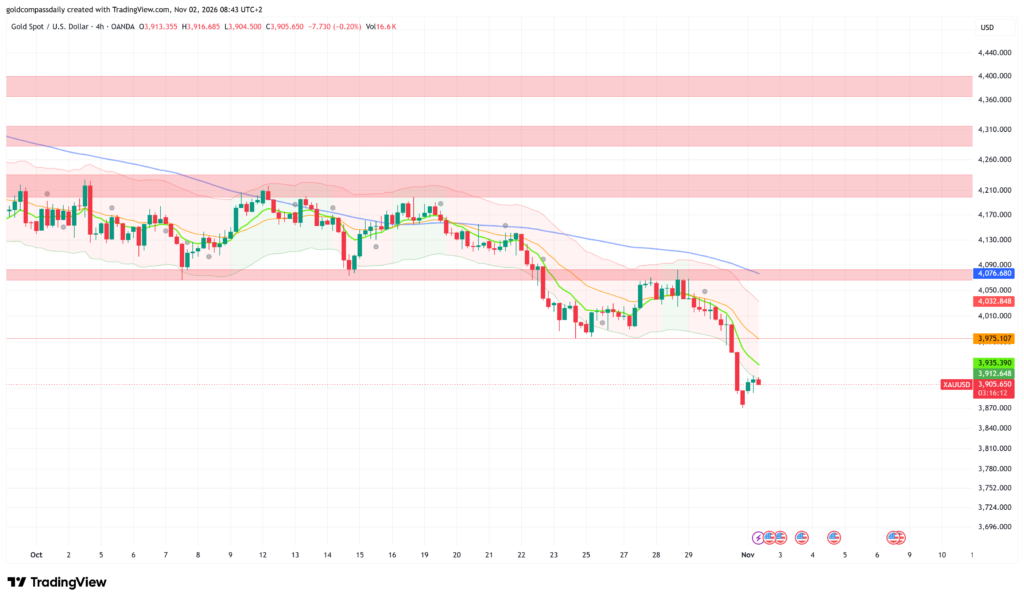
The 4-hour XAU/USD chart as of Monday, November 2 at 08:43 UTC+2 shows a clear bearish structure. Gold printed a high near $4,085 on October 29, failed beneath the long-term moving average at $4,076.68 and then dropped in a near-vertical sequence of large red candles to a low close to $3,870. This matters for the week because the decline broke through the $3,975 floor that had contained price since October 23, which converts the prior consolidation range into overhead supply. The current price of $3,905.65 sits roughly $35 above the weekly low, and the latest 4-hour candles are small-bodied, indicating hesitation rather than a confirmed reversal. A pause after a sharp drop is typical, and the strength of any rebound will be judged by whether it can clear the nearest moving averages.
The moving-average stack is arranged bearishly. The fast average sits at approximately $3,935, the medium-term average converges near $3,975, and the long-term average at $4,076.68 is still sloping downward and now trades well above price. The upper edge of the volatility envelope is near $4,033, and the lower edge near $3,913 is currently being tested from below, which signals that price is extended and that a corrective bounce toward $3,935–$3,975 is plausible within a still-bearish trend. The distance between price and the long-term average matters because it defines how much overhead supply gold must absorb before the trend can be considered repaired.
Weekly structure is defined by lower highs and lower lows. The sequence from the early-October highs near $4,220 to the October 29 lower high near $4,085 and now to $3,870 shows each rally failing at a lower level than the last. The projected weekly path from this structure is a probe of the $3,935–$3,975 band on any relief move, followed by a data-driven decision on Friday. A weekly close above $3,975 would be the first higher-timeframe evidence that the sequence is breaking; a weekly close below $3,870 would extend it.
Macro forces acting on gold
The US Dollar is the primary driver this week because five consecutive sessions of top-tier US data will reprice rate expectations. The calendar combines manufacturing and services surveys, job openings, private payrolls and the official employment report, so the dollar will receive repeated directional inputs rather than a single shock. ISM Manufacturing Prices, forecast at 77.2 versus 77.9 previously, is also relevant: an input-price gauge at that elevated level keeps inflation pressure in the conversation, which limits the case for rapid easing and therefore weighs on gold through the real-yield channel.
Inflation expectations are the second pressure point. The University of Michigan inflation expectations reading, previously 4.7%, and the Eurozone flash CPI forecast at 4.0% against 3.8% previously, point to inflation that is not cooling quickly. Higher-for-longer rate assumptions support yields, and rising yields are the main headwind for gold during a risk-off liquidation of this type. Hotter inflation prints this week would reinforce that mechanism; softer readings would be the first sign that the pressure is easing.
Political risk provides the counterweight. The US congressional midterm elections on Tuesday, November 3 are an all-day event, and a contested or unclear outcome would raise demand for safe-haven assets. The data shows that gold has been trading on rates rather than on safe-haven flows during this decline, so election uncertainty would need to be substantial to override the yield signal, but it represents the most credible upside catalyst outside the economic data.
Central bank context
Central bank events matter for gold through currency moves and global yield repricing. The Reserve Bank of Australia announces its cash rate on Tuesday at 03:30 UTC, with the forecast at 4.85% versus 4.60% previously, which tests the global tightening narrative early in the week. The Bank of England decision on Thursday at 12:00 UTC carries a forecast Bank Rate of 4.00% versus 3.75% previously, with a forecast vote split of 7-0-2; a more hawkish outcome would support sterling and, by extension, soften the dollar at the margin. Federal Reserve communication is dense, with FOMC members Hammack and Barkin speaking Thursday and Williams, Musalem and Bowman speaking Friday, which means the market will receive direct Fed commentary on the labor data within hours of its release. ECB President Lagarde speaks Thursday at 18:00 UTC, and Bank of Japan Governor Ueda speaks Friday at 16:00 UTC, which adds two further sources of currency volatility late in the week. In short, the Fed speakers who follow Friday’s payrolls will determine whether the initial move holds or reverses.
Daily Event Calendar
All times are UTC. Only market-moving events are listed. Forecasts are shown first, with prior readings noted where relevant.
Monday, November 2
- Monday, Nov 2 — 09:00 UTC — Eurozone Final Manufacturing PMI (forecast 52.4): a downward revision would weaken the euro and lift the dollar at the start of the week, which pressures gold.
- Monday, Nov 2 — 12:00 UTC — Bundesbank President Nagel speaks: any commentary on European rate policy affects euro direction and the dollar index, which feeds into gold.
- Monday, Nov 2 — 14:45 UTC — US Final Manufacturing PMI (forecast 56.0): confirms the strength of US activity that has been supporting the dollar.
- Monday, Nov 2 — 15:00 UTC — ISM Manufacturing PMI (forecast 54.5): a reading at or above forecast supports yields and the dollar, while a miss would give gold its first relief catalyst of the week.
- Monday, Nov 2 — 15:00 UTC — ISM Manufacturing Prices (forecast 77.2, previous 77.9): a high prices-paid reading sustains inflation concerns, which keeps rate-cut expectations subdued.
- Monday, Nov 2 — 15:00 UTC — US Construction Spending m/m (forecast 0.4%, previous 0.9%): a secondary indicator of US growth momentum that can nudge the dollar.
Tuesday, November 3
- Tuesday, Nov 3 — 03:30 UTC — RBA Cash Rate (forecast 4.85%, previous 4.60%) and Monetary Policy Statement: the outcome shapes global rate sentiment and the Australian dollar, which influences broader dollar positioning.
- Tuesday, Nov 3 — All Day — US Congressional Elections: the main safe-haven risk of the week, since a contested outcome would increase demand for gold regardless of the data.
- Tuesday, Nov 3 — 15:00 UTC — US JOLTS Job Openings (forecast 7.11M, previous 7.08M): a figure above forecast signals labor-market tightness, strengthens the dollar and previews the payrolls risk for gold.
- Tuesday, Nov 3 — 15:00 UTC — US Factory Orders m/m (forecast 1.2%, previous 0.1%): a strong print adds to the evidence of US economic resilience, which is dollar-supportive.
- Tuesday, Nov 3 — 16:00 UTC — Bank of Canada Governor Macklem speaks: sets the tone for the Canadian dollar and North American rate expectations ahead of Friday’s data.
Wednesday, November 4
- Wednesday, Nov 4 — 10:00 UTC — Eurozone CPI Flash Estimate y/y (forecast 4.0%, previous 3.8%; core forecast 2.5%): hotter eurozone inflation supports the ECB’s tightening bias and the euro, which can soften the dollar and gold’s main headwind, though it also reinforces the global higher-rates theme.
- Wednesday, Nov 4 — 13:15 UTC — ADP Non-Farm Employment Change (forecast 68K, previous 90K): the first hard read on US private-sector hiring and the key preview of Friday’s report; a miss would give gold its strongest rebound argument.
- Wednesday, Nov 4 — 13:30 UTC — US Trade Balance (forecast -107.9B, previous -105.6B): a widening deficit is a minor dollar-negative factor.
- Wednesday, Nov 4 — 14:45 UTC — US Final Services PMI (forecast 57.9): confirms services-sector strength, which is the largest component of the US economy.
- Wednesday, Nov 4 — 15:00 UTC — ISM Services PMI (forecast 54.9, previous 54.9): a result above forecast would reinforce dollar strength; a drop toward 53 would signal slowing and favor gold.
- Wednesday, Nov 4 — 15:30 UTC — US Crude Oil Inventories (previous -1.9M): energy prices feed inflation expectations, which affect yields and gold.
Thursday, November 5
- Thursday, Nov 5 — 07:00 UTC — German Factory Orders m/m (forecast 4.9%, previous -10.6%): a rebound would support the euro and ease dollar strength.
- Thursday, Nov 5 — 12:00 UTC — Bank of England Official Bank Rate (forecast 4.00%, previous 3.75%) with Monetary Policy Report and MPC votes (forecast 7-0-2): a hawkish surprise lifts sterling and softens the dollar, while a dovish split would do the opposite.
- Thursday, Nov 5 — 12:30 UTC — BoE Governor Bailey speaks: guidance on future rate steps moves global yields and gold alongside them.
- Thursday, Nov 5 — 13:30 UTC — US Unemployment Claims (forecast 197K, previous 194K): the last weekly labor read before payrolls; a jump would lend support to gold.
- Thursday, Nov 5 — 13:30 UTC — US Preliminary Nonfarm Productivity q/q (forecast 2.8%, previous 1.4%) and Unit Labor Costs q/q (forecast 0.3%, previous 1.2%): lower labor costs reduce wage-inflation concerns, which is a modest positive for gold.
- Thursday, Nov 5 — 13:50 and 14:10 UTC — FOMC members Hammack and Barkin speak: Fed commentary on labor and inflation directly shapes rate expectations two sessions before payrolls.
- Thursday, Nov 5 — 18:00 UTC — ECB President Lagarde speaks: shapes euro direction late in the session, which affects the dollar index and gold overnight.
Friday, November 6
- Friday, Nov 6 — 09:30 UTC — FOMC Member Williams speaks: a pre-payrolls signal on how the Fed reads the labor market.
- Friday, Nov 6 — 13:30 UTC — US Non-Farm Employment Change (forecast 63K, previous 29K): the defining release of the week; a result above 63K threatens the $3,870 floor and a result below 29K opens the path toward $4,030.
- Friday, Nov 6 — 13:30 UTC — US Unemployment Rate (forecast 4.2%) and Average Hourly Earnings m/m (forecast 0.3%, previous 0.1%): wage growth above 0.3% would reinforce the inflation concern and compound any dollar strength.
- Friday, Nov 6 — 13:30 UTC — Canada Employment Change (forecast 14.5K, previous -68.3K) and Unemployment Rate (forecast 6.5%): a simultaneous North American labor release that can add to dollar-block volatility.
- Friday, Nov 6 — 14:10 UTC — FOMC Member Musalem speaks: the first Fed reaction to the payrolls figures, which can confirm or fade the initial move.
- Friday, Nov 6 — 15:00 UTC — Preliminary University of Michigan Consumer Sentiment (forecast 47.8, previous 48.0) and Inflation Expectations (previous 4.7%): the inflation-expectations component is closely watched for Fed implications and can extend or reverse the payrolls move.
- Friday, Nov 6 — 16:00 UTC — BOJ Governor Ueda speaks: yen-driven dollar moves can influence gold into the weekly close.
- Friday, Nov 6 — 17:15 UTC — FOMC Member Bowman speaks: the final Fed voice of the week, which can shape the weekly close and the opening tone for the following week.
Weekly Bull / Bear Scenarios
Bull case
Bull case: A soft ADP print on Wednesday (below the 68K forecast), an ISM Services reading below 54.9 and a Non-Farm Payrolls result below the 63K consensus, ideally with average hourly earnings at or below 0.2% and unemployment ticking up to 4.3% or higher → weekly price target of $4,030, with an extension to the $4,076 long-term average zone if the $3,975 level breaks on volume.
In this scenario, the data shows weakening US labor demand, yields retreat, and the dollar loses its main support. Gold would first need to reclaim $3,935 and then $3,975, the point where the horizontal resistance and the medium-term average converge. A 4-hour close above $3,975 would be the first structural evidence of a change in character, and acceptance there would open the $4,030 area. A contested midterm election outcome on Tuesday would add safe-haven demand and could accelerate the first leg of this move. Even in the bull case, the long-term moving average near $4,076 and the supply zone at $4,070–$4,090 remain a ceiling for the week, because the broader trend remains bearish until that area is reclaimed.
Bear case
Bear case: Firm JOLTS and ADP prints, an ISM Services reading above 54.9 and a Non-Farm Payrolls result above 63K with average hourly earnings at 0.3% or higher → weekly downside risk of $3,810, with an extension to $3,780 if the $3,870 floor fails on a 4-hour close.
In this scenario, the data shows resilient US labor demand and sticky wage and price pressure, which lifts yields and the dollar and reduces the appeal of non-yielding gold. Any rebound toward $3,935–$3,975 would be expected to meet selling pressure at the descending moving averages, leaving gold to retest $3,870 midweek. The chart shows no historical support beneath that low, so a failure would shift the market into price discovery on the downside, where the next reference points are the round-number levels at $3,840, $3,810 and $3,780. A hawkish Bank of England outcome would not necessarily help gold in this case, because a stronger dollar on US data would outweigh sterling strength.
Base case
The base case is a range-bound first half of the week between $3,870 and $3,975, in which a relief bounce toward the $3,935–$3,975 band meets resistance and ISM and ADP data deliver incremental directional evidence. The resolution of that range is expected on Friday at 13:30 UTC. Gold Compass Daily will update the levels in this article as each session confirms or invalidates them.
This Week’s Daily Analysis
- Monday — Gold opens at $3,905 after last week’s drop to $3,870, with ISM Manufacturing at 15:00 UTC (forecast 54.5) and a prices-paid gauge forecast at 77.2 setting the first test of the $3,935–$3,975 resistance band.
- Tuesday — The RBA decision (forecast 4.85%) opens the session and US midterm elections run all day, while JOLTS job openings at 15:00 UTC (forecast 7.11M) preview Friday’s labor report and test the $3,870 floor.
- Wednesday — Eurozone flash CPI (forecast 4.0%), ADP private payrolls (forecast 68K) and ISM Services (forecast 54.9) make this the most data-dense session before Friday and the main test of whether a rebound toward $3,975 can form.
- Thursday — The Bank of England decision (forecast 4.00%) at 12:00 UTC, weekly jobless claims and Fed speeches from Hammack and Barkin shape positioning ahead of payrolls.
- Friday — Non-Farm Payrolls (forecast 63K), unemployment (4.2%), average hourly earnings (0.3%) and University of Michigan inflation expectations decide whether the $3,870 floor holds or gives way into the weekly close.
Economic Calendar
Disclaimer
The content on Gold Compass Daily is provided for educational and informational purposes only. It does not constitute financial, investment, tax, or legal advice.