As the first trading session of February 2026 unfolds, the European stock market performance is showing surprising resilience in the face of a global commodities sell-off. While US futures and precious metals have faced intense liquidation, major indices in London, Frankfurt, and Paris are trading in green territory at midday on February 2, 2026. Investors are currently balancing the “Warsh Shock” from the US with stabilizing domestic economic data across the Eurozone.
FTSE 100: Resilience Amidst the Mining Slump
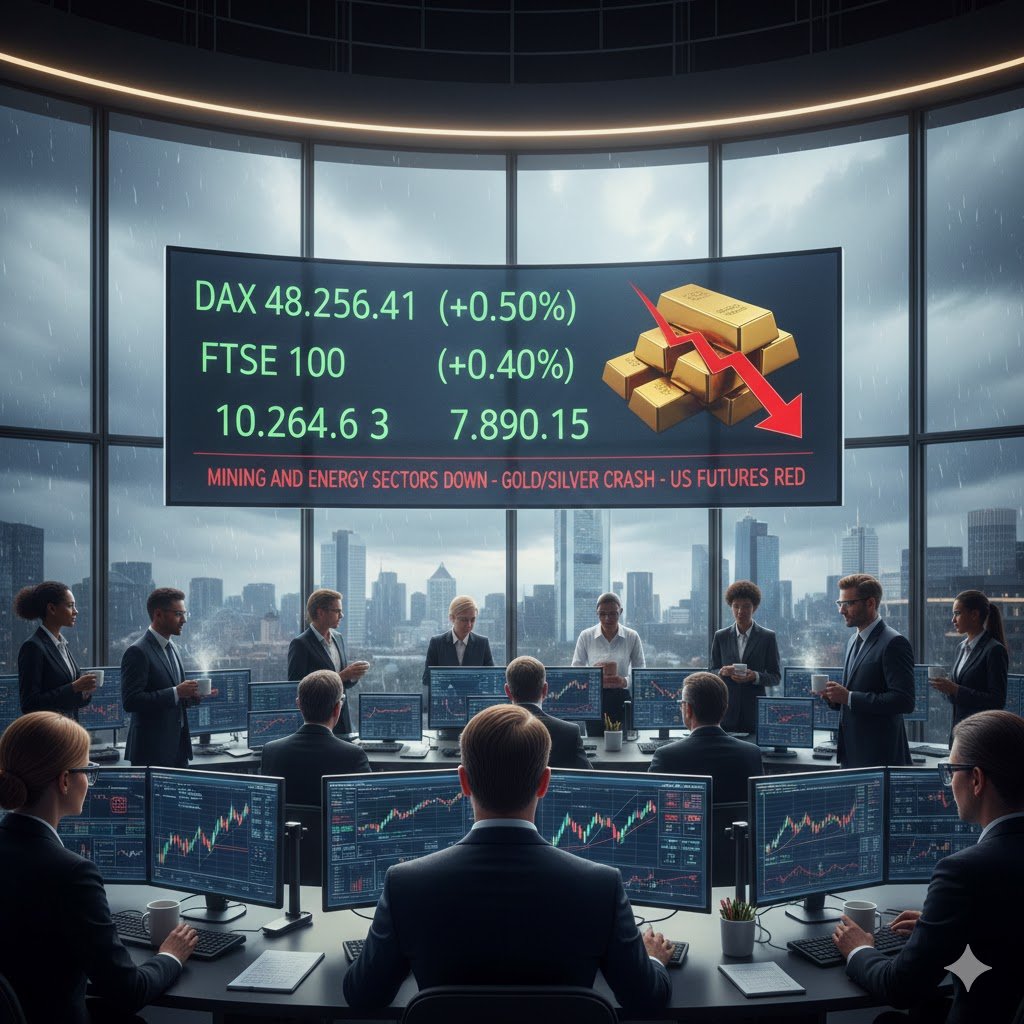
The London-based FTSE 100 index rose 41.09 points, or 0.4%, to reach 10,264.63 by midday. This positive European stock market performance is particularly noteworthy given the significant weight of commodity producers on the index. Mining giants like Endeavour Mining and Antofagasta have seen their shares slide by over 3% as gold and copper prices crater. However, gains in the financial and defensive sectors have managed to offset these losses, keeping the blue-chip index afloat.
DAX 40 and CAC 40: Steady Gains in Frankfurt and Paris
Across the English Channel, the European stock market performance remains steady. Germany’s DAX 40 in Frankfurt edged 0.5% higher, while the CAC 40 in Paris rose by 0.4%. The strength in European equities is partly attributed to a rotation out of highly valued US technology stocks into more reasonably priced European industrials and banks. Companies like Adidas and SAP are providing a boost, rebounding after a volatile end to January.
Recent Eurozone GDP data, which showed an unexpected 0.3% expansion in the final quarter of last year, is also providing a supportive backdrop. This suggests that the currency bloc’s economy is gaining traction despite the ongoing trade uncertainties and geopolitical tensions that have dominated recent headlines.
Macro Drivers: US Monetary Policy and the Euro
The primary external factor influencing European stock market performance today is the strengthening US Dollar. The dollar has gained ground against the euro and sterling as markets digest the hawkish implications of Kevin Warsh’s nomination to lead the Federal Reserve. A stronger dollar typically presents a mixed bag for European exporters; while it makes their goods more competitive abroad, it also increases the cost of dollar-denominated imports like energy.
Investors are also cautiously awaiting policy decisions from the European Central Bank (ECB) and the Bank of England (BoE) later this week. Both central banks are widely expected to keep interest rates unchanged at their current levels as they assess the cooling inflation figures against the need to support moderate economic growth.
Sector Breakdown: Defensives vs. Commodities
A closer look at today’s European stock market performance reveals a clear divide between sectors. The defense sector continues to be a top performer, underpinned by persistent geopolitical tensions and expectations of increased military spending across Europe. In contrast, the materials and energy sectors are underperforming as Brent crude oil prices fall by over 4% to approximately $66.23 per barrel.
- Top Gainers: Banking and Defense sectors (up 0.8% – 1.2%)
- Top Losers: Mining and Energy sectors (down 2.1% – 3.5%)
- Currency: Euro trading lower at $1.1867; Sterling at $1.3703
Conclusion: Navigating a Divergent Market
In conclusion, the European stock market performance on February 2, 2026, highlights a market that is attempting to decouple from the immediate panic seen in the US and commodities sectors. While the road ahead remains uncertain due to central bank meetings and potential tariff threats, the initial resilience of the DAX and FTSE 100 is a positive sign for regional investors.
Traders should monitor the US manufacturing PMI data due later today, as any major surprises could trigger a late-session reversal in Europe. For now, the focus remains on sector rotation and individual corporate earnings as the primary catalysts for price action.

Written by T. S. Gospodinov
T. S. Gospodinov is an Independent gold market analyst focused on liquidity structures and macro-driven price cycles.