Tuesday, March 24 is global Flash PMI day — the first comprehensive real-time read on economic activity across manufacturing and services for the month of March. With data rolling in from Australia and Japan in the Asian session, through France, Germany and the Eurozone in the European morning, to the UK at midday and the United States at 3:45pm, today’s calendar offers a simultaneous snapshot of the global economy that no single data point can replicate. The picture emerging is one of persistent divergence: services holding up, manufacturing struggling, and the United States once again outpacing its peers.

Asia: Japan Beats, Australia Disappoints
The session opened with contrasting signals from the two major Asia-Pacific economies. Japan’s Flash Manufacturing PMI printed at 51.4 — above both the forecast of 53.2 and the prior 53.0, confirming continued expansion in Japanese factory output. Combined with yesterday’s strong Revised Industrial Production beat, Japan is presenting as the most resilient major economy in the region right now.
However, Japan’s National Core CPI y/y decelerated to 1.6% from a prior of 2.0% and below the 1.7% forecast. That is a meaningful drop in Japanese inflation — and it materially reduces the pressure on the BOJ to hike rates again in the near term. The yen faces a tug-of-war: the strong PMI supports it, the falling CPI undermines the case for rate hikes that were the primary yen-strengthening catalyst earlier this year.
USD/JPY impact: Net neutral to mildly dollar-positive. Strong manufacturing supports risk appetite but weak CPI removes the hawkish BOJ narrative. The pair remains sensitive to US data later today.
Australia’s data was more concerning. Flash Manufacturing PMI came in at 50.1 (prior 51.0) — barely in expansion. More significantly, Flash Services PMI collapsed to 46.6 from a prior of 52.8 — a sharp move into contraction territory that signals Australian service sector activity deteriorated dramatically in March. Coming just two days after the RBA’s surprisingly strong Employment Change beat, this creates a confusing picture for RBA policy.
AUD/USD impact: Bearish. A services sector in contraction offsets the employment beat and raises questions about whether the labour market strength will be sustained. The RBA may need to acknowledge the deterioration at its next meeting.
10:15am–11:00am — European PMIs: Manufacturing Remains the Problem
The European PMI sequence is expected to confirm what markets already suspect: Eurozone manufacturing is sliding back into contraction while services provide a narrowing cushion.
French Flash Manufacturing PMI is forecast at 49.4 (prior 50.1) and French Flash Services PMI at 49.2 (prior 49.6). A double reading below 50 for France — both manufacturing and services in contraction simultaneously — would be a negative signal for the French economy and increase pressure on the ECB to cut rates faster than currently signalled.
German Flash Manufacturing PMI is forecast at 49.6 (prior 50.9), slipping back below the expansion threshold after a brief recovery in February. German Flash Services PMI at 52.5 (prior 53.5) — still expanding but decelerating. Germany returning to manufacturing contraction matters beyond its domestic implications: it is a signal about global trade flows, industrial demand, and the health of supply chains that feed into economies far beyond Europe.
The Eurozone composite readings at 11:00am — Manufacturing 49.4 (prior 50.8), Services 51.1 (prior 51.9) — point to a bloc that is growing at a marginal pace, with services barely keeping the headline composite above 50.
EUR/USD impact: Weak PMIs add to the dovish ECB case and keep the pair under pressure. The critical question is whether the misses are deep enough to push EUR/USD through the 1.07 support level that has held since the post-FOMC dollar surge. A manufacturing print below 48 in Germany would be the trigger for that move.
DAX / European equities impact: Counterintuitively, weak PMIs can be equity-positive in a central bank-driven market — if they accelerate ECB cut pricing. Rate-sensitive sectors like real estate, utilities, and financials in Europe benefit from lower rate expectations. Export-heavy German industrials benefit from a weaker euro. The net effect for the DAX is likely modestly positive unless the PMI misses are severe enough to trigger genuine growth fears.
11:30am — UK PMIs: Services Is the BOE’s Benchmark
UK Flash Manufacturing PMI is forecast at 50.0 (prior 51.7) — exactly on the expansion-contraction boundary, a significant deceleration. UK Flash Services PMI at 52.8 (prior 53.9) — still in expansion but the trend is clearly lower.
The services number is the one the Bank of England watches most closely. UK services inflation has been the primary reason the BOE has been slower to cut than the ECB — it reflects wage pressures and domestic demand more accurately than manufacturing. A reading below 52 today would be significant: combined with last week’s slowing Average Earnings Index (3.9% from 4.2%), it would complete a picture of a UK economy where the inflationary impulse is genuinely fading, making a May BOE rate cut from 3.75% increasingly likely.
GBP/USD impact: Sensitive to the services reading specifically. A miss below 52 weakens sterling and accelerates GBP/USD downside. A beat above 54 provides a brief bounce. The tentative UK 10-year Bond Auction (prior 4.59|3.6) will also be watched — higher gilt yields would provide support to GBP.
FTSE 100 impact: A weaker pound is net positive for the FTSE 100 given its heavy weighting toward international earners (energy, mining, pharmaceuticals). Domestic-focused mid-caps in the FTSE 250 are more exposed to weak PMI signals.
2:30pm — US Labor Costs: The Inflation Signal
Revised Nonfarm Productivity q/q is forecast at 1.9% (prior 2.8%) and Revised Unit Labor Costs q/q at 3.6% (prior 2.8%). The labor costs revision is the more important of the two for markets. Unit labor costs rising to 3.6% — above the prior 2.8% — would be an inflationary signal that validates the Fed’s hawkish stance and supports the dollar. A revision lower would be the opposite: disinflationary, dollar-negative, and potentially gold-positive heading into the 3:45pm PMI release.
USD (DXY) impact: A hot Unit Labor Costs print above 3.6% extends dollar strength. A soft print below 2.5% would be the first meaningful data point to challenge the post-FOMC hawkish narrative.
The ADP Weekly Employment Change at 2:15pm (prior 9.0K) is a secondary labour market indicator. Last week’s print was already soft — a second consecutive weak reading would raise questions about whether the strong monthly NFP data is masking underlying labour market softening.
3:45pm — US Flash PMIs: The Session’s Defining Moment
US Flash Manufacturing PMI is forecast at 51.5 (prior 51.6) — essentially unchanged, modest expansion. US Flash Services PMI at 52.0 (prior 51.7) — a slight improvement expected. If the US data prints in line or above forecast, it will complete a picture of stark transatlantic divergence: Europe contracting or barely growing, the United States expanding solidly.
That divergence is the primary fundamental driver of EUR/USD weakness in 2026. A US services beat today would be the most powerful single catalyst for further dollar strength this week.
S&P 500 / Nasdaq impact: The reaction is context-dependent. A strong US PMI in a post-FOMC hawkish environment is a mixed signal — good for earnings growth expectations but bad for rate cut hopes. The Nasdaq is more sensitive to rate expectations (growth stocks are long-duration assets), while the S&P 500 is more balanced. A services print above 54 would likely see tech underperform value on the day.
A US services PMI miss — particularly anything below 50 — would be the session’s most significant surprise. It would call into question the Fed’s confidence in the labour market and economic resilience, force a repricing of the dot plot, weaken the dollar, and provide the most powerful single-session catalyst for gold since the FOMC decision itself.
Full Forex and Asset Class Summary
- EUR/USD: Under pressure from weak Eurozone PMIs + hawkish Fed divergence. Key level 1.07 — a German manufacturing print below 48 breaks it. US PMI beat accelerates the move lower.
- GBP/USD: BOE cut pricing the dominant driver. UK services PMI below 52 = GBP weakness. A beat above 54 = brief bounce. Overall trend lower while USD is dominant.
- USD/JPY: Strong Japanese PMI vs falling CPI = net neutral. US PMI is the directional driver — beat lifts the pair, miss sends it lower.
- AUD/USD: Services PMI collapse is AUD-negative. Any risk-off move from weak global PMIs amplifies the downside. Watch for a retest of recent lows.
- USD/CAD: Canadian data light today. US PMI drives the pair — USD strength = CAD weakness. No major Canadian catalysts until Friday’s GDP data.
- USD/CHF: SNB Chairman Schlegel speaks at 7:00pm — any intervention language or rate cut signals would push the pair higher. Watch for post-market moves.
- S&P 500: US PMI beat = mixed (good growth, bad for cuts). Miss = sharp rally on rate cut repricing. Post-FOMC selling pressure is the dominant trend — a reversal requires data deterioration.
- Nasdaq: More sensitive to rate expectations than the S&P 500. A US PMI miss is the strongest near-term bullish catalyst. A beat extends the post-FOMC underperformance.
- DAX: Weak Eurozone PMIs are manageable if they accelerate ECB cut pricing. A German manufacturing print below 48 is the threshold for genuine concern — below that, the DAX faces a more difficult session.
- FTSE 100: Benefiting from GBP weakness. UK services PMI is the key domestic input. A miss on services below 52 is net positive for the FTSE 100 via currency effect.
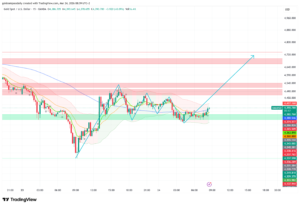
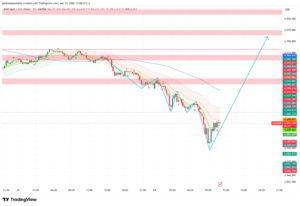
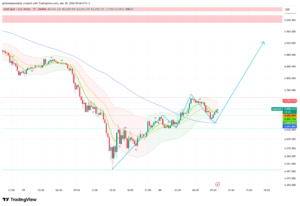
- Gold (XAU/USD): Holding $4,380. US PMI miss at 3:45pm = strongest bullish catalyst. Beat = headwind at $4,417 resistance. Target $4,720 if the recovery structure holds.
- WTI Crude: Weak manufacturing PMIs globally = lower industrial demand signal = mild headwind. API oil data at 10:30pm will shape overnight direction.
Today’s PMI data is not just about economic conditions in individual countries — it is a real-time map of global divergence. The US holding up while Europe softens is the dominant macro theme of 2026, and every data point today will either reinforce or challenge that narrative. The 3:45pm US release is when the picture becomes complete.
Economic data sourced from the daily macro calendar for March 24, 2026. This article is for informational and educational purposes only and does not constitute financial advice.

Written by T. S. Gospodinov
T. S. Gospodinov is an Independent gold market analyst focused on liquidity structures and macro-driven price cycles.