Global Stock Market Rally: The Day the Dow Hit 50,000
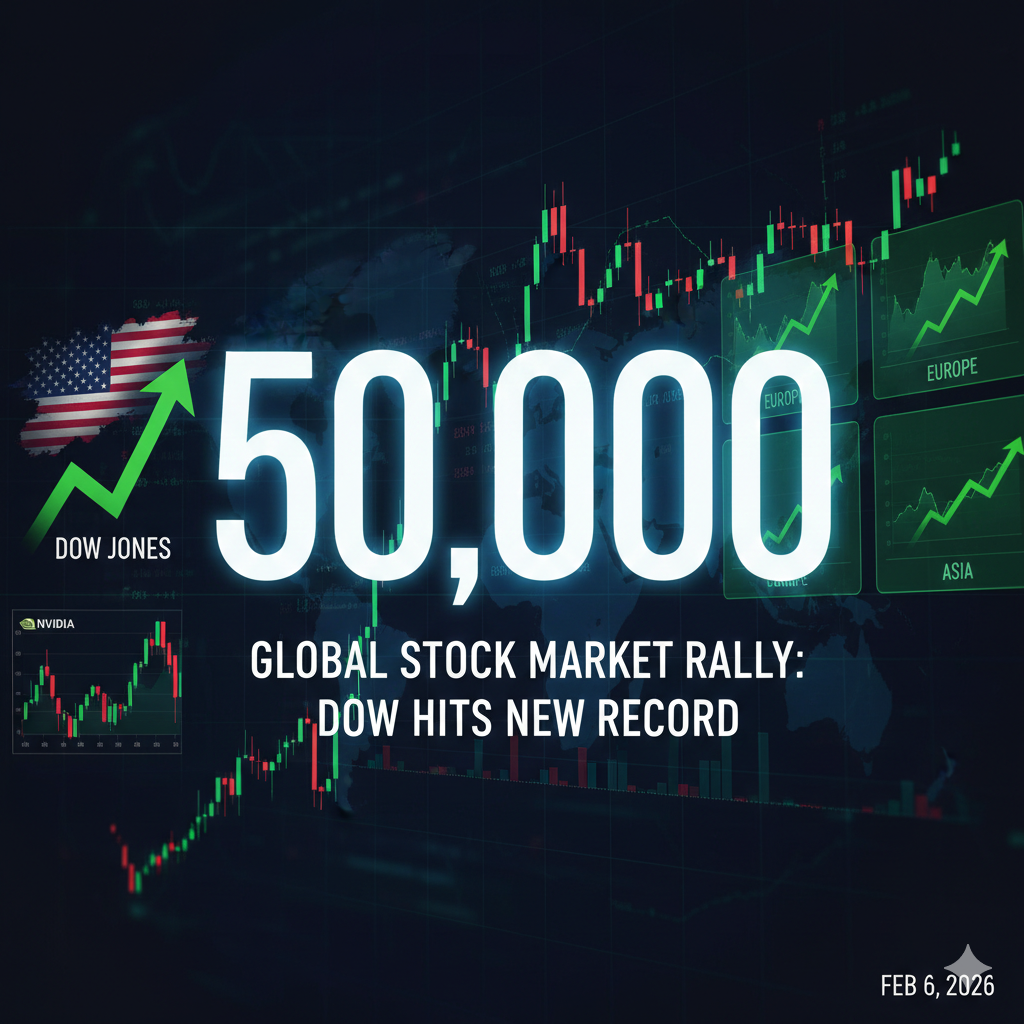
February 6, 2026, will be remembered as a watershed moment for international finance. After a week of intense volatility that saw $285 billion wiped off software stocks, the Global Stock Market Rally returned with a vengeance. The Dow Jones Industrial Average (DJIA) lead the charge, shattering its all-time record to close at 50,115.67—a stunning 1,207-point leap that signaled the triumph of value and industrial stocks over short-term panic.
This milestone wasn’t just a number; it was a psychological breakthrough for individual investors. While the general public often views the market as a “trader’s game,” the move to 50,000 represents the resilience of the broader economy, driven by better-than-expected consumer sentiment and moderating inflation expectations.
The Three Pillars: US, Europe, and Asia Performance
To understand the current Global Stock Market Rally, one must look at the synchronized performance across the world’s three major trading zones. The interconnectedness of these markets has created a “virtuous cycle” of growth.
- The American Powerhouse: Beyond the Dow’s 2.4% gain, the S&P 500 climbed 2% and the Nasdaq Composite rose 2.2%. The rally was ignited by AI leaders like Nvidia, which reclaimed a $4.5 trillion valuation after rising 7.9%.
- European Resilience: European equity markets ended a turbulent week in the green despite a localized slump in automotive stocks like Stellantis. Indices across the region, including the German DAX and French CAC, benefited from the tech-led rebound and hopes for easing interest rates.
- Asian Momentum: The week started with a massive 3.9% surge in Tokyo, propelling the Nikkei 225 to its highest-ever close of 54,720. While some Chinese and Hong Kong indices faced headwinds from trade tensions, the overall regional sentiment remained supported by strong earnings in the tech and industrial sectors.
Why This Rally Is Different
Unlike previous “bubbles,” the 2026 Global Stock Market Rally is underpinned by tangible economic shifts. Analysts point to a fundamental rotation where investors are moving from pure growth tech into “value” sectors like industrials, financials, and healthcare.
Furthermore, the U.S. economy has shown remarkable durability. The University of Michigan’s preliminary consumer sentiment index hit 57.3—its highest level since August—crushing economist forecasts and proving that the American consumer is still a driving force in global trade.
The Risks Ahead: Bubbles and Trade Wars
Despite the euphoria of the 50,000 Dow milestone, seasoned observers warn that the path forward will not be linear. The “SaaSpocalypse” earlier in the week, which saw massive selloffs in high-flying software names, serves as a reminder that overvalued sectors are vulnerable to sharp corrections. Additionally, aggressive trade strategies and tariff threats continue to cast a shadow over export-heavy markets in Europe and Asia.
Critical Milestones for Next Week:
1. **Sustaining 50,000:** Will the Dow hold its ground or experience a “milestone pullback”?
2. **AI Capital Spending:** Investors are closely watching Amazon and Alphabet’s massive $200B+ investment plans to see if AI remains a sustainable growth engine.
3. **Monetary Pivot:** All eyes are on central bank commentary as traders price in the possibility of lower interest rates by early summer.
Conclusion: A New Era for Investors
The Global Stock Market Rally of February 2026 is a testament to the enduring appeal of innovation and the resilience of global commerce. Whether you are a long-term retirement saver or an active day trader, the breaching of the 50,000 mark on the Dow serves as a clear signal: the bull market of the 2020s is far from over. Strategic patience and a focus on value-driven sectors will be the keys to success in this exhilarating new chapter of market history.

Written by T. S. Gospodinov
T. S. Gospodinov is an Independent gold market analyst focused on liquidity structures and macro-driven price cycles.