Gold is in freefall. The Federal Reserve delivered a hawkish hold on Wednesday evening, and XAU/USD paid the price — dropping from above $5,015 to a current level of $4,770 in less than 24 hours. That is a $245 decline in a single session, and the 15-minute chart suggests the selling is not finished. With three major central bank decisions still ahead today — the Bank of Japan, the Bank of England, and the European Central Bank — the conditions for further downside remain firmly in place.
The Post-Fed Damage: What the Chart Shows
The structure on the 15-minute chart is unambiguously bearish. Price broke through every support level in sequence after the FOMC statement — the pink zones at $5,036, $4,975, and $4,857 all gave way without meaningful defence. The moving averages are pointing sharply lower, the Bollinger Bands are fully expanded to the downside, and there has been no sustained bounce — only brief, weak recoveries that were immediately sold into.
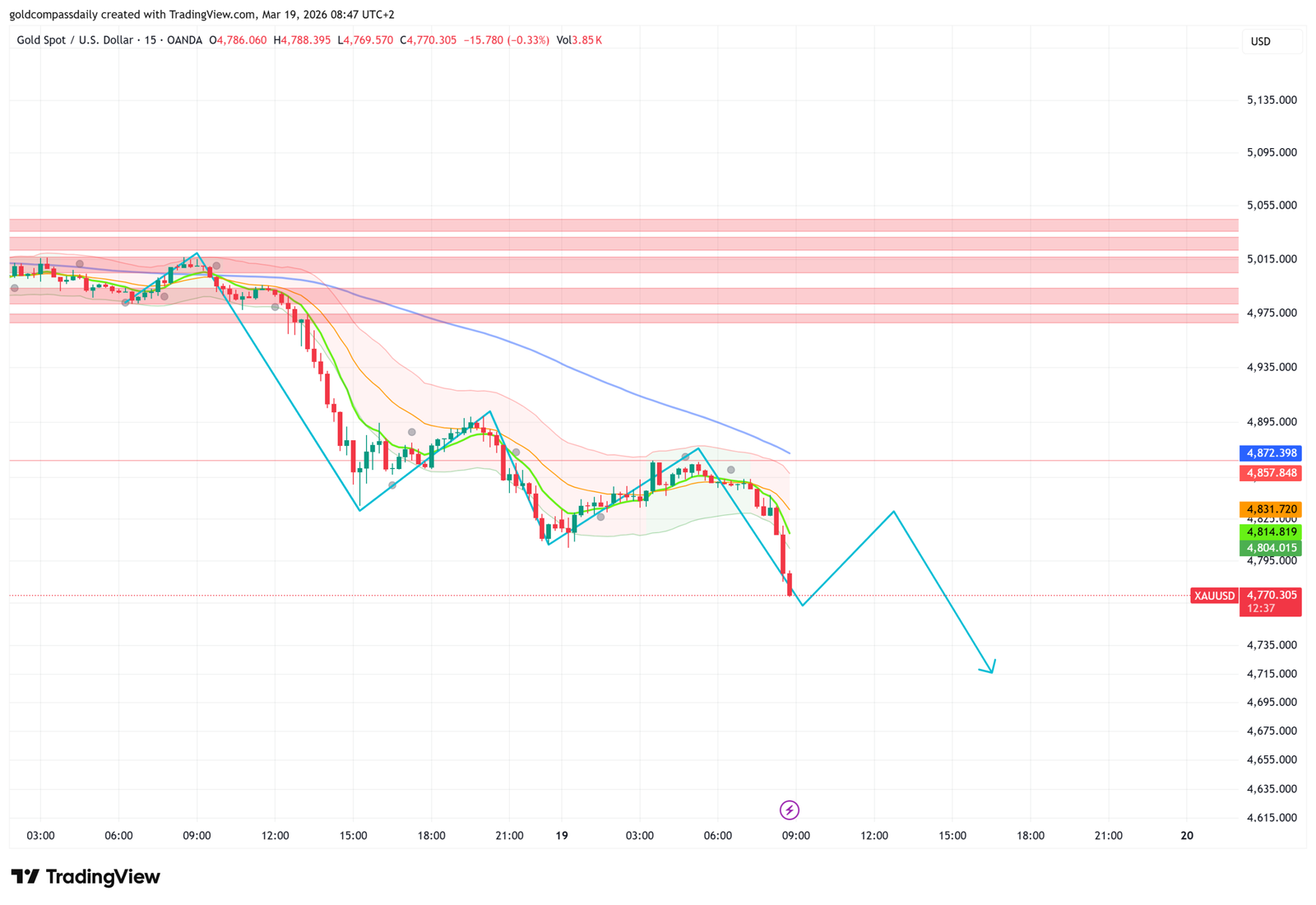
The projected path on the chart shows one more leg lower, with the arrow targeting the $4,715–$4,720 area before any stabilisation becomes possible. The current price of $4,770 sits in open air — there is no established support between here and that zone. The pink resistance bands that were support last week are now overhead resistance, capping any recovery attempt below $4,857 and more significantly below $4,975.
Why the Fed Triggered This Move
The FOMC held rates at 3.75% as expected — but the dot plot and Powell’s press conference delivered a hawkish message. The median dot shifted, signalling fewer rate cuts in 2026 than markets had priced. Powell emphasised that inflation remains sticky and that the Fed is in no rush to ease. Real yields moved higher, the dollar strengthened, and gold — which had been holding support at $4,993 all week — collapsed through the floor.
This is the classic post-Fed gold selloff: not driven by a surprise rate hike, but by the removal of cut expectations. When the market prices in two cuts and the Fed signals one, gold reprices lower to reflect the new rate environment. That repricing appears to still be in progress this morning.
Today’s Calendar: Three Central Banks, Maximum Complexity
Thursday’s macro calendar is one of the most event-dense sessions of the quarter. Three central banks deliver decisions today, and each carries implications for gold through its impact on the dollar, risk sentiment, and global rate expectations.
Bank of Japan — Policy Rate at 4:46am (already published)
The BOJ held its policy rate below 0.75% — in line with expectations and the prior reading. The Monetary Policy Statement offered no hawkish pivot, and the press conference at 8:30am is unlikely to move markets significantly. Japan’s Revised Industrial Production m/m came in at 4.3% against a prior of 2.2% — a strong beat that strengthened the yen modestly. A stronger yen in a risk-off environment is historically gold-supportive, but today that dynamic is being overwhelmed by dollar strength from the Fed.
USD/JPY: Dollar strength post-Fed is pushing this pair higher, partially offsetting the yen-positive IP data. Watch for intervention risk if USD/JPY moves aggressively.
UK Labour Market Data — 9:00am
The UK labour market data is a triple release: Claimant Count Change (prior 28.6K, forecast 25.8K), Average Earnings Index 3m/y (prior 4.2%, forecast 3.9%), and Unemployment Rate (prior 5.2%, forecast 5.3%). A rising unemployment rate combined with slowing wage growth would reinforce the case for BOE cuts and weaken the pound.
GBP/USD: Already under pressure from dollar strength. Soft labour data accelerates the decline. A surprise improvement could provide a brief bounce but will not change the direction while the dollar is dominant.
Bank of England — 2:00pm
The BOE is expected to hold the Official Bank Rate at 3.75%. The MPC vote split is forecast at 0-2-7 (hold), compared to the prior 0-4-5 — meaning fewer members voted for a cut this time. That is a slightly more hawkish composition than last meeting, which could provide brief support to the pound. The Monetary Policy Summary and BOE Inflation Letter will be parsed carefully for any change in language around the pace of future cuts.
GBP/USD: A hawkish hold (fewer dovish dissenters) is modestly GBP-positive. A surprise cut or more dovish votes would push GBP/USD sharply lower.
Gold: BOE outcome has limited direct impact on XAU/USD unless it triggers a significant USD move in response to GBP volatility.
Swiss National Bank — 10:30am
The SNB is expected to hold its policy rate at 0.00% — already at the floor. The Monetary Policy Assessment and press conference at 11:00am are the key outputs. The SNB has historically used FX intervention as a tool, and any language around currency strength will be watched closely. The Swiss franc has been strengthening in the risk-off environment — the SNB may push back against that.
USD/CHF: SNB dovish language or intervention hints would weaken the franc and push USD/CHF higher — dollar-positive, mildly gold-negative at the margin.
European Central Bank — 3:15pm
The ECB holds its Main Refinancing Rate at 2.15% — expected, matching the prior. The Monetary Policy Statement and press conference at 3:45pm with President Lagarde are the market movers. Yesterday’s Eurozone CPI confirmation at 1.9% — below the 2% target — gives the ECB room to signal further cuts. If Lagarde strikes a dovish tone, the euro weakens and the dollar strengthens further, adding another headwind for gold.
EUR/USD: Dovish ECB + hawkish Fed = further EUR/USD downside. The 1.07 level is the next significant support. A break below it would represent a meaningful dollar strengthening event and would likely accelerate gold selling.
Gold: This is the second most important event of the day for XAU/USD after the post-FOMC continuation. A dovish Lagarde at 3:45pm into an already-weakened gold market could be the catalyst for the final leg lower toward $4,715.
US Unemployment Claims — 2:30pm
Weekly Unemployment Claims are forecast at 215K, slightly above the prior 213K. A reading above 220K would be a meaningful miss and would introduce doubt about the Fed’s hawkish stance — potentially providing a brief relief rally for gold. A reading at or below forecast confirms labour market resilience and keeps the hawkish Fed narrative intact.
Key Levels and Scenarios
- Current price: $4,770 — in open air, no established support above $4,715
- Overhead resistance: $4,804 → $4,857 → $4,975 (all former support, now resistance)
- Downside target: $4,715–$4,720 — projected move from the chart
- Invalidation of bearish view: Recovery and close above $4,857 — would signal the selloff is exhausted
- Key event risk: ECB press conference at 3:45pm — dovish Lagarde accelerates decline
Bearish Scenario (Primary)
Dollar strength continues post-FOMC. ECB delivers a dovish statement at 3:15pm. UK labour data disappoints. Gold continues lower from $4,770 toward $4,715, with potential for further extension if ECB language is more dovish than expected.
Bullish Scenario / Invalidation
US Unemployment Claims spike above 220K, casting doubt on the hawkish Fed narrative. BOE surprises with a hold and fewer dovish votes than expected. Gold stabilises above $4,804 and recovers toward $4,857. A close above $4,857 would be the first signal that the post-FOMC selloff is losing momentum.
Today is a continuation day. The Fed set the direction last night — three more central banks will either confirm or complicate that move. Watch EUR/USD as the primary real-time indicator for gold: if the euro breaks below 1.07, gold’s path to $4,715 is open. If EUR/USD stabilises, gold may find a floor sooner than the chart suggests.
Analysis based on the XAU/USD 15-minute chart as of March 19, 2026, 08:47 UTC+2. Economic data sourced from the daily macro calendar. This article is for informational and educational purposes only and does not constitute financial advice.

Written by T. S. Gospodinov
T. S. Gospodinov is an Independent gold market analyst focused on liquidity structures and macro-driven price cycles.