Gold is heading into the final session of the week with the wind at its back. After Thursday’s claims-driven dip to $4,355 — which held the green demand zone and reversed sharply — XAU/USD is trading at $4,454 on Friday morning, with the 15-minute chart pointing toward $4,580 as the weekly close target. The macro picture this morning is quietly supportive: UK consumer confidence surprised to the upside, UK retail sales beat forecasts, and the afternoon calendar brings University of Michigan sentiment data alongside three Federal Reserve speakers who could either reinforce or soften the post-FOMC hawkish tone that has dominated the week.
The Chart: Higher Low Holds, Target $4,580
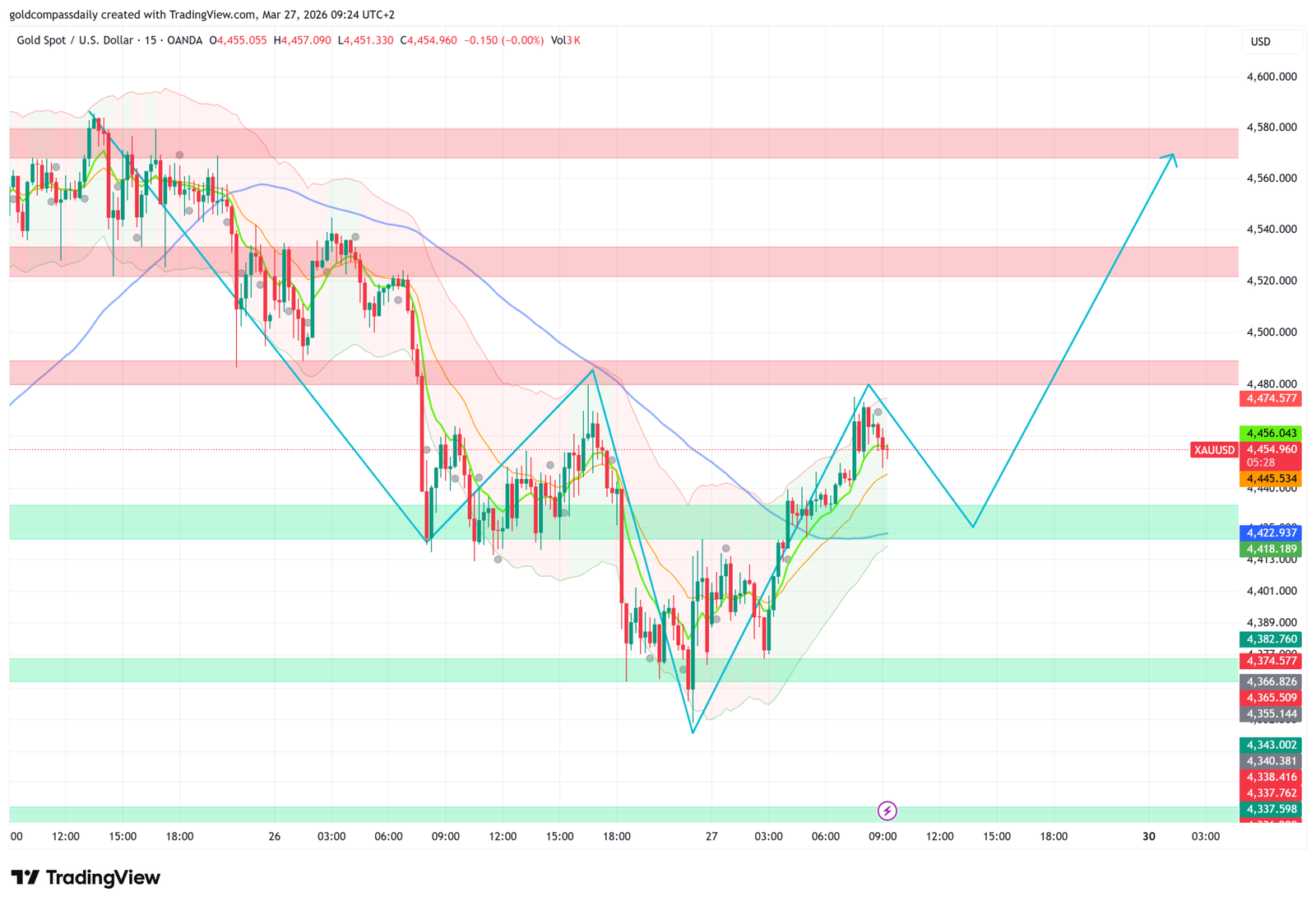
The structure of the recovery from the $4,100 low continues to develop exactly as the chart has projected throughout the week. Thursday’s dip to $4,355 — triggered by stronger-than-expected US Unemployment Claims — held precisely at the green demand zone between $4,374.577 and $4,382.760, printing a higher low relative to every prior corrective move since Monday. The reversal from that level was sharp and immediate, confirming that buyers are active at structurally significant support.
Price is currently navigating the pink resistance band between $4,474.577 and $4,532 — the same zone that has capped price on multiple attempts this week. A clean break and close above $4,474.577 in the European session would be the trigger for the move toward $4,580, which aligns with the upper pink resistance band visible at the top of the chart. That level represents a significant recovery milestone — clearing it would put gold within reach of the $4,640–$4,660 zone that was the initial upside target identified on Monday.
The projected path on the chart shows one more minor pullback into the $4,422.937 green zone before the final push to $4,580. That sequence — a shallow dip that holds the green zone, followed by continuation — has been the pattern every day this week. The floor to hold is $4,374.577. A close below that breaks the week-long higher-low structure.
Already Published: UK Data Beats Across the Board
The morning data from the UK has come in better than expected on both releases. UK GfK Consumer Confidence at 2:01am printed at -21, significantly better than the forecast of -24 and the prior of -19. That is a meaningful improvement in UK consumer sentiment — the best reading relative to expectations in several weeks — and stands in stark contrast to yesterday’s German GfK miss at -28.0. British consumers are more optimistic than their German counterparts, and this divergence matters for the relative EUR/GBP cross.
UK Retail Sales m/m at 9:00am printed at -0.4%, better than the forecast of -0.6% and a significant improvement from the prior of +2.0%. While the monthly reading is still negative — consumers are spending less than last month — the beat relative to expectations removes the downside surprise risk that had been priced in after this week’s weak PMI data and rising unemployment. The UK consumer is softening but not collapsing.
GBP/USD impact: Both beats are GBP-positive. The pound should outperform EUR in the European session — EUR/GBP faces downward pressure as UK data beats while Eurozone data continues to disappoint. GBP/USD has room to recover from recent lows, though the broader dollar-strength trend from the FOMC limits the upside. The MPC speakers yesterday (Taylor and Greene) will have set the tone — if either was dovish, sterling’s upside on today’s data beats is capped.
FTSE 100 impact: A weak retail sales headline (-0.4%) is mildly negative for domestic consumer stocks. However, a GBP recovery from the beat vs forecast limits the currency tailwind for large-cap FTSE exporters. Net: mixed for the index, with domestic retailers underperforming international earners.
All Day — Eurogroup Meetings: Fiscal Policy in Focus
Eurozone finance ministers are meeting today for the Eurogroup session. The agenda will cover fiscal coordination, the EU’s response to US tariff threats, and progress on the joint defence spending framework announced at this week’s Euro Summit. Any concrete announcements around joint EU bond issuance or significant fiscal stimulus would be EUR-positive — potentially providing a counterweight to the dovish ECB pressure that has weighed on the currency all week.
This is an underappreciated risk event for EUR/USD. The market is positioned for EUR weakness on ECB dovishness — a surprise fiscal announcement from the Eurogroup could force a short squeeze in the pair, which would temporarily weaken the dollar and provide an additional tailwind for gold.
10:00am — Spanish Flash CPI: Eurozone Inflation Picture
Spanish Flash CPI y/y is forecast at 3.6%, significantly above the prior reading of 2.3%. That is a dramatic expected acceleration in Spanish inflation — the largest single-month jump in the Eurozone CPI picture this year. If confirmed, it would be the one piece of data that complicates the ECB’s dovish narrative: Lagarde cannot easily justify aggressive rate cuts if Spanish inflation is running at 3.6% while the Eurozone headline is at 1.9%. The internal dispersion of inflation across member states becomes a political and monetary policy challenge.
EUR/USD impact: A Spanish CPI beat above 3.6% is paradoxically EUR-positive — it reduces the case for aggressive ECB easing and could trigger a short squeeze in an oversold pair. A reading in line with 3.6% is neutral. A miss below 3% would confirm the disinflation narrative and add to EUR downside.
Gold: A hot Spanish CPI that strengthens EUR/USD and weakens the dollar would be a near-term tailwind for XAU/USD heading into the afternoon session.
4:00pm — University of Michigan: Consumer Confidence and Inflation Expectations
The Revised UoM Consumer Sentiment is forecast at 53.9, down from the prior 55.5 — a further deterioration in American consumer confidence. This follows the preliminary reading from two weeks ago and, if confirmed or revised lower, would add to the accumulating picture of a US consumer becoming more cautious in the face of high interest rates, persistent inflation, and trade policy uncertainty.
The more consequential number for gold is the Revised UoM Inflation Expectations, forecast at 3.4%. Consumer inflation expectations at 3.4% are elevated — above the Fed’s 2% target and above the current CPI readings. If revised higher, it sends a signal that Americans expect prices to remain elevated, which could give the Fed additional justification for keeping rates higher for longer. A revision lower — toward 3.0% or below — would be the more market-friendly outcome and would support both equities and gold by reducing the urgency of the hawkish stance.
USD impact: Sentiment miss + inflation expectations revision lower = dollar weakens = gold positive. Sentiment beat + elevated inflation expectations = dollar holds = gold faces resistance at $4,474.
S&P 500 / Nasdaq: A deterioration in consumer sentiment to 53.9 is a soft landing concern — not a crash signal, but a trend that equity markets cannot ignore indefinitely. The Nasdaq is most sensitive to the inflation expectations component: higher expectations = higher rates = growth stock headwind.
5:00pm–5:30pm — Three FOMC Members: The Week’s Final Fed Words
The week closes with a trio of Federal Reserve communications: Barkin at 5:00pm, Daly at 5:30pm, and Paulson at 5:30pm. Coming after this week’s weak PMI data, the German GfK deterioration, and a claims print that was strong but not dramatically so, these speakers have a choice: double down on the post-FOMC hawkish message, or begin the subtle process of acknowledging that the data is softening.
Barkin has historically been a pragmatic centrist on the FOMC — his comments on growth risks will be particularly watched. Daly, as San Francisco Fed President, tends to focus on labour market conditions and financial stability. Any language from either speaker that acknowledges deteriorating consumer confidence, weak PMI data, or international growth headwinds would be interpreted as a dovish lean — dollar-negative, gold-positive.
Three Fed speakers on a Friday afternoon is unusual. The volume of Fed communication this week — Cook last night, now three today — suggests the Fed may be in messaging mode, attempting to manage market expectations after the FOMC-driven volatility of the past week.
Key Levels and Full Weekly Close Scenarios
- Gold (XAU/USD): $4,454 · Target $4,580 · Minor dip to $4,422 possible · Floor $4,374 · Key: UoM at 4:00pm + FOMC speakers 5:00–5:30pm
- GBP/USD: UK data double-beat = GBP outperforms EUR · MPC speakers from yesterday shape the tone · Room for recovery in a dollar-dominated week
- EUR/USD: Eurogroup headlines throughout day = upside risk · Spanish CPI at 10:00am = key input · ECB dovishness vs fiscal stimulus narrative in play
- EUR/GBP: UK beats vs Eurozone misses = cross moves lower (GBP stronger vs EUR) · Clearest directional trade of the morning
- USD/JPY: Three FOMC speakers at 5:00–5:30pm drive the afternoon · Dollar direction from UoM at 4:00pm sets the stage
- S&P 500 / Nasdaq: UoM sentiment and inflation expectations at 4:00pm · Weak sentiment + lower inflation expectations = relief rally into the weekly close
- DAX: Eurogroup fiscal headlines are the key upside catalyst · Spanish CPI affects ECB cut pricing · Net: cautiously positive if Eurogroup delivers
- Gold end-of-week positioning: Close above $4,474 = bullish weekly close, sets up continuation toward $4,580–$4,640 next week · Close below $4,422 = indecisive week, risk of retest toward $4,382
Gold has had a remarkable week. From the post-FOMC low of $4,100 on Monday to Friday’s open near $4,454, the metal has recovered over $350 — more than 8% — in four sessions. The structure is intact, the higher-low sequence is unbroken, and the macro backdrop is gradually shifting in gold’s favour as US economic data softens. The weekly close matters: a close above $4,474 sends a clear message that the recovery is real. The UoM data and the FOMC speakers this afternoon will write the final chapter of this week’s story.
Analysis based on the XAU/USD 15-minute chart as of March 27, 2026, 09:24 UTC+2. Economic data sourced from the daily macro calendar. This article is for informational and educational purposes only and does not constitute financial advice.

Written by T. S. Gospodinov
T. S. Gospodinov is an Independent gold market analyst focused on liquidity structures and macro-driven price cycles.