Gold enters April the way March ended — on the offensive. Yesterday’s weak US data delivered exactly what the chart called for: JOLTS job openings and CB Consumer Confidence both missed expectations, the dollar softened, and XAU/USD surged from $4,560 to a session high of $4,741.227. That is a $181 move in a single session, and it confirms that the recovery from the post-FOMC lows is gaining momentum rather than running out of steam. Wednesday’s calendar is one of the heaviest of the week — global manufacturing PMIs, ADP employment, US Retail Sales, ISM Manufacturing and ISM Prices all land today — and the picture they paint will set the tone for gold heading into Friday’s Non-Farm Payrolls.
The Chart: Rally Confirmed, One More Dip Before $4,780+
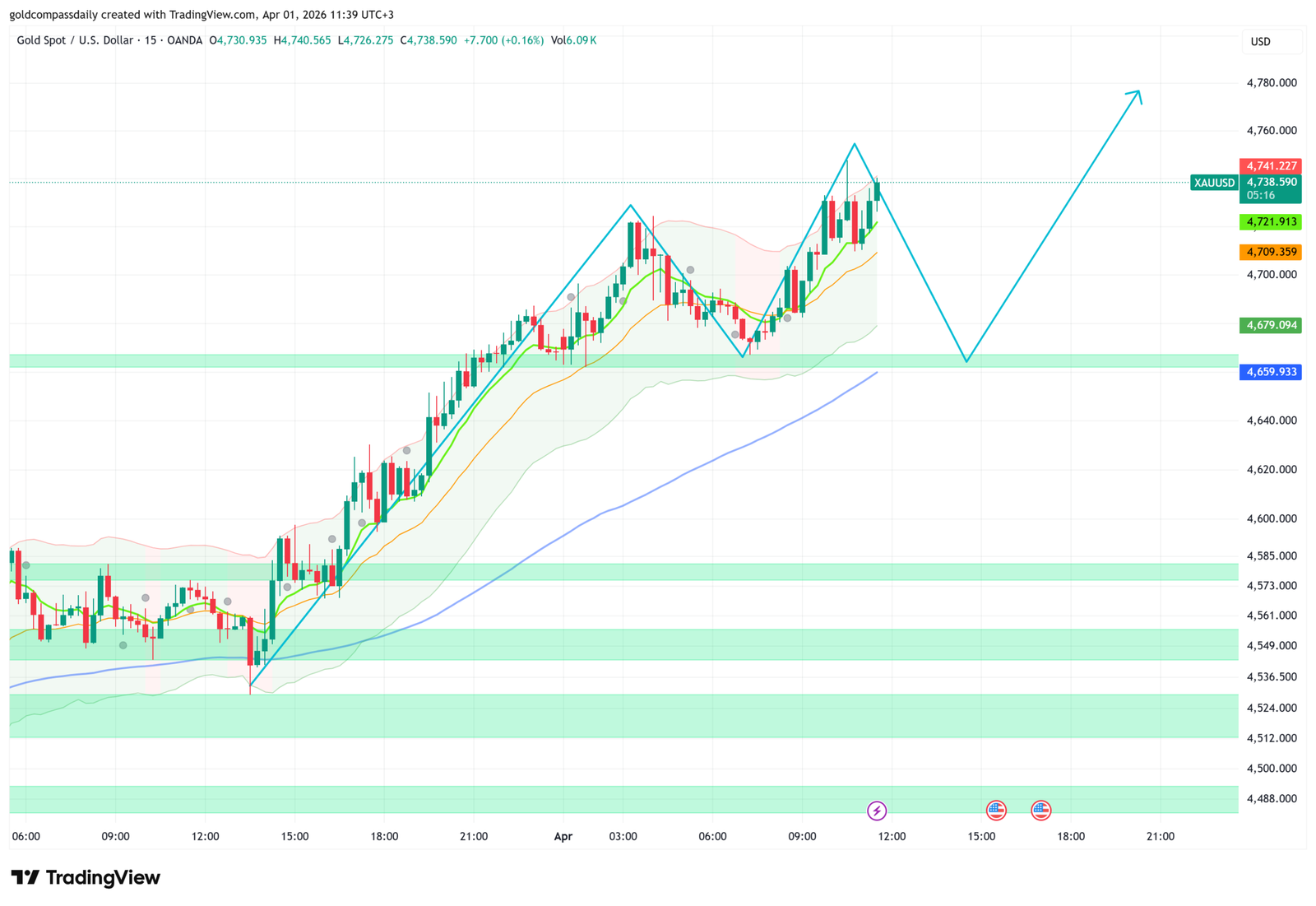
The 15-minute chart has entered a new phase. The green demand zones that defined last week’s recovery — $4,374, $4,422, $4,482 — have all been left well behind. Price is now trading at $4,738, and the chart projects one more corrective dip to the $4,659.933 level before the next sustained leg higher toward $4,780+.
The structure is emphatically bullish. Moving averages are pointing sharply higher, the Bollinger Bands are expanding upward, and each pullback since the March 23 reversal has been shallower than the last. The green demand zone that now acts as the primary floor sits between $4,659.933 and $4,679.094 — a $20 band that represents the upper end of last week’s consolidation range, now acting as support. A dip into that zone that holds would be the ideal setup for the continuation toward $4,780.
The immediate resistance is $4,741.227 — yesterday’s session high. A clean break and close above it opens the path to $4,760 and then the broader target of $4,780+. The invalidation level is a close below $4,659.933 — that would break the higher-low structure that has been intact since March 23 and would bring the $4,620–$4,640 zone back into focus.
Already Published: Global Manufacturing Beats Across the Board
The overnight and early morning session delivered a remarkably consistent message from global manufacturing PMIs — and it is a bullish one for risk assets and gold.
Japan’s Tankan Manufacturing Index printed at 17, above the forecast of 16 and the prior 15. The Tankan Non-Manufacturing Index came in at 36, significantly above the forecast of 33 and the prior 34. These are the strongest Tankan readings in several quarters and signal that Japanese business confidence — both in manufacturing and services — is running well ahead of expectations. The yen is mildly supported on this data.
Australia’s Building Approvals m/m exploded higher at 29.7% against a forecast of 5.8% and a prior of -7.2% — a dramatic beat that signals a surge in Australian construction activity. Commodity Prices y/y at 12.8% (prior 4.9%) is a significant jump in Australian export prices — driven in part by the China PMI recovery confirmed yesterday. The AUD is the strongest G10 currency this morning.
China’s RatingDog Manufacturing PMI at 50.8 — above the forecast of 51.6 but below the prior 52.1. A slight miss on this secondary reading does not undermine yesterday’s official PMI beat at 50.4. The overall China manufacturing picture remains one of recovery.
European manufacturing PMIs are delivering the most significant beats of the morning. German Final Manufacturing PMI at 52.2 — above the forecast of 51.7 and the prior 51.7. This is a meaningful beat — Germany’s manufacturing sector expanding at 52.2 is the strongest reading in over a year and represents a genuine turnaround from the contraction territory that defined the sector throughout 2025. Italian Manufacturing PMI at 51.3 (forecast 50.9), French Final Manufacturing PMI at 50.0 (exactly on the expansion threshold, forecast 50.2 — a slight miss but still not contracting). The Eurozone Final Manufacturing PMI at 51.6, above the forecast of 51.4.
Switzerland’s Manufacturing PMI at 53.3 — a dramatic beat against the forecast of 47.2 and the prior 47.4. That is one of the largest single-month PMI surprises in recent Swiss data history and signals that Swiss manufacturing is expanding strongly despite the strong franc headwind.
Spain was the one exception: Spanish Manufacturing PMI at 48.7, below the forecast of 50.5 and the prior 50.0 — back into contraction. Given Friday’s hot Spanish CPI forecast, this creates an unusual combination of high inflation and weak manufacturing in the same economy.
EUR/USD impact: The German manufacturing beat at 52.2 is the most EUR-positive data point of the morning. Combined with yesterday’s Eurozone CPI Flash coming in at 2.6% (as forecast), the EUR has a genuine fundamental case for recovery. The pair should push higher through the European session — a move that weakens the dollar at the margin and supports gold.
DAX: German manufacturing at 52.2 is directly positive for industrial stocks. This is the strongest domestic economic signal Germany has produced in months. BASF, Siemens, and automotive suppliers benefit most from a manufacturing recovery.
The UK Final Manufacturing PMI at 51.0 — below the forecast of 51.4 and the prior 51.4. A slight miss for the UK, but still in expansion. Not a major GBP mover.
12:00pm — Eurozone Unemployment Rate
The Eurozone Unemployment Rate is forecast to hold at 6.1% (prior 6.1%). A stable reading confirms that the Eurozone labour market remains resilient despite the weak growth environment — this is the same dynamic the ECB has been navigating all quarter. No major market reaction expected unless the reading comes in above 6.3% (signs of deterioration) or below 5.9% (surprisingly tight).
12:30pm — UK FPC Meeting Minutes and Statement
The Bank of England’s Financial Policy Committee Minutes and Statement at 12:30pm are focused on financial stability rather than monetary policy — they assess systemic risks in the UK financial system rather than setting rates. The FPC statement will be watched for any language around housing market risks (given the mortgage approval data from Monday), bank capital requirements, and the impact of global rate volatility on UK financial institutions. Not a primary sterling mover unless it contains a surprise warning about specific financial stability risks.
3:15pm — ADP Non-Farm Employment: The NFP Warm-Up
ADP Non-Farm Employment Change is forecast at 41K — a significant deterioration from the prior reading of 63K. ADP has been running well below the official NFP readings throughout 2026, signalling that the strong headline payrolls numbers may be overstating actual private sector hiring momentum. A reading at or below 41K would be a meaningful pre-NFP signal that Friday’s official payrolls report could disappoint — dollar-negative, gold-positive.
A reading above 60K would be the first challenge to the softening labour market narrative and could trigger a brief dollar recovery — the most significant near-term headwind for gold’s approach to $4,741 resistance.
USD impact: ADP below 41K = dollar weakens, gold breaks $4,741. ADP above 60K = dollar recovers, gold faces resistance. The asymmetry of the reaction is notable — the market is positioned for weak data, so a beat would have outsized impact.
3:30pm — US Retail Sales: Consumer Spending Reality Check
Core Retail Sales m/m is forecast at 0.3% (prior 0.0%) and headline Retail Sales m/m at 0.5% (prior -0.2%). Both readings are expected to show a meaningful bounce from last month’s weak prints. If confirmed, this would be a positive signal for US consumer spending and would complicate the narrative of a deteriorating American consumer that drove yesterday’s CB Confidence miss.
A retail sales beat today combined with a strong ADP would represent the most challenging combination for gold’s rally — it would force a reassessment of whether the CB Confidence miss was a temporary anomaly rather than a trend. In that scenario, the projected dip to $4,659 becomes more likely and potentially deeper.
A retail sales miss — particularly a Core reading that comes in flat or negative — would confirm that the consumer is weakening and would accelerate gold’s move through $4,741.
5:00pm — ISM Manufacturing PMI and Prices: The Stagflation Test
The ISM Manufacturing PMI is forecast at 52.3 (prior 52.4) — essentially unchanged, firmly in expansion. This follows this morning’s global manufacturing PMI beats and would confirm that US factory activity is holding up well. A reading in line with forecast is neutral. A beat above 54 would be dollar-positive. A miss below 50 — contraction — would be the most dramatic US data surprise of the week and would send gold sharply higher.
The more consequential number for gold is ISM Manufacturing Prices, forecast at 74.0 against a prior of 70.5. A reading of 74 on manufacturing prices is significantly elevated — it signals that US manufacturers are paying dramatically higher prices for inputs, which is an inflationary signal that could give the Fed justification for maintaining its hawkish stance even as growth softens. This is the stagflation indicator: rising prices + slowing growth = the worst environment for both bonds and equities, but historically supportive for gold as a safe-haven store of value.
If ISM Prices come in at 74 or above today, it creates a complex backdrop for gold. On one hand, high inflation supports the metal as a hedge. On the other, it validates Fed hawkishness and supports the dollar. The net effect for gold in a stagflationary environment has historically been positive — but the initial market reaction may be negative as the dollar initially strengthens on Fed hawkishness concerns before the inflation hedge narrative takes over.
S&P 500: ISM Manufacturing above 52 + Prices above 74 = stagflation concern = equities under pressure. The combination of rising input costs and slowing consumer demand (from CB Confidence miss) is a margin compression scenario for corporate earnings.
5:30pm — Crude Oil Inventories
Crude Oil Inventories are forecast to show a build of 2.0M barrels against a prior draw of -6.9M. A build of this magnitude after last week’s large draw would signal that the inventory cycle is normalising — mildly negative for oil prices. A larger-than-expected build (above 4M) would weigh more significantly on WTI and could spill over into broader commodity sentiment, which would be a marginal headwind for gold.
Key Levels and Full Market Summary
- Gold (XAU/USD): $4,738 · Resistance $4,741 · Target $4,780+ after dip to $4,659 · Floor $4,659.933 · Key: ADP 3:15pm + ISM Prices 5:00pm
- EUR/USD: German manufacturing PMI 52.2 is the morning bullish catalyst · Eurozone unemployment at noon · Dollar direction from ADP and Retail Sales at 3:15–3:30pm drives afternoon · Bull case strengthening
- AUD/USD: Building approvals explosion + commodity prices surge = strongest G10 performer · China recovery + Australian construction boom = AUD outperforms
- GBP/USD: UK PMI slight miss, FPC statement at 12:30pm · Broadly follows EUR/USD direction · No major GBP-specific catalyst today
- USD/JPY: Tankan double-beat supports yen · ADP and Retail Sales drive afternoon · Weak ADP = pair falls · Strong Retail Sales = pair holds
- S&P 500 / Nasdaq: Global PMI beats = positive open · ADP below 41K = rally on cut repricing · ISM Prices at 74 = stagflation concern = mixed · Nasdaq sensitive to rate expectations
- DAX: German manufacturing at 52.2 = strongest domestic signal in months · Industrial stocks lead · EUR strength from PMI beats adds to positive picture
- Copper: China + global manufacturing recovery = primary driver · Strong session expected
- WTI Crude: Inventory build forecast (2.0M) is mild headwind · Global manufacturing recovery supports demand outlook · Net: sideways to mildly positive
- ISM Manufacturing Prices at 74: The stagflation signal to watch · Above 74 = inflationary pressure = Fed hawkish case · Gold benefits medium-term but may face initial dollar headwind
April opens with gold at $4,738, the highest level since the post-FOMC collapse began. The recovery from $4,100 now stands at $638 — 15% — in eight trading sessions. The chart projects one more dip to $4,659 before the continuation to $4,780+. Today’s data sequence will write the script: if ADP disappoints and ISM confirms the stagflation read, gold enters the NFP week on the strongest footing since mid-March. If retail sales and ADP both beat, expect the $4,659 dip to come sooner and potentially sharper before the recovery resumes.
Analysis based on the XAU/USD 15-minute chart as of April 1, 2026, 11:39 UTC+3. Economic data sourced from the daily macro calendar. This article is for informational and educational purposes only and does not constitute financial advice.

Written by T. S. Gospodinov
T. S. Gospodinov is an Independent gold market analyst focused on liquidity structures and macro-driven price cycles.