Gold Price Analysis 2026: Can the “V-Recovery” Hold Above $5,000?
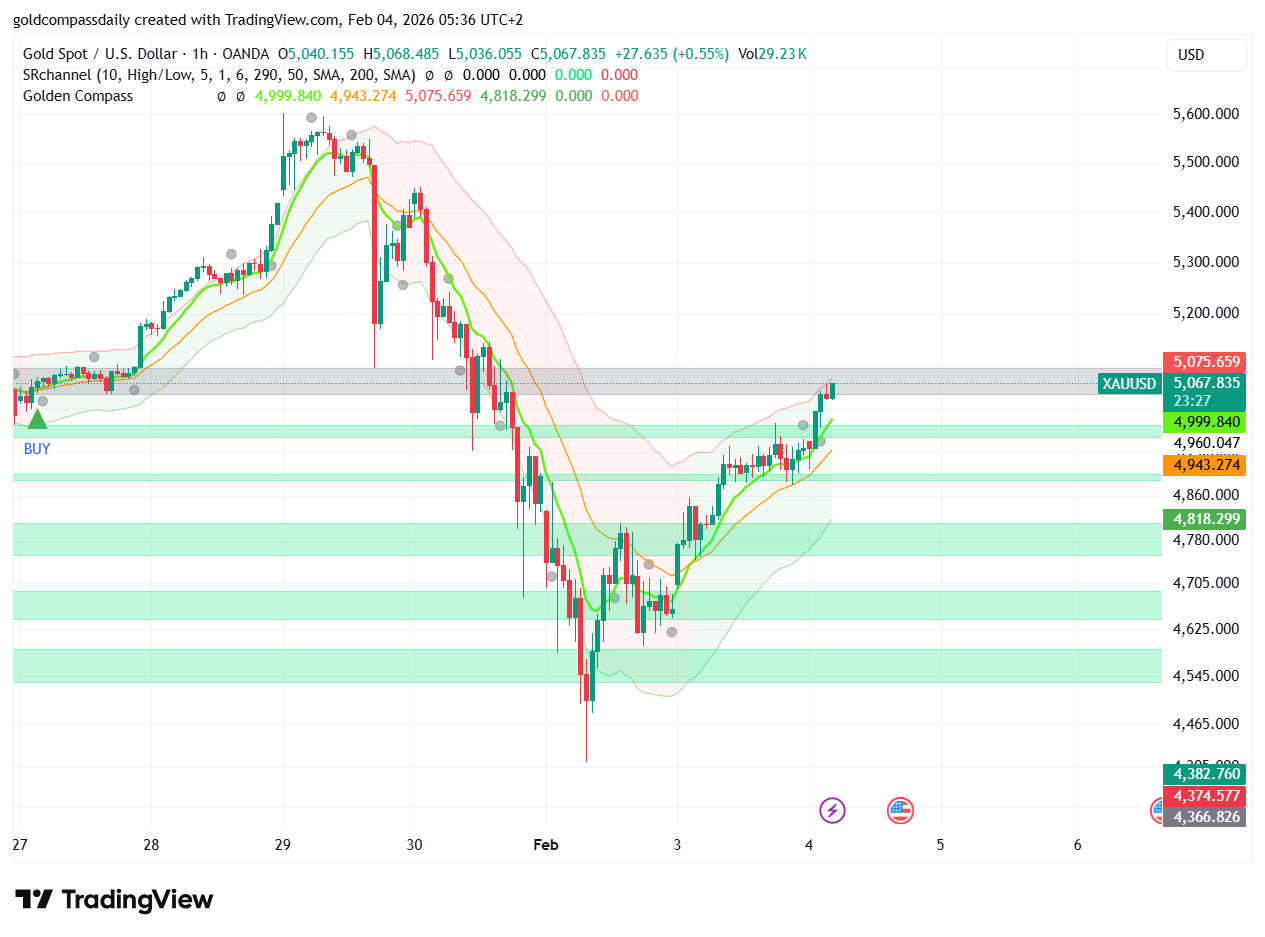
The first week of February 2026 has been a “baptism by fire” for precious metals investors. After a parabolic run-up to nearly $5,600, gold suffered a “Black Friday” style collapse, dropping 9% in its steepest one-day fall since 1983. However, as of today, February 4, 2026, the narrative has shifted from panic to profit as gold surged 6.2%—its biggest daily gain since 2008—to reclaim the psychological $5,000 level. This Gold Price Analysis 2026 dives into whether this is a “dead cat bounce” or the start of the next leg toward $6,000.
The sudden volatility was triggered by a “perfect storm”: the nomination of hawkish Kevin Warsh as the next Federal Reserve chair and a hike in futures margins by the CME Group. These factors forced a massive liquidation of “crowded” long positions, essentially cleaning out weaker hands and creating an entry point for institutional giants.
Technical Breakdown: The 1-Hour Chart Outlook
Analyzing the short-term 1-hour chart reveals a textbook “V-shaped” recovery attempt. After hitting a pivotal support at $4,405—where the 50-day moving average and an ascending channel boundary converged—gold began a rapid mean-reversion rebound.
- Resistance Levels: The immediate challenge for bulls is the $5,050 – $5,100 zone. A sustained break above $5,169 (the 61.8% Fibonacci retracement level) would confirm that the corrective phase is over.
- Support Zones: Today’s pivot sits at $4,800. If gold holds above this level, the $6,300 targets forecasted by major banks remain firmly in play.
- Momentum Indicators: The hourly RSI has climbed back above the 50 level, indicating that bullish momentum is re-accelerating after being in extreme “oversold” territory just 48 hours ago.
Why Major Banks Are Still Betting on $6,300
Despite the recent 1983-style crash, the structural bull case for gold has not changed. In fact, J.P. Morgan recently upgraded their year-end Gold Price Analysis 2026 forecast to $6,300 per ounce. This bullishness is driven by a massive “diversification trend” among central banks, which are projected to buy at least 850 metric tons of gold this year to reduce their reliance on the US Dollar.
Geopolitical tensions are also providing a fresh “safe-haven” jolt. Reports of US forces downing drones in the Arabian Sea remind investors that despite Fed leadership changes, global risks are far from settled. When paper assets feel risky, “real assets” like gold become the ultimate insurance policy.
Trading Scenarios: What to Watch Today
For traders navigating this volatility, the game plan is clear. The “Buy the Dip” strategy has been validated at $4,400, but the market is not out of the woods yet.
- The Bull Case: A consolidation above $5,000 followed by a breach of $5,170. This would likely trigger a wave of FOMO (fear of missing out) and a retest of the $5,600 all-time highs.
- The Bear Case: If gold fails to hold the $4,900 mark on a closing basis, it suggests the rebound was purely technical. This could lead to a retest of the $4,400 support floor to build a more stable foundation.
Conclusion: The “New Normal” for Gold
Gold’s ability to recover over $500 in a single session proves its enduring role as the world’s premier defensive asset. While the road to $6,000 may be more volatile than we saw in 2025, the underlying demand from central banks and savvy retail investors is creating a robust framework for the rest of the year. Stay disciplined, watch the $5,100 resistance, and remember that in 2026, volatility is not just a risk—it is an opportunity.

Written by T. S. Gospodinov
T. S. Gospodinov is an Independent gold market analyst focused on liquidity structures and macro-driven price cycles.