As of February 10, 2026, gold prices are experiencing a slight pullback, with XAU/USD trading around $5029.480 per ounce, down 0.18% from recent levels. This follows a volatile session where prices tested highs near $5038 before retreating. Current spot prices range from $5016.420 low to $5038.600 high, according to real-time data from Trading Economics and Investing.com, reflecting broader market caution ahead of U.S. economic releases. For everyday investors considering gold as a safe-haven asset, and for active traders navigating intraday swings, this gold price today analysis delves into the 1-hour chart movements, fundamental influences, and possible scenarios. With ongoing central bank buying and geopolitical tensions, could this dip signal a buying opportunity or further downside?
Current Gold Price Today Overview
Gold opened the Asian session on a subdued note, consolidating above $5000 after yesterday’s rebound. By early European hours, XAU/USD has dipped to $5016.420, closing the latest candle at $5029.480 with volume at 45.53K. This represents a -0.18% change, but the broader daily picture shows resilience, with prices up approximately 1% from February lows around $4960–$4990. Year-over-year, gold has surged over 100%, driven by record highs in January at $5608, as reported by Kitco and BullionVault.
For non-experts, gold’s price fluctuations often mirror global uncertainty – rising when stocks falter or inflation looms. Today, with U.S. data like CPI and jobs reports on the horizon, this volatility could present entry points for diversifying portfolios through ETFs or physical holdings, without requiring deep trading knowledge.
Technical Breakdown: The 1-Hour Chart Insights
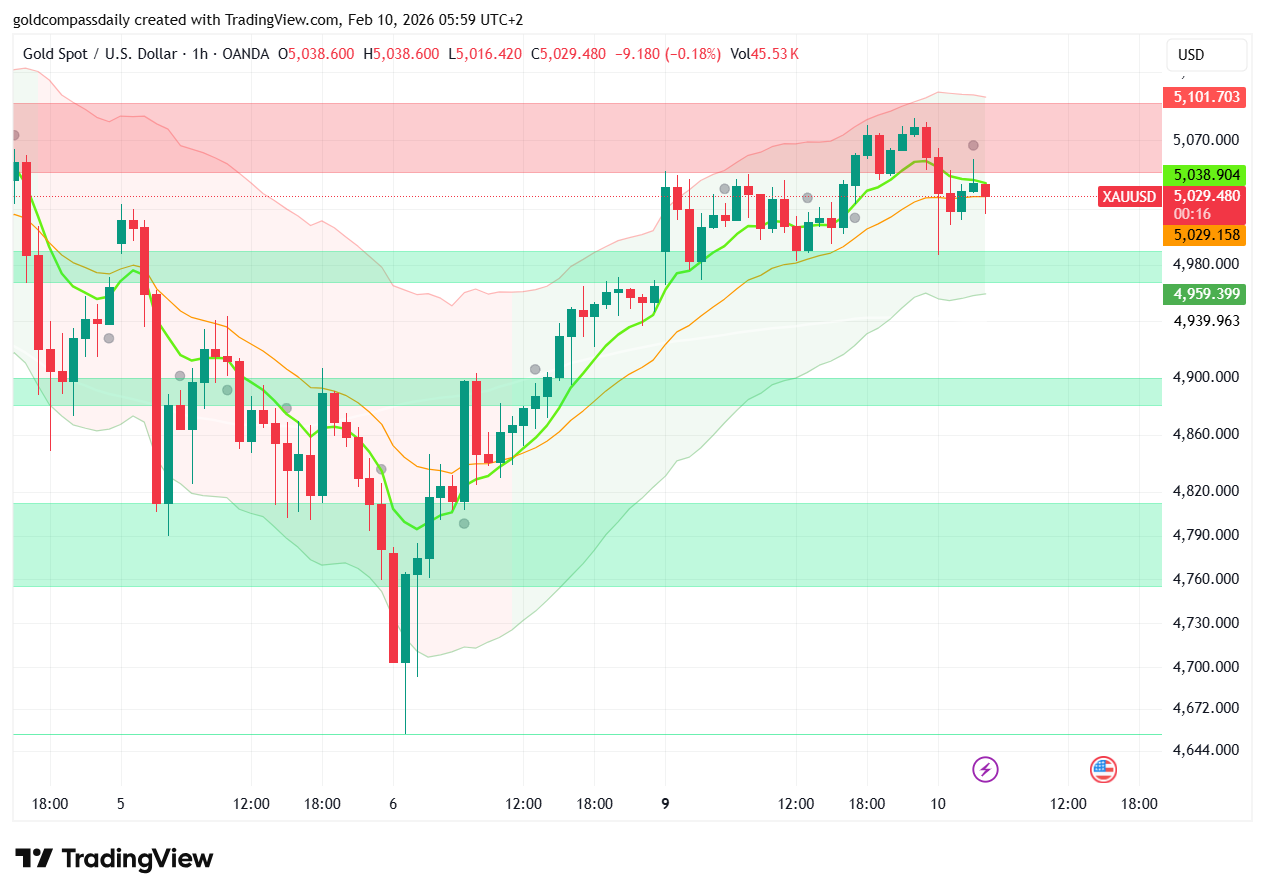
The 1-hour TradingView chart for XAU/USD illustrates a short-term correction within an uptrend. Spanning February 5–10, prices climbed from ~$4672 lows on Feb 5 to peaks around $5101 by Feb 9, forming a bullish channel supported by the SR Channel indicator. However, the latest candles show bearish pressure: a series of red bars pulling back from $5038.600, testing lower supports with doji patterns indicating indecision.
Key technical levels include:
- Resistance ($5038–$5101): This zone has capped recent advances, with the Golden Compass upper band at $5101.703. A break above could reignite momentum toward $5128–$5200.
- Support ($5016–$4980): The session low acts as immediate pivot. Holding here prevents a slide to $4960, while a bounce could form a higher low, confirming bullish continuation.
- Moving Averages: The 50-period SMA at ~$5029 slopes downward, crossing below shorter MAs, signaling potential exhaustion. Momentum indicators imply oversold conditions, hinting at a rebound if volume picks up.
The chart’s pullback resembles a “flag” pattern – a common consolidation in bull markets. For beginners, this means the market is pausing after gains, potentially gearing up for another push higher when buyers return.
Fundamental Drivers Shaping Gold Prices
Fundamentally, today’s dip is influenced by a stronger U.S. dollar and rising Treasury yields, offsetting gold’s safe-haven appeal. Kevin Warsh’s Fed Chair nomination continues to weigh on sentiment, with hawkish policies potentially capping upside. However, downside is limited by robust demand: China’s central bank added to its reserves for the 15th month, per Reuters, providing a structural floor amid currency concerns.
Geopolitical tensions in the Middle East and U.S. tariff threats add support, as noted in Bloomberg reports. Upcoming U.S. CPI data tomorrow could spike volatility – hotter inflation might boost gold as an hedge, while cooler numbers strengthen the dollar. Analysts from JPMorgan forecast $6000+ by end-2026, citing fiscal deficits and de-dollarization trends. For average readers, this underscores gold’s role beyond trading – as a protector against economic shifts, suitable for long-term savings.
Trading Strategy: Navigating the Dip
For traders, the 1-hour chart presents tactical opportunities. Scalpers can fade the dip near $5016 support with tight stops below $4980, targeting $5038–$5101 for quick gains. Swing traders might wait for a confirmed rebound above $5038 to enter longs, aiming for $5128, using 1–2% risk per trade amid 45K volume indicating liquidity.
Conversely, if support breaks, shorts could target $4960 with caution ahead of data. Non-traders can consider dollar-cost averaging into gold ETFs on pullbacks below $5000, leveraging the bull trend. Market psychology remains optimistic post-January’s 16–18% correction – this minor dip flushes weak hands, allowing institutions to accumulate.
Conclusion: Watching for Rebound Signals
This gold price today analysis suggests a temporary setback, with the 1-hour chart hinting at potential recovery if supports hold. While near-term volatility persists from U.S. data, fundamentals like central bank buying keep the outlook positive for 2026. Monitor $5000–$5038 levels closely, and avoid impulsive trades in uncertain sessions.
Gold’s enduring appeal lies in its stability amid chaos – whether for active plays or passive protection, today’s movements offer insights for all.

Written by T. S. Gospodinov
T. S. Gospodinov is an Independent gold market analyst focused on liquidity structures and macro-driven price cycles.