

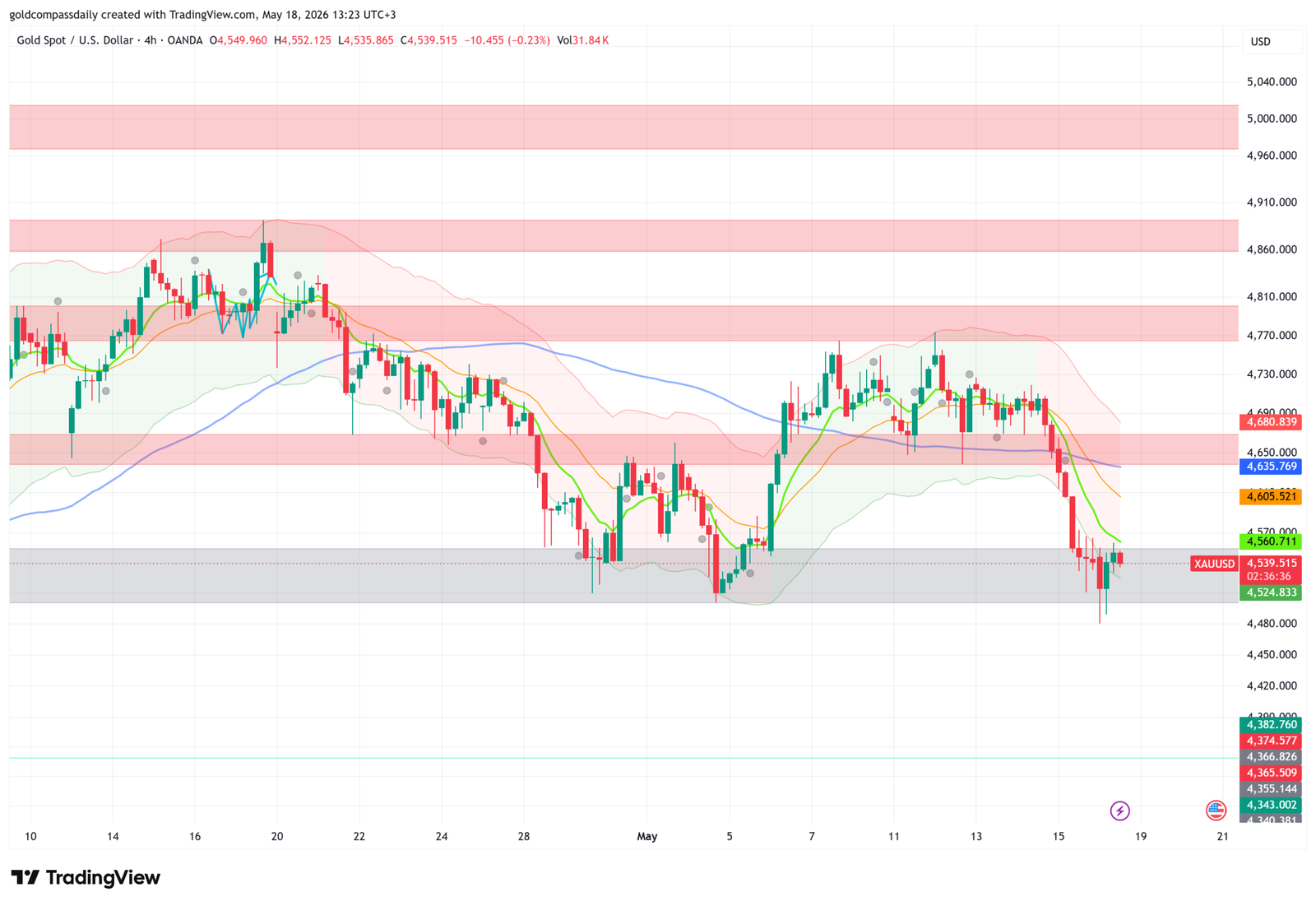
Gold enters the week of May 18 at a critical inflection point. After rallying from the post-FOMC low of $4,100 in late March to a peak of $4,900 in mid-April, XAU/USD has spent the past three weeks consolidating and correcting — dropping from $4,860 to a weekly low near $4,488 before stabilising at the current level of $4,539. The 4-hour chart shows price sitting in a grey demand zone between $4,524.833 and $4,560.711, with the green support bands at $4,343–$4,382 well below and the pink resistance cluster at $4,635–$4,680 as the first meaningful ceiling above. The week ahead is one of the most data-intensive of May — with Canadian and UK inflation, Flash PMIs from every major economy, FOMC minutes, and Australian employment all landing between Tuesday and Thursday. The data will determine whether gold’s correction is complete or whether one more leg lower is needed before the next bull run begins.
This article serves as the weekly hub for gold analysis. Each major event day will receive its own dedicated intraday breakdown — linked below as the week progresses.
The Big Picture: Why Gold Sold Off and Why the Bull Case Remains
The correction from $4,860 to $4,488 over the past two weeks was driven by two converging forces. First, the US-China trade situation showed signs of de-escalation — reports of preliminary trade discussions and potential tariff adjustments reduced the geopolitical risk premium that had been supporting gold since Liberation Day. When the primary safe-haven catalyst softens, gold gives back the premium. Second, a sequence of US data beats — including a stronger-than-expected NFP and a CPI that came in at 3.7% y/y as forecast — reduced the near-term probability of Federal Reserve rate cuts and strengthened the dollar. Higher real yields and a stronger dollar are the most direct short-term headwinds for gold.
Neither of these forces has fundamentally altered the medium-term bull case. The tariff environment — even partially de-escalated — still represents the most significant structural shift in global trade since the 1980s. Import price acceleration (US Import Prices at 2.3% last week, China PPI at 2.8%) is still feeding through to consumer prices. The Fed is still holding rates at 3.75% in an economy where consumer confidence has deteriorated to post-pandemic lows. And gold’s structural demand from central banks, Asian buyers, and institutional safe-haven allocations has not reversed.
The $4,488–$4,539 zone is where these competing forces are being resolved. The week ahead’s data will tilt the balance.
Monday, May 18 — China Data, UK MPC Speaker, G7 Meetings Begin
The week opens with several already-published China data points that set the global growth backdrop. China Industrial Production y/y at 4.1% — below the forecast of 6.0% and the prior 5.7%. A significant miss on Chinese factory output adds to the picture of a Chinese economy feeling the impact of tariff-related uncertainty on export orders and production schedules. China Retail Sales y/y at 0.2% — dramatically below the forecast of 2.0% and the prior 1.7%. Chinese consumers pulled back sharply in April — the weakest retail reading in years. China Fixed Asset Investment ytd/y at -1.6% (forecast 1.7%, prior 5.7%) — a dramatic reversal in Chinese capital expenditure. The Chinese data this morning is uniformly weak — a global growth concern that is mixed for gold: reduces safe-haven premium from Chinese financial stress (mildly gold-negative) but increases global recession fears (mildly gold-positive). The net effect is broadly supportive for gold’s safe-haven demand.
MPC Member Greene speaks at 10:00am. Following last week’s BOE decision (hold at 3.75% with one dovish dissent), Greene’s comments will be parsed for any shift in language around the May cut probability. Any acknowledgement of the tariff-driven growth slowdown would add to the dovish BOE case and weaken GBP.
Italian Trade Balance at -4.718B (forecast 5.25B, prior 4.988B) — a significant deterioration in Italy’s trade position. Combined with weak Chinese data and deteriorating Eurozone consumer confidence, the European trade picture is softening.
G7 Meetings begin (Day 1) — finance ministers from the world’s seven largest economies convene. Trade policy, tariff coordination, and the global economic outlook are the agenda items. Any joint G7 statement on trade policy or tariff frameworks would be market-moving — particularly if it signals coordinated pressure on the US to moderate Liberation Day measures.
The afternoon brings NAHB Housing Market Index at 5:00pm (forecast 34, prior 34) and TIC Long-Term Purchases at 5:00pm (prior $62.4B) — the latter showing foreign demand for US Treasury securities. A strong TIC number would signal continued international confidence in dollar assets — dollar-positive, gold-headwind. A weak number would suggest foreign investors are reducing US exposure — dollar-negative, gold-supportive.
Tuesday, May 19 — Canadian CPI, UK Labour Market, G7 Day 2
Tuesday is the week’s first major inflation day. Canadian CPI arrives at 3:30pm in multiple measures: Core CPI m/m forecast 0.6% (prior 0.9%), Common CPI y/y forecast 2.6% (prior 2.4%), Median CPI y/y forecast 2.2% (prior 2.3%), Trimmed CPI y/y forecast 2.2% (prior 2.3%). The Canadian inflation picture is expected to show modest deceleration across core measures — consistent with the BOC’s easing path. A surprise to the upside on Common CPI (above 2.7%) would challenge the case for further BOC cuts. A miss across all measures would accelerate the easing cycle and weaken CAD.
The UK morning delivers three labour market readings at 9:00am: Claimant Count Change (forecast 25.9K, prior 26.8K), Average Earnings Index 3m/y (forecast 3.8%, prior 3.8%), and Unemployment Rate (forecast 4.9%, prior 4.9%). UK wage growth holding at 3.8% alongside a stable unemployment rate would maintain the BOE’s cautious stance on cuts — the last argument against faster easing is that services inflation, driven by wage growth, remains above target. A wage miss below 3.5% would be the most dovish UK data signal available this week.
Westpac Consumer Sentiment for Australia at 4:30am (prior -12.5%) and RBA Monetary Policy Meeting Minutes at 4:30am — the detailed account of the May rate decision that held at 4.35%. The minutes will reveal how close the RBA was to cutting and what conditions would trigger a move. Given last week’s weak NAB Business Confidence (-24) and the CPI deceleration, the minutes may signal that a June cut is being seriously considered.
At 3:15pm, FOMC Member Waller speaks — the first Fed communication of the week. Waller is one of the more hawkish members of the committee; his framing of last week’s CPI (3.7% y/y) and the broader inflation trajectory will set the week’s initial USD tone ahead of Wednesday’s FOMC Minutes.
Also at 3:15pm: ADP Weekly Employment Change (prior 39.3K) — the first weekly labour data point of the week.
Pending Home Sales m/m at 5:00pm (forecast 1.2%, prior -3.2%) — an expected bounce in US housing activity after last month’s sharp decline. A beat would add to US economic resilience signals.
Wednesday, May 20 — FOMC Minutes: The Week’s Most Important Event for Gold
Wednesday is the week’s defining day for gold. The FOMC Meeting Minutes publish at 2:00am (from the May meeting held the week before — the balanced hold at 3.75%). These minutes will be the most comprehensive account of the Fed’s internal debate about the tariff-growth-inflation trilemma — how does the committee balance above-target CPI (3.7%), deteriorating consumer confidence, weak PMIs, and a still-resilient labour market?
The specific language to watch: how many members discussed the possibility of cuts if growth deteriorates? How did the committee assess the tariff inflation as “transitory” versus “persistent”? Was there any discussion of conditions under which the neutral rate might need to be revised lower? The answers to these questions will determine whether the post-FOMC balanced tone from early May was a genuine shift toward dovishness or a tactical communication choice.
The morning brings UK CPI at 9:00am — the week’s second major inflation reading. Core CPI y/y forecast 3.1% (prior 3.1%), CPI y/y forecast 3.0% (prior 3.0%), PPI Output m/m forecast 0.9% (prior 0.0%). UK CPI holding at 3.0% alongside accelerating PPI output (0.9% vs 0.0%) would be a stagflation signal for the UK — consumer prices sticky, producer prices re-accelerating. That combination makes the BOE’s May cut decision more difficult and is GBP-positive but growth-negative.
German PPI m/m at 9:00am (forecast 2.5%, prior 2.5%) — German producer prices expected to hold at 2.5% monthly. If confirmed, it validates that the tariff-driven import price acceleration (German Import Prices at 3.6% last week) is feeding through to domestic producer costs. Another step in the global inflation transmission chain that supports gold’s medium-term bull case.
At 4:15pm, FOMC Member Barr speaks — ahead of the 5:30pm Crude Oil Inventories (prior -4.3M). The combination of Barr’s comments and the oil inventory data will set the commodity market tone heading into Thursday’s major data sequence.
Thursday, May 21 — Flash PMIs, Australian Employment, Unemployment Claims: The Week’s Data Climax
Thursday is the single most data-intensive day of the week — and one of the most consequential of the entire month. The session opens with Australian data at 2:00am: Flash Manufacturing PMI and Flash Services PMI (prior 50.7 — already in expansion) alongside MI Inflation Expectations (prior 5.0%). At 4:30am: Employment Change (forecast 15.7K, prior 17.9K) and Unemployment Rate (forecast 4.3%, prior 4.3%). The Australian employment data will be the first clear signal of whether the Liberation Day tariff shock is affecting Asia-Pacific labour markets.
The European session brings the critical Flash PMI sequence. German Flash Manufacturing PMI at 10:30am (forecast 51.0, prior 51.4), German Flash Services PMI (forecast 49.3, prior 49.9), Eurozone Flash Manufacturing PMI at 11:00am (forecast 51.8, prior 52.2), Flash Services PMI (forecast 47.4, prior 47.6). The European PMI picture is expected to show continued manufacturing expansion alongside persistent services contraction — an unusual combination that reflects tariff-front-running in goods markets alongside domestic demand weakness.
UK Flash Manufacturing PMI at 11:30am (forecast 53.0, prior 53.7) and Flash Services PMI (forecast 51.7, prior 52.4) — both expected to decelerate but remain in expansion. A UK services miss below 50 would be the most significant UK data point of the week.
The US session at 3:30pm delivers the pre-NFP double: Unemployment Claims (forecast 220K, prior 211K) and Prelim Nonfarm Productivity q/q (prior 1.8%) alongside Prelim Unit Labor Costs q/q (prior 4.4%). A claims reading above 225K — combined with Flash PMI misses — would be the most gold-bullish combination available Thursday, potentially driving a break above the $4,635 resistance heading into the weekly close.
At 4:45pm: US Flash Manufacturing PMI (forecast 53.6, prior 54.5) and Flash Services PMI (forecast 51.0, prior 51.0). At 5:00pm: Consumer Confidence (forecast -21, prior -21.0) and Natural Gas Storage. The consumer confidence reading will be the fifth consecutive data point confirming or contradicting the deteriorating American consumer narrative — each reading below -20 adds incrementally to the case for Fed cuts and gold upside.
Friday, May 22 — German GDP, UK Retail Sales, Canadian Retail, Revised UoM
The week closes with several tier-two data points that collectively define the final positioning into the weekend. German National GDP q/q at 9:00am (forecast 0.3%, prior 0.2%) — a confirmation of Germany’s Q1 growth that precedes Liberation Day’s full impact. German GfK Consumer Climate (forecast -33.8, prior -33.1) — European consumer pessimism expected to deepen further. UK GfK Consumer Confidence at 2:00am (forecast -26, prior -23) — UK consumers expected to be significantly more pessimistic than last month.
UK Retail Sales m/m at 9:00am (forecast -0.6%, prior -0.3%) — an expected acceleration in UK retail decline after last week’s BRC retail monitor showed -3.4% year-on-year. If confirmed, this would be the weakest consecutive UK retail reading in years and would significantly accelerate BOE cut timing. UK Core Retail Sales m/m (forecast -0.5%, prior -0.4%) — same direction.
Canadian retail data at 3:30pm: Core Retail Sales m/m (forecast 0.9%, prior -0.5%) and Retail Sales m/m (forecast 0.7%, prior -0.7%) — both expected to bounce from last month’s declines. A Canadian retail beat would be CAD-positive and reflect the Canadian trade surplus beat published last week.
The week’s final significant release: Revised UoM Consumer Sentiment at 5:00pm (forecast 48.2, prior 49.8) and crucially Revised UoM Inflation Expectations (prior 4.5%). A sentiment revision lower combined with inflation expectations above 4.5% would be the clearest available stagflation signal heading into the weekend — and the most gold-positive closing data point of the week.
The Week’s Key Levels for Gold
- Current price: $4,539
- Immediate support: $4,524.833 (grey zone floor) → $4,488 (weekly low) → $4,382–$4,343 (green demand bands)
- First resistance: $4,560.711 → $4,605.521 → $4,635.769
- Key resistance: $4,680.839 (pink band) → $4,750 → $4,810
- Bull case trigger: FOMC Minutes dovish + Flash PMI misses + Claims above 225K = break above $4,635 → target $4,680–$4,750
- Bear case risk: FOMC Minutes hawkish + US data beats + UK CPI hot = break below $4,488 → $4,382 support tested
- Weekly close to watch: Above $4,635 = bullish weekly close confirming recovery · Below $4,488 = correction extends into next week
The Week’s Verdict
Gold’s correction from $4,860 to $4,488 has brought price back to a level where the structural demand for the metal — inflation hedge, safe-haven, central bank accumulation — intersects with a technical support zone that has held on every meaningful test since April. The week ahead will provide the most comprehensive data sweep of the month: inflation from Canada and the UK, growth from Flash PMIs across four major economies, labour market signals from Australia and the US, and the FOMC’s own internal debate in the Minutes.
The balance of evidence entering this week favours the bulls. Chinese data is weakening. European consumer confidence is deteriorating. UK and US retail spending is declining. These are the conditions that historically force central banks toward easing — and easier monetary conditions are gold’s most powerful medium-term catalyst. The tariff inflation, meanwhile, is not going away: German PPI, UK CPI, and US import prices are all confirming that Liberation Day costs are working their way through the system.
Watch Wednesday’s FOMC Minutes above all else. That is the week’s defining event for gold. Daily analysis for each session will be published here as the week progresses.
Analysis based on the XAU/USD 4-hour chart as of May 18, 2026, 13:23 UTC+3. Economic data sourced from the weekly macro calendar. This article is for informational and educational purposes only and does not constitute financial advice.