

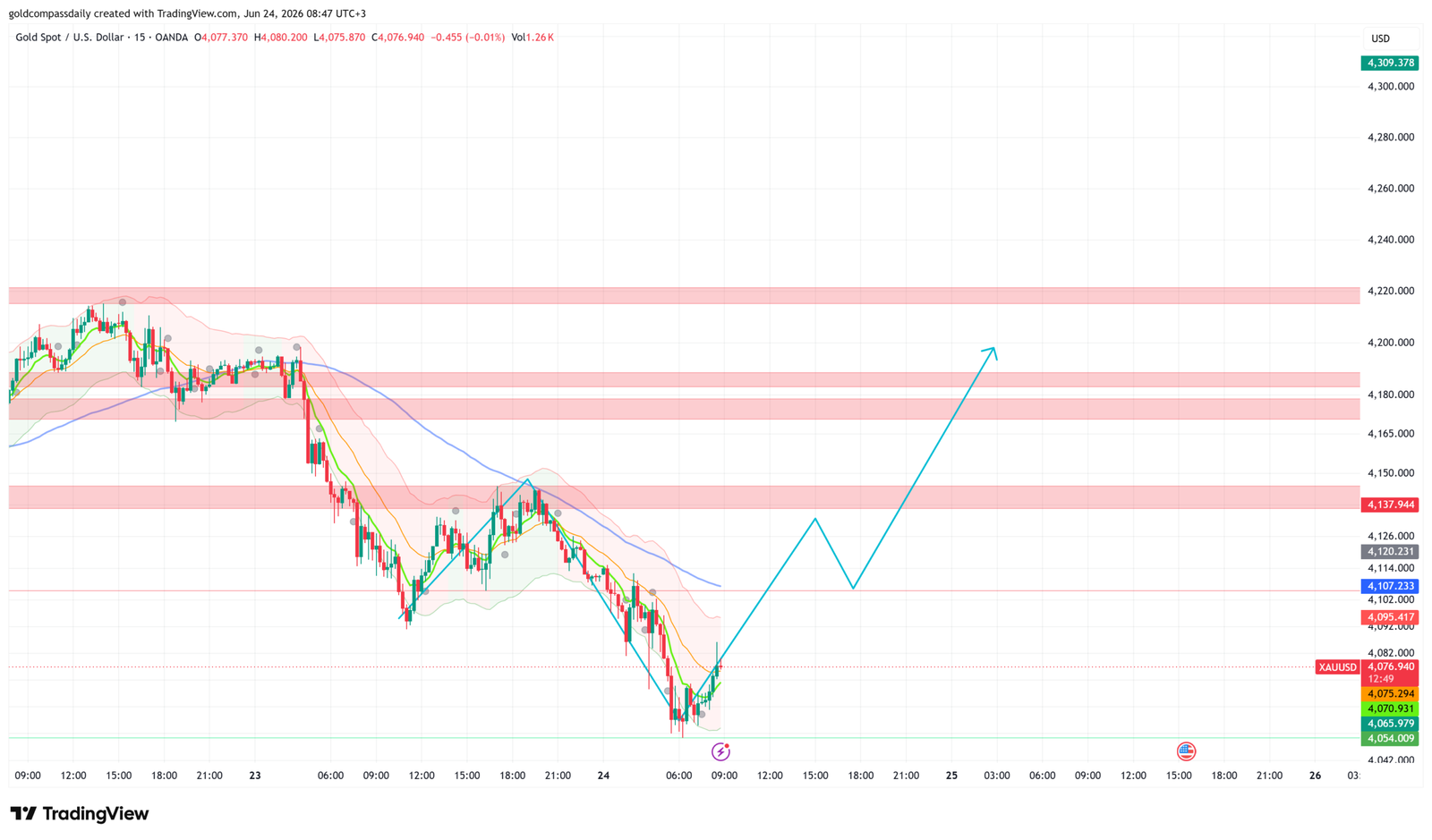
Gold trades cautiously bullish at $4,077 on Tuesday, recovering from a session low of $4,054 as dollar strength shows early signs of fading heading into a light but event-rich U.S. afternoon session. The metal remains under structural pressure following last week’s sharp decline from the $4,309 peak, but the 15-minute chart shows buyers stepping in at the lower demand zone, with the projected path pointing toward a retest of $4,138–$4,200 resistance before Thursday’s Core PCE.
For the weekly macro context, see Gold Compass Daily’s Week Ahead Hub: June 23–27 — Core PCE and PMI Data in Focus. Monday’s session is covered in Gold Slides to $4,127 as PMI Data and Dollar Strength Weigh.
Key Levels
- Bias: Cautiously Bullish above $4,054 (session low / demand zone)
- Support: $4,065 → $4,054 (session low, critical near-term floor)
- Resistance: $4,095 → $4,107 → $4,120 → $4,138 (confirmed resistance shelf)
- Session target: $4,138–$4,145 (conditional on U.S. data coming in soft and dollar retreating)
- Extended target: $4,180–$4,200 zone (aligns with chart projection if recovery extends into Wednesday)
- Invalidation: Break and close below $4,054 = demand exhausted, opens path toward $4,020–$4,000
Catalyst of the Day
The primary catalyst for Tuesday’s session is the U.S. New Home Sales print at 5:00 PM UTC+3 (forecast: 638K vs prior 622K), followed by Bank Stress Test Results at 11:00 PM UTC+3. A stronger-than-expected housing print would reinforce the “resilient U.S. economy” narrative, reducing the Fed’s urgency to cut — a headwind for gold. Conversely, a miss would ease real yield expectations and provide room for XAU/USD to push toward the $4,138 resistance. The stress test results, while equity-centric, could move risk sentiment broadly and affect safe-haven demand into the Asian open. Watch the 5:00 PM UTC+3 release for the directional trigger.
Fundamental Context
Australia’s CPI data released early Tuesday delivered a notable downside surprise, with the monthly CPI falling 0.7% against a forecast of -0.4% and a prior reading of +0.4%. The annual rate printed at 4.0%, below the 4.3% forecast. While AUD-specific, the data reinforces a global disinflationary trend that has begun to weigh on the U.S. dollar’s relative safe-haven premium. For gold, broad disinflation outside the U.S. reduces the argument for aggressive Fed tightening while simultaneously supporting the case for rate cuts further out — a medium-term tailwind for the metal.
The German ifo Business Climate for June (forecast: 85.6 vs prior 84.9) due at 11:00 AM UTC+3 adds to the European demand picture. Deteriorating European growth sentiment typically drives flows toward dollar-denominated safe havens, but with the ECB already in a dovish pivot and European sovereign yields retreating, the impact on gold tends to be directionally positive if the data disappoints materially. The U.S. Current Account deficit print at 3:30 PM UTC+3 (forecast: -$212B vs prior -$191B) serves as a secondary dollar indicator — a wider deficit can suppress USD strength and provide near-term support for gold.
Chart Analysis
The XAU/USD 15-minute chart as of 08:47 UTC+3 shows price at $4,076.94 after printing a session low of approximately $4,054 in the early morning hours of June 24. The decline from the $4,309.38 high (visible at the top of the chart) has been sustained and structured, with price trading well below the 200-period simple moving average — now acting as dynamic resistance near $4,165–$4,180. The shorter-period EMAs (yellow and green) remain in a bearish stack above current price, with the Bollinger Bands contracted and lower band previously tagged at the session low. The chart’s projected path annotation shows a V-shaped recovery sequence: a base near $4,054–$4,065 → bounce toward $4,107–$4,120 → pullback → continuation toward $4,180–$4,200 by the June 25 session. The $4,137.94 level is marked as a confirmed resistance shelf on the right side of the chart. For the bullish scenario to develop, price must first reclaim $4,095 and then $4,107 on a closing basis, which would confirm demand absorption at the current floor.
Bull / Bear Scenarios
Bull Scenario
Trigger: Price holds above $4,065 and closes a 15-minute candle above $4,107 during or after the New Home Sales release.
Target: $4,138 initial resistance → $4,165–$4,180 extended target into Wednesday’s session.
Confirmation: EMA stack begins to compress and flatten; Bollinger Bands widen upward.
Bear Scenario
Trigger: New Home Sales beat forecasts significantly and USD strengthens; price breaks and closes below $4,054 on the 15-minute chart.
Target: $4,020 → $4,000 psychological support.
Confirmation: No recovery within two candles of the break; price opens the U.S. session below $4,065.
Events Ahead This Week
- Tuesday, 5:00 PM UTC+3 — U.S. New Home Sales (forecast: 638K): Housing strength extends the “no-cut needed” Fed narrative — bearish for gold on a beat.
- Tuesday, 11:00 PM UTC+3 — U.S. Bank Stress Test Results: Systemic risk signal; a failure in major banks would spike safe-haven demand for gold.
- Wednesday — U.S. Durable Goods Orders: Forward-looking demand indicator; weak print supports gold’s rate-cut thesis.
- Thursday — U.S. Core PCE (May): The defining macro event of the week. A print at or below 2.6% y/y would be a strong gold catalyst; a beat above 2.8% would compress gold sharply.
- Friday — U.S. Consumer Sentiment (final): Secondary sentiment read; watch for inflation expectations component which directly affects real yield pricing.
New York Session Update
Price Check
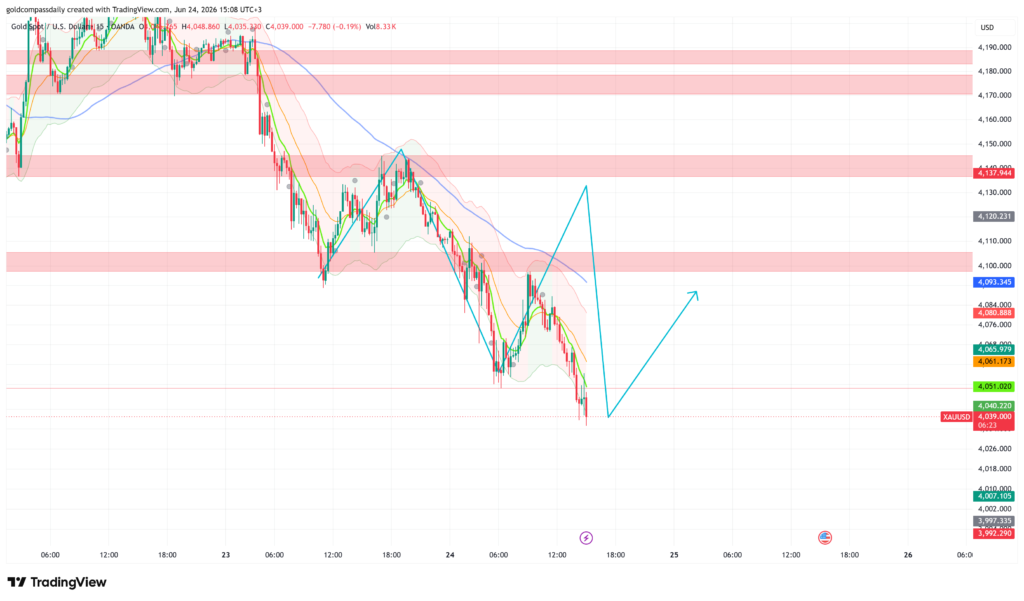
Gold has extended its decline sharply through the European and early New York session, with XAU/USD printing a session low of $4,035 and trading at $4,039 at time of writing — well below the $4,077 level referenced in the morning analysis. The morning bias toward a cautious recovery has failed to materialize; instead, price rejected the $4,107–$4,120 resistance cluster and resumed the dominant downtrend.
What Changed
The intraday bounce that briefly lifted price toward $4,111 during the early European session was fully absorbed at the $4,093–$4,107 resistance shelf, with sellers re-engaging aggressively on the approach to $4,120. The rejection confirms that resistance band as a structurally significant ceiling. Price has since broken below the $4,051 support level noted on the morning chart, establishing a new intraday low and shifting the near-term structure decisively bearish. The channel between $4,040 and $4,115 now defines the trading range for the remainder of the New York session, with the lower bound currently being tested. No U.S. data release has printed yet to alter the fundamental picture; the move is technically driven, with the 15-minute EMA stack remaining in full bearish alignment and price trading below all visible moving averages.
Updated Levels
- Current price: $4,039
- Bias now: Bearish — morning recovery thesis invalidated; price below all key intraday supports
- Updated support: $4,040 (channel floor, current test) → $4,007 (next structural level visible on chart)
- Updated resistance: $4,051 → $4,061–$4,065 → $4,093 (former support, now resistance)
- NY session target: $4,007 on a confirmed close below $4,035; $4,061 on a recovery bounce
Scenarios Into the Close
Bull: Price holds $4,035–$4,040 on a 15-minute closing basis and reclaims $4,061 → targets $4,080–$4,093 into the close, consistent with the chart’s projected V-recovery path.
Bear: Sustained close below $4,035 on elevated volume → next support at $4,007, with $3,992 as the extended downside target before Thursday’s Core PCE.
Chart Analysis
The XAU/USD 15-minute chart at 15:08 UTC+3 shows price at $4,039, having declined in a near-uninterrupted sequence from the $4,190 area visible at the left of the chart through to the current session low of $4,035. The bearish EMA stack — short-period EMAs (yellow, green) compressing and pointing sharply lower, with the 200-period SMA (blue) now descending steeply above $4,150 — confirms the dominant trend. Bollinger Bands are fully expanded to the downside with price pinned to the lower band, indicating sustained selling pressure rather than an overextended spike. The $4,137.94 resistance shelf and $4,093.35 level are both now positioned well above price and act as layered overhead supply. The chart’s projected path annotation suggests a base near current levels, a relief bounce toward $4,130–$4,140, followed by a lower high — a structure consistent with a corrective bounce within a broader downtrend rather than a trend reversal. A clean hold of $4,040 is the minimum requirement for that scenario to develop.
Analysis based on the XAU/USD 15-minute chart as of June 24, 2026, 08:47 UTC+3. This article is for informational and educational purposes only and does not constitute financial advice.