

Market Snapshot
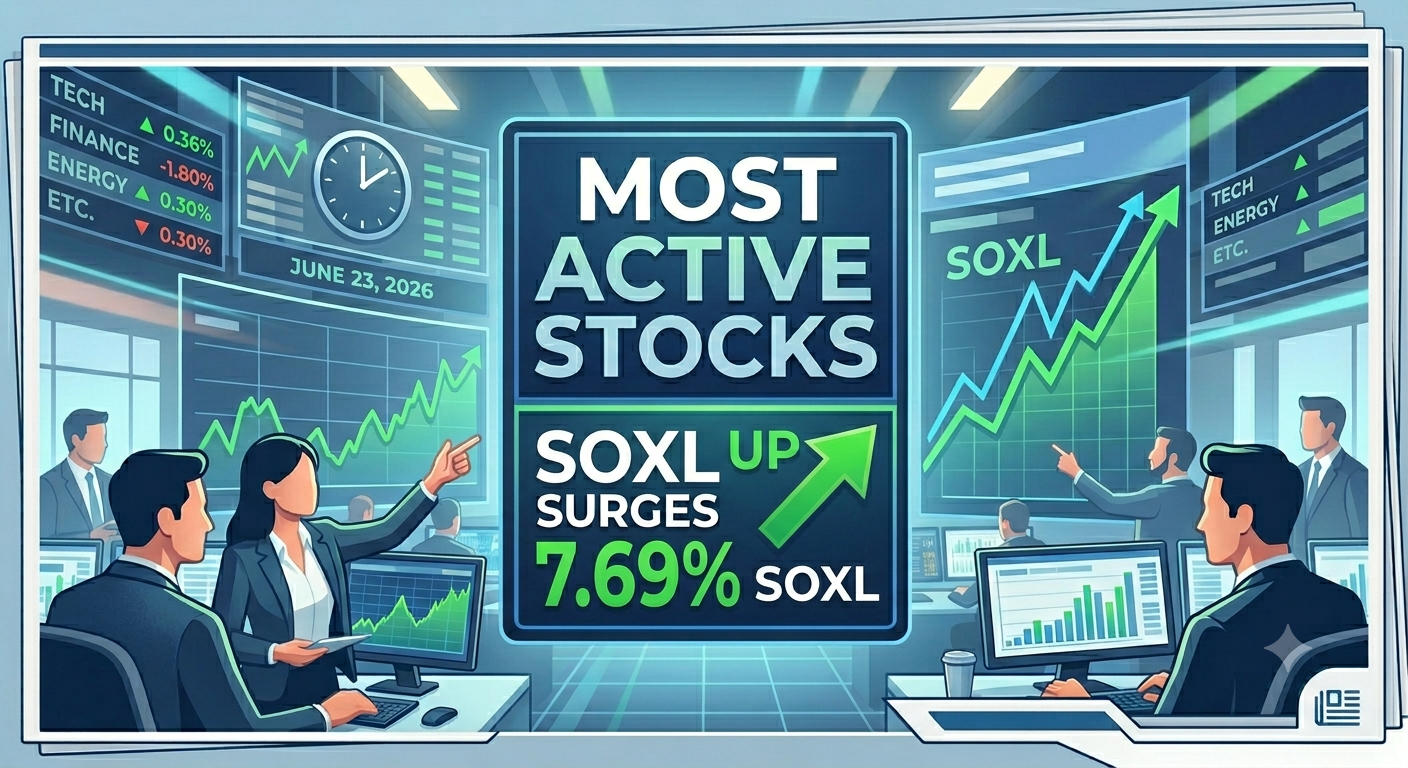
A mixed-to-cautiously-risk-on tone defined Monday’s most active stocks session, with semiconductor leveraged exposure and specialty technology leading the gainers while uranium, mining, and biotech names absorbed meaningful selling pressure. The session’s single most notable move belonged to SOXL (Direxion Daily Semiconductor Bull 3X ETF), which surged +7.69% to $300.77 — reflecting amplified momentum in the underlying Philadelphia Semiconductor Index and drawing concentrated volume from traders seeking leveraged chip exposure. The broader tape was split, with the S&P 500 ETF (SPY) slipping a modest 0.31%, suggesting the day’s outsized moves were concentrated in individual sectors rather than broad market direction.
Today’s Top Movers
- SOXL — Direxion Daily Semiconductor Bull 3X ETF: $300.77 (+7.69%) — amplified semiconductor sector strength; the specific session catalyst was not immediately specified, consistent with follow-through momentum or index-level buying in semiconductor names.
- AAOI — Applied Optoelectronics Inc: $171.23 (+5.80%) — notable single-session gain in an optical networking component name; the driver was not immediately specified, but the magnitude is consistent with news-driven or earnings-adjacent volume.
- ESI — Element Solutions Inc: $49.09 (+6.79%) — specialty chemicals and electronic materials name posting a significant one-day advance; trading volume spike without a clear single catalyst confirmed in available data.
- CAI — Caris Life Sciences Inc: $17.31 (−6.28%) — the session’s heaviest percentage decliner among most actives; the magnitude of the move is consistent with company-specific news flow, though no specific catalyst was confirmed in available data.
- UEC — Uranium Energy Corp: $11.47 (−4.50%) — continued pressure on uranium exploration names; weakness reflects either sector-level rotation out of energy transition plays or commodity price softness.
- EQX — Equinox Gold Corp: $10.25 (−2.47%) — gold mining equity underperforms alongside broader pullback in junior and mid-tier miners, consistent with gold sector pressure on the session.
Sector Read
The dominant narrative of the session was a semiconductor and technology-adjacent rally running in parallel with sustained weakness across resource and mining equities. The semiconductor theme commanded the day’s most visible gains — SOXL’s 7.69% advance and AAOI’s 5.80% move both drew high volume, while XBI (SPDR S&P Biotech ETF) added +3.75%, suggesting a coordinated appetite for growth and innovation exposure. Element Solutions (ESI, +6.79%) reinforced the read: specialty materials tied to electronic manufacturing saw buying that aligns with the semiconductor narrative even outside the ETF space.
By contrast, the mining and uranium cluster — BTG (−2.33%), DNN (−2.24%), EQX (−2.47%), UEC (−4.50%), NG (−2.83%), TGB (−2.52%) — registered broad-based declines that point to rotation away from commodity-sensitive and energy-transition names. This is not panic selling given the magnitudes involved, but the consistency across multiple unrelated mining tickers on the same session is a signal worth monitoring. Gold miners in particular faced headwinds, with three names from that cluster appearing among the day’s decliners despite gold itself maintaining elevated price levels in recent sessions. The SPY’s mild 0.31% decline and IWM’s (Russell 2000) modest +0.88% gain suggest small-cap breadth held up while large-cap indices tread water.
Notable Gainers
The session’s standout performer by percentage was FNGD (Bank of Montreal MicroSectors FANG+ Index -3X Inverse ETN) at +7.85% — an inverse leveraged product on FANG names, which signals that at least some participants were positioning against large-cap technology even as semiconductor names surged, a divergence worth noting. Alongside it, SOXL’s +7.69% represented the most visible directional conviction trade of the day, consistent with either a fresh catalyst in semiconductor earnings guidance, supply chain commentary, or simply continuation of recent momentum that has driven the underlying index. Applied Optoelectronics (AAOI) at +5.80% and Element Solutions (ESI) at +6.79% both represent single-stock moves of a magnitude that, absent confirmed catalysts, is consistent with earnings pre-announcements, analyst upgrades, or institutional positioning shifts.
Notable Decliners
Caris Life Sciences (CAI) led the downside at −6.28% to $17.31, a move notable both for its magnitude and for the name’s presence among the most active tickers — elevated volume accompanying a decline of this size is often a signal of news-driven repositioning rather than passive selling. Uranium Energy Corp (UEC) fell 4.50% to $11.47, adding to what appears to be a sector-wide reset in uranium equities: DNN (−2.24%), EQX (−2.47%), BTG (−2.33%), and NG (−2.83%) all declined in parallel, suggesting the pressure is thematic rather than name-specific. The iShares Silver Trust (SLV) slipping 1.01% to $58.91, combined with the mining equity weakness, rounds out a session where precious metals and related equities broadly underperformed the growth and technology cohort.
What to Watch
AAOI (Applied Optoelectronics) warrants close attention into Tuesday’s session: a +5.80% single-day advance in a relatively thinly covered optical networking name carries elevated follow-through risk in both directions, and confirmation or denial of the catalyst driving today’s volume could produce a sharp reversal or continuation. The mining complex — particularly uranium names DNN and UEC — also deserves monitoring given the breadth of the sector decline; if the selling extends into a second session without a corresponding move in spot uranium or gold prices, it may signal a more durable rotation rather than a one-day rebalancing event.
SPCX (Space Exploration Technologies) dominated the session by volume with 157.4 million shares traded — well above its 3-month average of 268.6 million — falling $30.58 (−16.53%) to $154.42. A decline of this magnitude on elevated volume is consistent with a major company-specific catalyst; the specific driver was not confirmed in available data at time of publication.
Alphabet (GOOGL/GOOG) was the session’s most consequential megacap decliner, with both share classes dropping approximately 5% — GOOGL falling $18.35 to $349.68 and GOOG shedding $18.68 to $348.78 on combined volume exceeding 83 million shares. The move erased a meaningful portion of Alphabet’s 52-week gain of over 109%, suggesting a sharp sentiment shift in large-cap technology on the session.
Amazon (AMZN) fell $11.60 (−4.75%) to $232.79 on 53.9 million shares, trading well above its 3-month average volume of 45.3 million. Microsoft (MSFT) declined $12.06 (−3.18%) to $367.34, a notable move given the stock trades near its 52-week low of $356.28 — a level that may attract technical attention in the sessions ahead.
NVIDIA (NVDA) shed $2.04 (−0.97%) to $208.65, a relatively contained decline compared to its megacap peers despite trading 97.5 million shares. Apple (AAPL) was similarly resilient, slipping just $1.00 (−0.34%) to $297.01 — both names outperforming the broader large-cap technology selloff on a percentage basis.
The sole gainer among the most active large caps was Taiwan Semiconductor (TSM), which added $5.55 (+1.20%) to $467.67. TSM’s resilience — and its 52-week gain of over 112% — stands in contrast to the selling across U.S.-listed technology names, and may reflect continued institutional confidence in semiconductor supply chain fundamentals independent of near-term software and platform sector headwinds.
See yesterday’s winners listNew York Session Update
Session Shift
The semiconductor and technology-led risk-on tone identified in Gold Compass Daily’s earlier snapshot has given way to a broader large-cap technology selloff in New York trading, with Alphabet, Amazon, and Microsoft all posting significant declines that were not present in the midday read. Biotech names have simultaneously surged to the top of the gainers board, marking a clear sector rotation within the session.
What Changed
SPCX (Space Exploration Technologies) — absent from the original most-active list — has emerged as the session’s most disruptive mover, appearing simultaneously as both the top loser and the second-most-active name by volume with a decline of 16.43%. This entry alone represents the single largest development since the earlier report. Separately, SMCI (Super Micro Computer) is now among the most active names with a gain of +15.66%, a move not reflected in the morning snapshot, while Nokia (NOK) and Keel Infrastructure (KEEL) have entered the most-active list as new volume entrants. On the gold mining side, AGI (Alamos Gold) and GFI (Gold Fields Limited) appearing among the top losers at −11.83% and −10.29% respectively reinforces the mining sector weakness flagged in the original report and extends it into a more acute decline.
Updated Top Movers
- DFTX — Definium Therapeutics: $36.67 (+49.80%) — the session’s largest percentage gainer; the catalyst was not confirmed in available data, though a move of this magnitude is consistent with clinical trial results or M&A activity.
- APGE — Apogee Therapeutics: $132.55 (+46.66%) — second-largest gainer; move consistent with a binary biotech event; no specific catalyst confirmed at time of update.
- SPCX — Space Exploration Technologies: $154.60 (−16.43%) — heaviest decliner by percentage and second-highest by volume; catalyst not confirmed in available data.
- SMCI — Super Micro Computer: $35.46 (+15.66%) — new entry among most active; trading volume spike without a confirmed single catalyst.
- AGI — Alamos Gold: $32.04 (−11.83%) — sharpens the gold mining sector decline flagged earlier; move extends sector-wide pressure.
- NOK — Nokia Oyj: $14.43 (+6.97%) — new most-active entrant; driver not confirmed in available data.
Into the Close
DFTX and APGE carry the highest volatility risk into the final hour given their near-50% single-session moves on what appear to be unconfirmed catalysts — late-session profit-taking in both names is a credible risk. SPCX also warrants monitoring given its volume profile relative to average, with the potential for further dislocation if no clarifying information surfaces before the close.
Data based on most active stocks by trading volume as of June 23, 2025, market close (U.S. Eastern Time). This article is for informational and educational purposes only and does not constitute financial advice.