

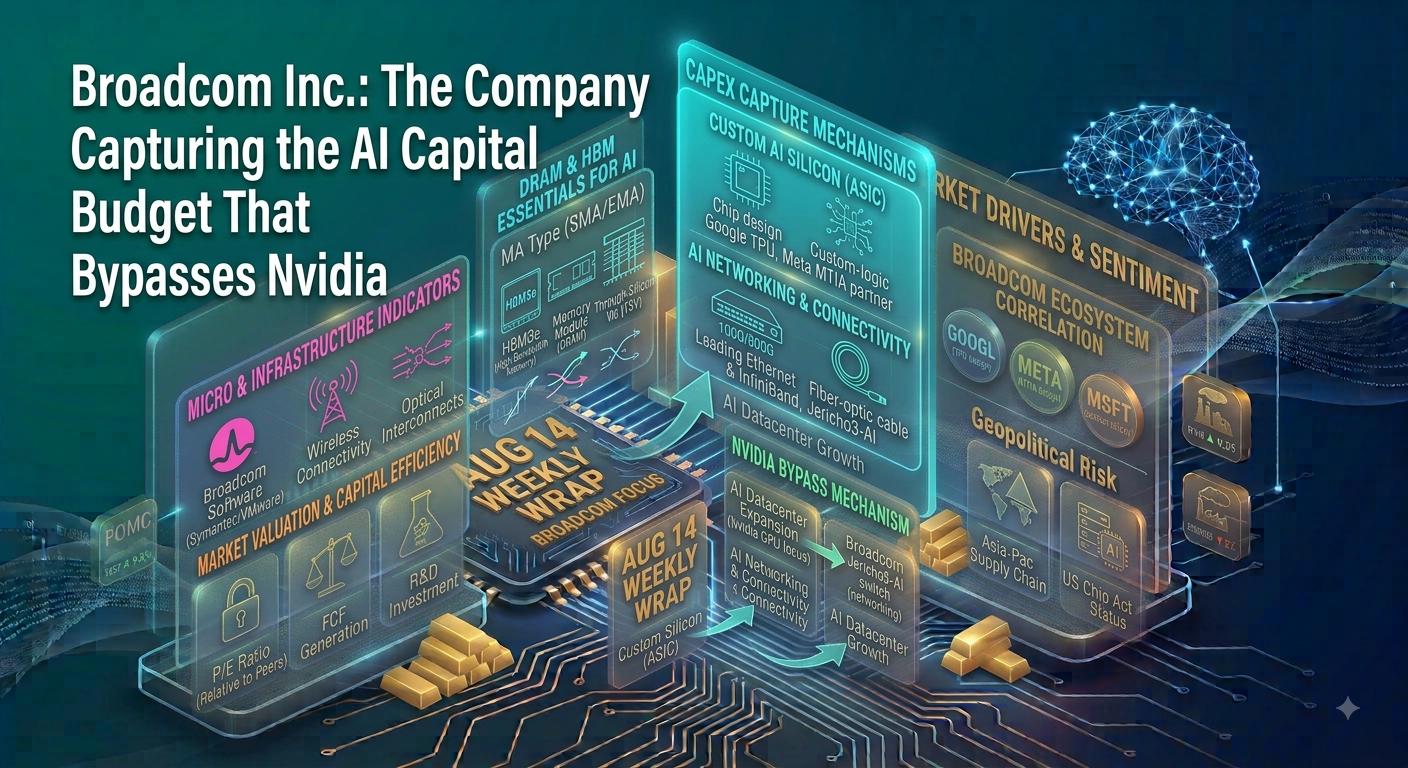
There is a narrative in technology investing that frames the AI infrastructure buildout as a binary competition between Nvidia and the rest of the world. Nvidia wins; everyone else plays catch-up. That narrative is incomplete, and understanding where it breaks down reveals one of the most compelling large-cap positions available to equity investors in August 2026. Broadcom Inc. is not competing with Nvidia. It is capturing a different layer of the same capital expenditure wave — the custom silicon and AI networking layer that hyperscalers are building specifically because they want an alternative to general-purpose GPU dependence. Every time Google, Meta, OpenAI, or Anthropic scales its AI compute infrastructure in 2026, a substantial portion of that spending routes through Broadcom hardware. The company does not need to beat Nvidia. It needs to remain the dominant architect of the infrastructure surrounding every Nvidia cluster ever built, and of the custom accelerators designed to replace those clusters at inference scale.
August 2026 is a positioning month for Broadcom investors. The fiscal third quarter, covering the period ending August 2, will be reported on September 2 — but the data points that define that quarter are already locked. Management guided Q3 revenue to $29.4 billion, an 84% year-over-year increase. AI semiconductor revenue alone was guided to $16 billion for the quarter, representing more than 200% year-over-year growth and accounting for more than half of expected total revenue. The $73 billion committed customer backlog disclosed earlier this year extends revenue visibility through fiscal 2028. For investors who understand what is inside these numbers — the customer relationships, the product roadmap, the dual-engine business model — August is a window to build or add to a position before the September 2 confirmation.
The Q2 FY2026 Foundation and What the Selloff Missed
Broadcom reported fiscal Q2 2026 results on June 3, 2026, delivering record revenue, record operating profit, and record free cash flow — and watched its stock fall 12.6% in a single session. Understanding that reaction is essential to understanding the investment opportunity available in August.
The headline numbers were unambiguously strong. Total revenue reached $22.19 billion, up 48% year-over-year, beating the LSEG consensus of $22.13 billion. AI semiconductor revenue hit $10.8 billion, up 143% year-over-year — above the company’s own forecast. Non-GAAP diluted EPS were $2.44, against an estimate of $2.40. Non-GAAP operating income was $14.93 billion, with operating margin at approximately 67.3%, up from 65.3% a year earlier. Adjusted EBITDA margin reached 69% — a record. By any conventional measure, this was an exceptional quarterly report.
The selloff had two triggers. First, total revenue came in $80 million below one sub-set of analyst estimates, a rounding-level miss on a $22 billion revenue base. Second, and more substantively, CEO Hock Tan did not raise the fiscal year 2027 AI semiconductor revenue target above the previously communicated figure of “in excess of $100 billion,” despite first-half AI revenue approaching $19 billion and Q3 guidance of $16 billion pointing to a run rate well beyond that level. A subset of the buy-side had priced in an upward revision, and when it did not materialise, they sold.
What the selloff missed: Tan disclosed on the Q2 earnings call that Q2 AI bookings exceeded $30 billion against $10.8 billion actually shipped in the quarter. A book-to-bill ratio approaching 3x does not indicate slowing demand — it indicates demand so strong that it extends delivery visibility years forward. The $73 billion committed customer backlog, the $30 billion Q2 bookings figure, and the reiterated $100 billion-plus FY2027 AI revenue target together constitute one of the most compelling forward revenue pictures in the global semiconductor industry. Since the June 3 selloff, AVGO shares recovered approximately 9% by early August, closing near $420 on August 7 — still well below the 52-week high of $495, and below a consensus analyst price target now sitting above $518.
Six Customers, $73 Billion Backlog: The Custom Silicon Franchise
The architecture of Broadcom’s AI semiconductor business is what distinguishes it from every other company in the sector. Nvidia designs general-purpose GPUs optimised for the broadest possible range of AI workloads. Broadcom designs custom chips — XPUs and ASICs — optimised for the specific workloads of individual hyperscaler customers. That distinction has compounding strategic implications.
The confirmed customer list as of the Q1 FY2026 earnings call comprises six major AI frontier labs and hyperscalers: Google, Meta, OpenAI, Anthropic, Apple, and one additional undisclosed partner. Each relationship is co-developmental — Broadcom’s engineering teams work alongside the customer’s AI infrastructure group to design a chip architecture that maximises performance per watt for that customer’s specific model types and deployment patterns. Google’s TPU v7 Ironwood, the most mature custom AI chip programme in the industry, entered production volume in 2026 under a supply agreement that extends through 2031 and represents the seventh successive generation of co-designed silicon between the two companies. Meta signed a three-gigawatt MTIA XPU supply commitment through 2028. Anthropic is scaling its TPU compute from roughly one gigawatt in 2026 to more than three gigawatts in 2027. OpenAI’s first-generation Broadcom-designed inference chip is targeting 2027 deployment at more than one gigawatt capacity, inside a ten-gigawatt by 2029 framework agreement.
The commercial logic of this model is powerful. Custom XPUs offer 30–50% lower total cost of ownership than general-purpose GPUs for specific, high-volume inference workloads. At the scale of billions of daily AI tokens — which Meta, Google, and OpenAI are each operating at — that cost advantage compounds into billions of dollars annually. The switching cost is also meaningful in the opposite direction: once a customer co-develops a chip generation with Broadcom, the engineering integration, software tooling, and manufacturing qualification process creates a multi-year relationship by construction. Broadcom estimates it now controls approximately 70% or more of the custom AI accelerator design services market, up from the 60–80% Bloomberg Intelligence estimate earlier in 2026.
The networking dimension of Broadcom’s AI position receives less attention than its custom chip business but is equally strategic. The company’s Tomahawk 6 switch ASIC entered volume production in March 2026 as the industry’s first 102.4 terabit-per-second Ethernet part — the highest-bandwidth switching product commercially available. Its companion Jericho 4 fabric chip interconnects over one million XPUs across data centres. By championing the Ethernet for Scale-Up Networking standard, Broadcom is providing an open-standard alternative to Nvidia’s proprietary NVLink interconnect, enabling hyperscalers to build scale-up AI fabrics using commodity Ethernet protocol. Every cluster — whether built around Nvidia GPUs or Broadcom XPUs — requires Broadcom networking to connect at scale. Nvidia’s competing Spectrum-X1600 switch is not expected in volume until the second half of 2026, leaving Broadcom with a 12-plus month lead in the highest-bandwidth switching tier.
The VMware Engine: Funding the AI Roadmap
Broadcom’s identity as a pure AI semiconductor company is a market simplification. The company operates two segments with fundamentally different margin profiles, and the interplay between them is central to the investment thesis.
The Infrastructure Software segment — built around VMware, which Broadcom acquired in 2023 for approximately $69 billion — generated $7.18 billion in Q2 revenue, up 9% year-over-year. The segment’s operating margin was approximately 79%, with gross margin at 93%. Despite accounting for roughly 32% of Q2 total revenue, the infrastructure software business generates a disproportionate share of Broadcom’s cash flow and operates at margin levels more comparable to enterprise SaaS companies than semiconductor manufacturers. The VMware Cloud Foundation platform, now in version 9.1, supports production AI inferencing across heterogeneous GPU and CPU compute architectures, and Standard Chartered has disclosed that it now powers approximately 70% of the bank’s global infrastructure — a validation of enterprise penetration that extends well beyond the AI narrative.
The significance of the infrastructure software segment for AVGO investors is what it enables on the semiconductor side. The 93% gross margin software business generates predictable, high-margin cash flow that funds Broadcom’s capital-intensive XPU roadmap without requiring external financing or balance sheet leverage at the rate that a pure semiconductor company would need. That dual-engine model — predictable software cash flow plus high-growth AI silicon — is the structural reason why Broadcom’s adjusted EBITDA margin of 68–69% substantially exceeds what a comparable pure-play semiconductor company would deliver. The Q2 VMware revenue miss of approximately $140 million versus StreetAccount consensus was the secondary trigger for the June 3 selloff, and it bears watching in the Q3 report on September 2. A resumption of double-digit software revenue growth would remove one of the two market concerns that drove the post-Q2 de-rating.
The Chips-Only Pivot and Its Strategic Implications
One of the less-discussed disclosures from the Q2 earnings call was CEO Hock Tan’s announcement that Broadcom would offer “chips only” — rather than the complete integrated AI systems it had previously indicated it would provide to customers. This represents a deliberate narrowing of Broadcom’s competitive scope, and it is the correct strategic choice. Integrated AI systems — full rack-scale deployments including power, cooling, networking, and compute — would put Broadcom in direct competition with its own customers’ preferred hyperscale design teams. The chips-only model keeps Broadcom as a partner and supplier rather than a competitor, preserving the collaborative design relationships that underpin every XPU engagement.
The commercial implication is also significant. Chips-only margins are structurally higher than integrated systems margins, because the value-add is concentrated in the silicon design intellectual property rather than in hardware assembly and integration logistics. The Q3 gross margin guidance of approximately 74% — down from 77.1% in Q2 — reflects the increasing share of AI chips in the revenue mix (AI silicon carries lower gross margins than networking or non-AI chips), not a deterioration in pricing power or design economics. Non-GAAP operating margin is guided to remain stable at 67%, confirming that operating leverage is holding even as the revenue mix shifts.
The September 2 Earnings Setup
Broadcom reports fiscal Q3 2026 results on September 2, 2026, after the market close. The quarter covers the period ending August 2, meaning all commercial activity is already captured. Consensus estimates project revenue of approximately $29.4 billion and non-GAAP EPS near $3.24 — roughly double the $1.69 EPS reported in the same quarter last year. AI semiconductor revenue is guided to reach $16 billion, representing the single largest quarterly AI semiconductor revenue figure in Broadcom’s history and more than 200% year-over-year growth.
The key questions for the September 2 call are: whether Hock Tan raises the fiscal year 2027 AI revenue target above $100 billion, which would be the primary catalyst for a re-rating; whether Q3 AI bookings continue to exceed shipped volume at a ratio that signals continued backlog expansion into 2027 and 2028; and whether the VMware infrastructure software segment returns to double-digit revenue growth following the Q2 deceleration. A positive answer on any two of those three would likely drive a meaningful single-session gain; a positive answer on all three would represent the catalyst the bull case requires. Conversely, a repeat of the Q2 pattern — strong results, maintained guidance rather than raised guidance, software deceleration — would likely produce another post-earnings pullback, creating what multiple analysts have described as an accumulation opportunity for investors with a twelve-month or longer time horizon.
Analyst Consensus and Valuation
As of early August 2026, AVGO trades near $420, against a 52-week high of $495 and a consensus analyst price target above $518. The Moomoo consensus of 23 authoritative analysts assigns a Strong Buy rating, consistent with the broader universe. Approximately 88–92% of covering analysts rate the stock Buy or Strong Buy. The stock trades at approximately 23–24 times forward non-GAAP earnings, a multiple that, measured against expected EPS growth of 70% in fiscal 2026 and continued high-double-digit growth in fiscal 2027, implies a PEG ratio well below 0.5.
The bull case is anchored in the FY2027 AI revenue trajectory. Full-year FY2026 AI semiconductor revenue is expected at approximately $56 billion, up 180% from FY2025. The reiterated FY2027 target of more than $100 billion in AI revenue — backed by a $73 billion committed backlog and multi-year supply agreements with customers scaling their compute by 3x or more in 2027 — implies an incremental $44 billion in AI semiconductor revenue between fiscal years. For a company with operating margins at 67% and a software segment generating 93% gross margins, that incremental AI revenue flows through to earnings at an exceptional rate.
The institutional ownership picture reinforces the consensus. Broadcom is widely held by Vanguard, BlackRock, and State Street as a core technology holding, and is used by many hedge funds as a paired position with Nvidia to capture the full AI infrastructure stack — Nvidia for GPU compute, Broadcom for custom silicon and networking. That pairing reflects the market’s understanding that the two companies are complements, not competitors, in the AI capex cycle.
Key Metrics Summary
- Current stock price (early August 2026): approximately $420
- 52-week high: $495
- Market capitalisation: approximately $1.96 trillion
- Q2 FY2026 total revenue: $22.19 billion (+48% YoY)
- Q2 FY2026 AI semiconductor revenue: $10.8 billion (+143% YoY)
- Q2 FY2026 non-GAAP EPS: $2.44 (vs. $2.40 estimate)
- Q3 FY2026 revenue guidance: $29.4 billion (+84% YoY)
- Q3 FY2026 AI semiconductor revenue guidance: $16 billion (+200%+ YoY)
- Q2 AI bookings: exceeding $30 billion (vs. $10.8 billion shipped)
- FY2026 AI semiconductor revenue guidance: $56 billion (+180% YoY)
- FY2027 AI semiconductor revenue target: in excess of $100 billion
- Committed customer backlog: $73 billion
- Non-GAAP operating margin (Q2): 67.3%
- Infrastructure software gross margin: 93%
- Custom AI accelerator market share: approximately 70%+
- Analyst consensus: Strong Buy; average price target $518+
- Next earnings date: September 2, 2026, after market close
Risks to the Investment Thesis
Customer concentration is the structural risk that no amount of revenue growth eliminates. Google alone is estimated to account for a large share of Broadcom’s AI semiconductor revenue. A change in Google’s TPU procurement strategy — whether driven by a shift to in-house design capabilities, a decision to consolidate on Nvidia GPUs for certain workloads, or a reduction in total AI infrastructure spending — would have an outsized impact on Broadcom’s AI revenue line. The six-customer disclosure from Q1 reduces but does not eliminate this concentration risk; the OpenAI and Anthropic engagements are in earlier ramp stages and do not yet contribute revenue at the scale of the Google TPU programme.
Gross margin compression from product mix is an ongoing watch item. The Q3 guidance of 74% consolidated gross margin — down from 77.1% in Q2 — reflects the higher share of AI chips, which carry lower margins than networking or software. If AI chip revenue continues to grow as a percentage of total revenue, consolidated gross margins will compress further even as operating margins hold. The VMware software segment, with its 93% gross margin, is the counterweight; any deterioration in software revenue growth rate removes that margin buffer.
The post-earnings volatility pattern is the near-term tactical risk. The 12.6% single-session drop following Q2 results — on a quarter that beat both revenue and EPS estimates — demonstrated that AVGO’s elevated valuation creates an asymmetric expectations problem: strong results that merely meet guidance produce limited upside, while any miss or failure to raise guidance can produce sharp drawdowns. Investors entering ahead of the September 2 report should size positions to tolerate that volatility while maintaining conviction in the twelve-month thesis.
Debt load, while manageable, bears noting. The VMware acquisition added approximately $66 billion in debt to Broadcom’s balance sheet. The company’s free cash flow generation — approximately $26.9 billion in fiscal 2025 — comfortably services that debt, but it constrains financial flexibility in a scenario where AI revenue growth decelerates and software cash flow compresses simultaneously.
Conclusion
Broadcom enters August 2026 as the company that captures the AI capital expenditure the market attributes entirely to Nvidia. With six confirmed hyperscaler and AI lab customers, a $73 billion committed backlog, a Q3 AI revenue guided to $16 billion, a fiscal 2027 target of more than $100 billion in AI semiconductor revenue, and a dual-engine business model that combines 93% gross margin software cash flow with the fastest-growing custom silicon business in the sector, Broadcom is structurally positioned at the centre of the AI infrastructure buildout rather than its periphery. At approximately $420, trading 15% below its 52-week high, with the September 2 earnings report as the next defined catalyst, AVGO represents one of the most clearly constructed large-cap AI infrastructure positions available to investors this month.
This article is for informational purposes only and does not constitute investment advice. All investors should conduct their own due diligence and consider their individual risk tolerance before making any investment decisions. Past performance is not indicative of future results.