

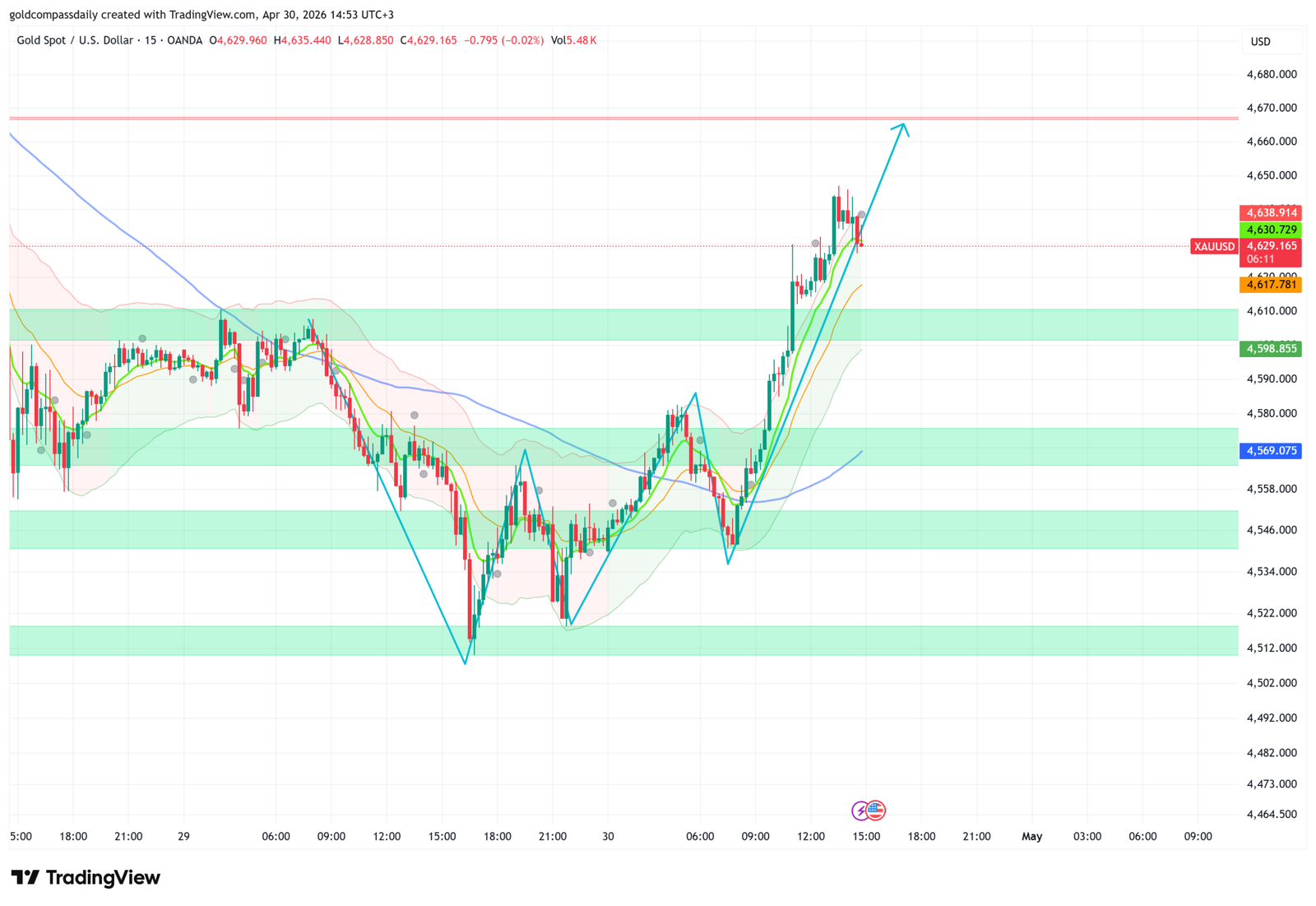
Gold is closing April on the offensive. After finding support at $4,512 following Wednesday’s pre-FOMC positioning selloff, XAU/USD reversed sharply — rallying to the current level of $4,629 as the Federal Reserve delivered the balanced hold markets needed to stabilise sentiment. The 15-minute chart projects a continuation toward $4,670+, with today’s unprecedented concentration of tier-one data and central bank decisions providing both the risk and the opportunity to close the month at its highs. This is one of the most data-intensive sessions of the year: Eurozone CPI Flash, three separate BOE decisions, the ECB rate announcement, US Advance GDP, Core PCE, Unemployment Claims, and the Employment Cost Index all land between noon and 3:45pm.
The Chart: Support Found, Rally Resuming
Wednesday’s price action told a clear story. The selloff from $4,720 to $4,512 was pre-FOMC positioning — not a structural breakdown. The moment the Fed delivered a balanced statement acknowledging both inflation and growth risks, buyers returned immediately. The $80+ reversal from $4,512 to the current $4,629 in a matter of hours confirms that the structural demand for gold remains intact at lower levels.
The 15-minute chart shows price breaking above the green demand zone at $4,598.855–$4,610 with conviction. Moving averages have crossed upward, the Bollinger Bands are expanding higher, and the structure has shifted from bearish (lower highs, lower lows) to bullish (higher lows, higher highs) in a single session. The projected path targets $4,670+ — the lower boundary of the pink resistance band — as the immediate objective, with the April high near $4,860–$4,900 as the broader target if today’s data confirms the macro support for gold.
The floor is $4,598.855. A close below that level would indicate the FOMC-driven bounce is fading. Above $4,638.914, the rally has clear momentum.
Already Published: European Morning Delivers Mixed Results
Japan’s Consumer Confidence at 32.2 (forecast 32.8, prior 33.3) — a miss, deteriorating further. Japanese consumers are becoming more pessimistic for the third consecutive month — consistent with last week’s Economy Watchers Sentiment collapse and the broader picture of global consumer confidence deteriorating under tariff uncertainty. Housing Starts y/y at -29.3% (forecast -28.7%, prior -4.9%) — a dramatic acceleration in Japanese housing construction declines. These are concerning domestic demand signals that keep pressure on the BOJ to pause its normalisation.
French Flash GDP q/q printed at 0.0% (forecast 0.2%, prior 0.2%) — France’s economy stagnated in Q1, missing the modest growth forecast. Zero growth is the weakest French quarterly reading in several quarters. French Consumer Spending m/m at 0.7% — exactly in line with the 0.7% forecast, recovering from the prior -1.4%. A French consumer rebound that arrives alongside GDP stagnation suggests spending is being concentrated in ways that aren’t feeding through to broader economic activity.
German Import Prices m/m at 3.6% — in line with the forecast of 3.6% and significantly above the prior 0.3%. German import prices jumping 3.6% in a single month is the most direct evidence yet of Liberation Day tariff pass-through: goods entering Germany are getting dramatically more expensive. This is the inflation signal that complicates the ECB’s dovish stance. German Retail Sales m/m at -2.0% — worse than the forecast of -0.3% and continuing the prior -0.3% trend. German consumers are not spending despite strong wage growth — a stagflation signal consistent with the broader European picture.
French Prelim CPI m/m at 1.0% (forecast 0.9%, prior 1.0%) — a slight beat on French monthly inflation. Combined with German import prices at 3.6%, the European inflation picture is clearly being influenced by tariff pass-through even as domestic demand remains weak.
KOF Economic Barometer at 97.9 (forecast 95.8, prior 95.6) — a meaningful beat. Swiss leading indicator improving to 97.9 suggests the Swiss economy’s near-term outlook is improving modestly — CHF mildly supportive.
Spanish Flash GDP q/q at 0.6% (forecast 0.5%, prior 0.8%) — a beat, Spain growing 0.6% in Q1 against a 0.5% forecast. Spain continues to be the Eurozone’s growth outperformer — driven by tourism, services exports, and a relatively domestically-driven economy less exposed to the manufacturing tariff shock.
German Unemployment Change at 20K — dramatically worse than the forecast of 4K and the prior 3K. Twenty thousand additional Germans registered as unemployed in April — the largest single-month deterioration in German unemployment in over a year. This is a significant data point: it confirms that the German economy is not just facing weak demand but is now showing labour market stress. For the ECB, rising German unemployment alongside tariff-driven import inflation creates the exact stagflation dilemma the market has been anticipating.
German Prelim GDP q/q at 0.3% (forecast 0.1%, prior 0.3%) — a beat. Germany grew 0.3% in Q1 against a 0.1% forecast — better than expected despite all the negative sentiment data. The GDP beat alongside rising unemployment and weak retail sales suggests the Q1 data precedes the Liberation Day impact — Q2 will be the first quarter fully exposed to the tariff environment.
Italian Prelim GDP q/q at 0.2% (forecast 0.1%, prior 0.3%) — a beat. Italy also outperformed the forecast. Two consecutive Eurozone GDP beats (Spain 0.6%, Germany 0.3%, Italy 0.2%) paint a surprisingly resilient Q1 picture for the bloc — before Liberation Day.
12:00pm — Eurozone CPI Flash: The Inflation Verdict
The Eurozone CPI Flash Estimate y/y at 3.0% — a significant jump from the prior 2.6% and the prior confirmed reading of 1.9%. Core CPI Flash Estimate y/y at 2.2% (prior 2.3%) — a slight deceleration in core. The headline CPI jumping to 3.0% while core eases to 2.2% is a classic tariff inflation signature: import-driven price increases (captured in headline) while underlying domestic demand inflation (captured in core) remains contained.
This is the most complex CPI signal the ECB has faced in this cycle. Headline above target (3.0% vs 2.0% target) driven by tariff-imported inflation — raising rates to fight it would be counterproductive (it’s a supply shock, not demand-driven). Core below prior (2.2% vs 2.3%) and approaching target — suggesting domestic demand is not inflationary. The ECB’s decision at 3:15pm will be made with this data in hand.
EUR/USD impact: Headline CPI at 3.0% is technically EUR-positive (higher inflation = less room to cut). But core easing to 2.2% gives the ECB cover to cut regardless. The net EUR reaction depends on which number the market weights — initially likely EUR-positive on the headline beat, then fading as core signals the ECB will cut anyway.
The Eurozone Unemployment Rate at 6.2% (prior 6.3%) — a slight improvement. The Eurozone labour market is still tightening despite the growth slowdown — adding to the ECB’s dilemma of cutting rates into a still-tight labour market with above-target headline inflation.
2:00pm — Bank of England Triple Decision
The BOE delivers its full May decision package at 2:00pm: Official Bank Rate held at 3.75% (forecast 3.75%, prior 3.75%), MPC vote split at 1-0-8 (forecast 1-0-8, prior 0-0-9). The vote split is the key signal: one member now voting for a cut (versus zero last meeting) while eight hold. This is a marginally more dovish composition — the first dissenting vote for a cut signals that the committee is beginning to move toward easing. The BOE Monetary Policy Report and Inflation Letter provide the detailed forward guidance.
BOE Governor Bailey speaks at 2:30pm — his post-decision press conference will be the most important BOE communication since the March meeting. Given the UK’s exposure to Liberation Day tariffs (manufacturing, financial services, and trade flows all affected), Bailey’s framing of the growth-inflation tradeoff will define the May rate cut probability. A dovish Bailey emphasising growth risks would accelerate May cut pricing and weaken GBP. A hawkish Bailey citing the tariff inflation pass-through would delay cut expectations and support sterling.
3:15pm — ECB Rate Decision: Cut or Hold?
The ECB Main Refinancing Rate is expected to hold at 2.15% (prior 2.15%). However, given today’s data — German unemployment surge, weak retail sales, GDP beats that predate Liberation Day, and a headline CPI flash that is tariff-driven rather than demand-driven — the ECB faces intense pressure to signal its next move clearly. The ECB Press Conference at 3:45pm with Lagarde is the critical output.
A hold with a dovish Lagarde (signalling June cut is coming, citing growth concerns and tariff uncertainty) is the base case. The EUR would initially weaken on dovish guidance but find support from the headline CPI beat. A surprise cut today would be EUR-negative and gold-positive. A hawkish hold (citing 3.0% headline CPI as a reason for caution) would be EUR-positive and gold-negative in the short term.
3:30pm — US Data Barrage: The Most Important 15 Minutes of the Month
The 3:30pm US data release is the most concentrated single-moment economic release of the quarter. Five major indicators arrive simultaneously:
Advance GDP q/q forecast at 2.2% (prior 0.5%). The prior Q4 reading of 0.5% was a significant slowdown — a recovery to 2.2% would signal that Q1 was stronger than feared, reducing immediate recession concerns. A miss below 1.5% would confirm that the US economy was already slowing before Liberation Day’s tariff shock, making the Fed’s hawkish stance even more problematic. This is the single most market-moving US data point of the day.
Core PCE Price Index m/m forecast at 0.3% (prior 0.4%) — the Fed’s preferred inflation measure. A reading in line with 0.3% signals inflation is gradually decelerating toward target. A miss above 0.4% would reignite Fed hawkishness concerns and could partially reverse last night’s balanced FOMC-driven gold rally. A surprise below 0.2% would be the most dovish signal available — dollar-negative, gold-positive.
Employment Cost Index q/q forecast at 0.8% (prior 0.7%) — a slight acceleration in US labour costs. The ECI is one of the Fed’s most watched inflation indicators because it captures the wage-price spiral risk. A reading above 0.9% would alarm the Fed and could override the balanced FOMC tone from last night. A reading below 0.7% would confirm that wage pressures are easing — strongly gold-positive.
Unemployment Claims forecast at 213K (prior 214K) — essentially unchanged, confirming labour market resilience. A reading above 225K would be the first meaningful signal of post-Liberation Day layoffs — the most significant labour market deterioration signal available before next week’s NFP.
Advance GDP Price Index q/q forecast at 3.8% (prior 3.7%) — a slight acceleration in the GDP deflator. This confirms that economic growth is increasingly nominal rather than real — a stagflation signal that supports gold’s inflation hedge narrative.
The combined read: GDP above 2.2% + Core PCE below 0.3% + ECI below 0.8% = the goldilocks scenario that would send gold through $4,670 resistance and target $4,720. GDP below 1.5% + Core PCE above 0.4% + ECI above 0.9% = stagflation signal = complex but ultimately gold-positive over 24–48 hours after initial dollar volatility.
Key Levels and Full Market Summary
- Gold (XAU/USD): $4,629 · Floor $4,598 · Resistance $4,638 → $4,670 · Target $4,670+ · Key: US GDP + Core PCE + ECI at 3:30pm · ECB Lagarde 3:45pm
- EUR/USD: CPI Flash 3.0% headline positive but ECB cut expected anyway · ECB decision 3:15pm + Lagarde 3:45pm = primary EUR driver · US GDP 3:30pm = afternoon direction
- GBP/USD: BOE hold at 2:00pm with first dovish dissent · Bailey 2:30pm = primary GBP catalyst · First cut vote = GBP under modest pressure · ECB and US data drive the close
- USD/JPY: Japan consumer confidence + housing starts miss = yen growth support · US Advance GDP at 3:30pm is the primary driver · Strong GDP = pair higher · Weak GDP = sharp decline
- AUD/USD: Follows risk sentiment · China data from last night (GDP beat) still supportive · US GDP and Core PCE drive the afternoon
- S&P 500 / Nasdaq: FOMC balanced hold positive · US GDP beat = equity rally · Stagflation signal (weak GDP + hot PCE) = mixed · ECI above 0.9% = tech headwind
- DAX: German GDP beat (0.3%) + unemployment surge = mixed · ECB decision is the key European input · Liberation Day impact will dominate Q2 data
- US Treasuries: Core PCE + ECI are the yield drivers · Below forecast = yields fall = gold rallies · Above forecast = yields spike = gold under pressure
- Gold month-end close: Above $4,638 = bullish April close · Target $4,670 into month-end · Below $4,598 = momentum fades · April narrative: $5,200 → $4,100 → $4,638 — the recovery is real
April has been the most volatile month for gold since the post-COVID recovery. The metal fell over $1,100, recovered $500, fell again, and is now closing near $4,629 — down from the March highs but with the structural bull case intact and the recovery momentum clearly established. Today’s data will determine whether April closes on a high note above $4,670 or consolidates for one more session before May’s next directional move. The 3:30pm US data window and Lagarde’s ECB press conference at 3:45pm are the last two decision points of the month.
Analysis based on the XAU/USD 15-minute chart as of April 30, 2026, 14:53 UTC+3. Economic data sourced from the daily macro calendar. This article is for informational and educational purposes only and does not constitute financial advice.