

There are books about trading, and then there is Market Wizards. Published in 1989, Jack Schwager’s first interview collection did something the trading literature had never done before: it went directly to the source. Instead of theorising about what makes a great trader, Schwager sat down with the people who had actually done it — traders who turned modest starting capital into tens or hundreds of millions of dollars — and asked them, in their own words, how they did it. The result is the most quoted, most referenced, and most re-read book in professional trading. Decades after publication, the lessons inside remain the closest thing the profession has to a consensus curriculum.
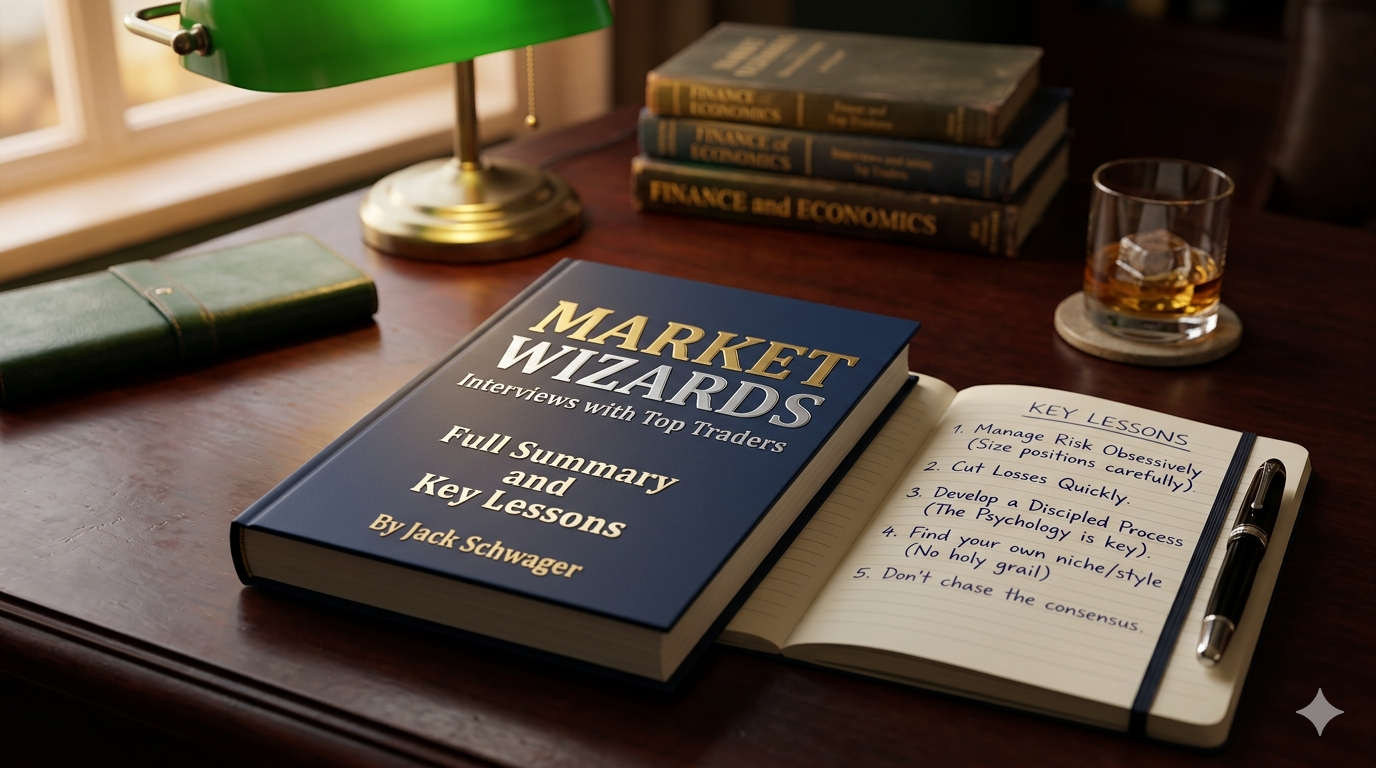
This article is part of our series on the 10 trading books every serious trader must read. Each volume in the list receives its own full summary. Market Wizards is where the series begins — because it is where most professional traders’ education begins.
What the Book Is and How It Is Structured
Market Wizards is a collection of seventeen interviews conducted by Schwager between 1988 and 1989. The subjects span futures trading, currencies, equities, and global macro. Some names are immediately recognisable even to people outside finance — Paul Tudor Jones, for instance, was already becoming a legend when the book was written. Others, like Ed Seykota and Michael Marcus, are less famous outside trading circles despite performance records that rank among the most extraordinary in financial history.
Each chapter is a standalone interview, structured as a conversation rather than a biography. Schwager asks pointed questions — about specific trades, about losing periods, about methodology, about psychology — and the traders answer in their own voice. The book does not impose a unified theory. It lets the contradictions stand. Some of the traders are technical analysts who never look at fundamentals. Others are fundamentally driven and dismiss chart reading entirely. Some hold positions for weeks; others are in and out within days. The diversity is not a flaw in the book’s design — it is the point. Edge takes many forms. What makes a great trader is not the specific tool but the discipline and consistency with which it is applied.
Michael Marcus: The Trader Who Started It All
Schwager opens the book with Michael Marcus — and the choice is deliberate. Marcus is not the most famous name in the collection, but his story is perhaps the most instructive for aspiring traders because it begins in failure. Before developing into one of the greatest futures traders of his generation, Marcus lost money repeatedly — in stocks, in commodities, chasing tips and acting on hunches rather than a coherent methodology. His early losses were not just financial; they were psychological, stripping away the illusions that most beginning traders carry into the market.
The turning point came when Marcus began working under Ed Seykota at Commodore Corporation and started learning to treat trading as a systematic discipline rather than an exercise in prediction. Under Seykota’s influence, Marcus developed his own trend-following methodology and the risk management principles that would eventually allow him to compound a $30,000 account into $80 million over the course of his career. That figure — $30,000 into $80 million — is cited repeatedly in trading literature, but Schwager presses Marcus on the specifics: how were position sizes determined? How were losing trades handled? What was the process when a major trend was missed?
The answers reveal several principles that recur throughout the book. Marcus never risked more than 5% of his equity on any single trade. He defined his exit point before entering a position. He was willing to sit in a losing trade through normal volatility but had a clear line — not a vague concept, but a specific price — at which he would exit regardless of his conviction about the fundamental outlook. And crucially, he learned to distinguish between being wrong about the market and being wrong about the trade. A trade can fail even when the underlying thesis is correct. A trader who cannot make that distinction will eventually blow up.
Ed Seykota: The Original Systems Trader
Ed Seykota may be the most philosophically interesting figure in the entire Wizards series. He was among the first traders to develop computerised trading systems in the early 1970s — before personal computers existed, he was writing programs on institutional mainframes to execute mechanical trend-following strategies. His performance over the following decade was extraordinary: the accounts he managed from 1972 to 1988 produced returns of 250,000% in some cases — numbers that, if applied to institutional capital, would represent one of the greatest investment track records in history.
But Schwager’s interview with Seykota is less about the numbers than about the philosophy. Seykota is the closest thing the book has to a sage — his answers to Schwager’s questions are often oblique, occasionally aphoristic, and consistently provocative. When asked what the most important qualities for a trader are, Seykota responds: “The elements of good trading are (1) cutting losses, (2) cutting losses, and (3) cutting losses.” The repetition is not a joke. It is the foundation of everything else he believes about markets.
Seykota also introduces what becomes one of the book’s most debated ideas: that every trader gets what they want from the market. Not what they consciously desire — enormous profits and a comfortable life — but what their unconscious psychology actually seeks. A trader who repeatedly violates their own rules and takes on excessive risk may, at some level, be seeking the excitement of the loss rather than the reward of the gain. This concept of trading as unconscious self-expression is uncomfortable for most readers the first time they encounter it. It becomes more credible with each year of market experience.
Bruce Kovner: The Global Macro Architect
Kovner’s chapter is perhaps the most immediately practical in the book for traders who deal with macroeconomic themes. He began trading with $3,000 borrowed against a credit card — a start that would be catastrophic for most people — and eventually built Caxton Associates into one of the world’s largest and most successful macro hedge funds. His methodology combined fundamental analysis of global economic conditions with technical analysis of price behaviour to construct positions across currencies, interest rates, and commodities simultaneously.
The most instructive part of Kovner’s interview concerns his approach to position sizing. He describes a specific framework for determining how large a position should be based not on how confident he is about the outcome but on the relationship between the expected gain and the expected loss. A trade where the potential reward is five times the potential loss and where the probability of success is only 40% is still a mathematically sound trade. Kovner’s ability to think in those terms — and to execute without being paralysed by the uncertainty — is presented as central to his success.
Kovner also discusses the importance of what he calls “scenario analysis” — before entering any major position, he explicitly maps out multiple possible outcomes and considers his response to each. This is not pessimism or second-guessing; it is preparation. When the market moves against him in a way he has already anticipated, his response is pre-planned and executed without the emotional interference that destroys most traders in adverse conditions.
Paul Tudor Jones: The Contrarian Momentum Trader
Jones’s chapter contains what may be the single most quoted line in the entire book. When Schwager asks him about his approach to risk, Jones responds: “Don’t focus on making money; focus on protecting what you have.” For a trader who had produced extraordinary returns — his Tudor Investment Corporation returned over 100% in each of its first five years — the emphasis on capital preservation over profit maximisation is striking. It reflects a philosophy that distinguishes the truly great traders from those who simply had a good run: the goal is never to win the most but to survive long enough to win consistently.
Jones is also one of the most technically oriented traders in the book. He uses Elliott Wave analysis extensively — a methodology that many quantitative traders dismiss as subjective — but his use of it is disciplined and systematic. He never allows his Elliott Wave analysis to override his price-based risk management rules. If the pattern says one thing and price says another, price wins. This hierarchy — price above all other signals — is another thread that runs through every successful trader in the collection.
The Jones interview also contains an important cautionary note. He discusses the 1987 stock market crash — a period when he made extraordinary profits by anticipating the crash through historical pattern analysis — and explicitly warns against using that specific episode as a template. The lesson is not the specific trade but the process: identify the conditions, develop the thesis, size appropriately, and be prepared for the position to be wrong.
Marty Schwartz: The Pit Bull
Schwartz’s story is one of the book’s most dramatic transformations. For nine years as a securities analyst on Wall Street, he was consistently losing money trading on the side — spending his own income on market losses while writing research about companies he was simultaneously misreading in his personal account. The turning point was not a new strategy or a mentor but a decision: he would stop trying to be right and start trying to manage risk. Within a few years of that shift, Schwartz became one of the most successful futures traders in the US, winning the US Investing Championships multiple times with returns that exceeded 700% in a single year.
His methodology is short-term technical trading — holding positions from minutes to days, using moving averages and price patterns to define entry and exit points. But what distinguishes Schwartz from other short-term traders is his absolute refusal to let a losing day become a losing week. He describes a specific rule: if his losses on any given day reach a predetermined threshold, he stops trading for the rest of the day. No exceptions. No “one more trade to get back to even.” The market will be there tomorrow; the capital must be protected today. This rule — which sounds simple and is extraordinarily difficult to follow in practice — is the key to his consistency.
The Consistent Themes Across All Interviews
Reading Market Wizards as a complete work rather than a collection of individual profiles reveals patterns that Schwager identifies in his final chapter — themes so consistent across seventeen very different traders that they begin to feel like laws rather than suggestions.
Every trader in the book has a clearly defined methodology that they can articulate precisely. None of them are guessing or going on feel. Some of their systems are more complex than others, but all of them know exactly what conditions must be present for them to enter a trade, what conditions would cause them to exit, and what the maximum loss on any position will be before they enter.
Every trader in the book treats capital preservation as their primary objective. The goal is never to maximise return — it is to stay in the game long enough for the edge to compound over time. Marcus, Seykota, Kovner, Jones, Schwartz — all of them discuss the trades where they lost money far more readily than the ones where they made it. The losers are instructive. The winners are just evidence that the methodology works.
Every trader in the book has experienced a catastrophic loss at some point in their career. Not a modest drawdown — a genuine disaster that wiped out a substantial portion of their equity or, in some cases, everything they had. And every one of them describes that loss as the most important educational experience of their trading life. The lesson was not specific to the trade that caused the loss. The lesson was about the psychology that allowed the loss to happen — the refusal to exit a losing position, the doubling down on a bad thesis, the certainty that the market “had to” reverse. The market never has to do anything.
Every trader in the book discusses the psychological dimension of trading with the same gravity as the technical or fundamental dimension. In some cases — Seykota most notably — the psychological component is treated as the primary driver of long-term performance. The specific methodology is almost secondary. What matters is whether the trader can execute it consistently under conditions of uncertainty, adverse price movement, and the constant temptation to override the rules that the system demands.
What Market Wizards Gets Right That Most Trading Books Get Wrong
The majority of trading books are written from one of two perspectives: either they are memoirs of success (with the losses minimised or omitted) or they are technical manuals that describe a methodology without addressing why most people who learn that methodology still fail to apply it profitably. Market Wizards does neither. Schwager’s subjects are honest about their failures in a way that is unusual in a profession where failure is rarely acknowledged publicly. And because the book is structured as interviews rather than monologues, the difficult questions get asked — and answered.
The result is a book that is simultaneously inspiring and sobering. The performance records described are genuinely extraordinary. But the process required to achieve them — the years of losing money before finding an edge, the emotional discipline to execute a system under adverse conditions, the willingness to be wrong repeatedly while waiting for the methodology to prove itself over a sufficient sample of trades — is not glamorous. It is meticulous, repetitive, often boring, and occasionally brutal.
That is perhaps the most important thing Market Wizards communicates to anyone who reads it carefully: great trading is not exciting in the way that popular culture portrays it. The traders in this book describe their best periods as almost mechanical — the system generates signals, the signals are executed, the edge accumulates over time. The excitement, when it appears, is almost always a sign that something has gone wrong.
Who Should Read This Book
Market Wizards is essential reading for anyone who trades financial markets seriously — whether that is equities, futures, currencies, or commodities. It is not a technical manual and it does not teach a specific strategy. What it teaches is the mental framework that underlies every successful strategy: how to think about risk, how to approach uncertainty, how to manage the psychology that turns a technically sound methodology into a consistently profitable one.
For beginning traders, the book is a reality check about the difficulty of what they are attempting — and a roadmap for the qualities they need to develop. For experienced traders, it is a periodic reminder of the principles that are easy to know and difficult to maintain under real market conditions. Most traders who read it for the second or third time report finding lessons they missed the first time around.
It belongs on the same shelf as the other nine books in our complete list of essential trading books — and if you read only one volume from that list, this is the one to start with.
This article is part of an ongoing series of full summaries of the most important books in trading. Each title on the list receives its own dedicated review covering the key ideas, the trader profiles, and the practical lessons applicable to active market participants.