

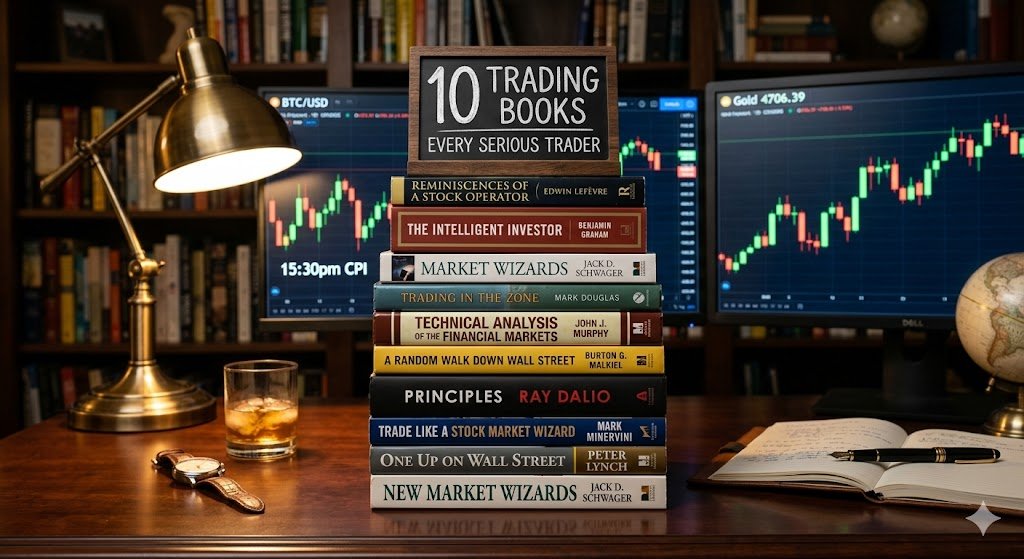
Not every trading lesson comes from a chart. Some of the most valuable insights in this profession were written down decades ago by the traders who lived them — and they remain as relevant today as the day they were published. If you have spent any time studying markets seriously, you have almost certainly heard the name Jack Schwager. His Market Wizards series gave the trading world something it rarely gets: honest, unfiltered conversations with the people who actually moved markets. What follows is a list of ten books — anchored by the Wizards series but extending beyond it — that belong on every serious trader’s shelf. Each one shaped how professionals think about risk, psychology, and the edge that separates consistent winners from the rest.
1. Market Wizards — Jack D. Schwager (1989)
The book that started it all. Schwager interviewed some of the greatest traders of the 1970s and 1980s — including Michael Marcus, Bruce Kovner, Paul Tudor Jones, and Ed Seykota — and asked them the questions every aspiring trader wants answered: How did you develop your edge? How do you manage risk? What separates winning from losing? The answers are as varied as the traders themselves, but the common threads — discipline, risk management, and psychological resilience — run through every interview. Marcus turned a $30,000 account into $80 million. Seykota turned $5,000 into $15 million over twelve years. The numbers are staggering; the lessons are timeless.
You can read the full review of this book here.
2. The New Market Wizards — Jack D. Schwager (1992)
The follow-up to the original, featuring a new generation of exceptional traders including Bill Lipschutz (the Sultan of Currencies at Salomon Brothers), Stanley Druckenmiller, and Mark Minervini. Schwager deepens the psychological dimension in this volume — several interviews deal extensively with how traders recovered from catastrophic losses and rebuilt both their accounts and their confidence. Druckenmiller’s chapter on working with George Soros and the philosophy of “being right and sitting tight” is alone worth the price of the book. The consistent message across all interviews: the best traders are obsessive about not losing money before they think about making it.
You can read the full review of this book here.
3. Stock Market Wizards — Jack D. Schwager (2001)
Schwager turns his attention specifically to equity markets in this third instalment, interviewing traders who made their fortunes in individual stocks rather than futures or currencies. Mark Minervini appears again in a longer format, detailing his SEPA methodology for finding superperformance stocks. Steve Cohen, before the legal controversies of later years, discusses pattern recognition and intuition. The most instructive theme in this book is the diversity of approaches that can generate exceptional returns in stocks — fundamental, technical, quantitative, and purely intuitive traders all appear, each with a coherent and internally consistent framework.
You can read the full review of this book here.
4. Hedge Fund Market Wizards — Jack D. Schwager (2012)
The most institutionally sophisticated of the Wizards books, featuring interviews with traders who manage hundreds of millions or billions of dollars. Ray Dalio appears discussing the all-weather portfolio concept that would later become the foundation of Bridgewater’s risk parity strategy. Colm O’Shea offers one of the most lucid explanations of global macro trading ever published — how to construct a thesis, size a position, and know when you are wrong before the market proves it. The recurring insight in this volume: at scale, the psychological challenges of trading multiply rather than diminish.
You can read the full review of this book here.
5. Unknown Market Wizards — Jack D. Schwager (2020)
Schwager’s most recent Wizards book deliberately seeks out traders who are not household names — retail and proprietary traders who have achieved extraordinary results without institutional backing or public profiles. The most striking takeaway from this volume is that exceptional trading performance is not confined to Wall Street. Several of the featured traders operate from home offices and suburban locations, managing their own capital with methodologies developed entirely independently. The book is a powerful argument that edge is personal — and that the best trading approach is always the one that fits your own psychology.
You can read the full review of this book here.
6. Reminiscences of a Stock Operator — Edwin Lefèvre (1923)
The oldest book on this list and arguably the most important. Written in 1923 as a thinly fictionalised account of Jesse Livermore’s trading career, it remains the most psychologically accurate description of what it actually feels like to trade for a living. The lessons about holding winners, cutting losers, the danger of tips, and the seductive pull of overtrading are as applicable to a modern algorithmic trader as they were to Livermore in the bucket shops of the 1890s. Every experienced trader who reads it for the second or third time discovers lessons they missed the first time. It is the book that keeps paying.
You can read the full review of this book here.
7. Trading in the Zone — Mark Douglas (2000)
The definitive book on trading psychology. Douglas identifies the core problem that prevents most traders from consistent profitability: the inability to accept uncertainty while maintaining disciplined execution. His concept of thinking in probabilities — treating each trade as one instance in a series of outcomes rather than a unique event that must be won — is the psychological framework that underlies every interview in the Wizards series, even when the traders themselves don’t articulate it that way. The book is not about methodology or strategy; it is about the mental state required to execute any strategy consistently under real market conditions.
You can read the full review of this book here.
8. The Disciplined Trader — Mark Douglas (1990)
Douglas’s first book, written ten years before Trading in the Zone, covers much of the same psychological territory but from a more foundational perspective. Where Zone focuses on the mindset required for consistent execution, Disciplined Trader examines why the market environment is fundamentally unlike any other environment humans encounter — and why our natural instincts, developed over millennia for physical survival, are almost perfectly calibrated to lose money in financial markets. The book explains why intelligent, disciplined people can be so consistently inconsistent as traders.
You can read the full review of this book here.
9. The Complete TurtleTrader — Michael W. Covel (2009)
The true story of Richard Dennis’s famous experiment: could trading be taught? Dennis recruited 23 ordinary people — the Turtles — and taught them a specific trend-following system. Several became legendary traders; others washed out immediately. Covel’s book is the definitive account of what happened and why. Beyond the fascinating story, the book is a rigorous argument for systematic trend following as a long-term edge — and an honest examination of why most people cannot execute a proven system even when they know exactly what it says. The psychological gap between knowing the rules and following them is the central lesson.
You can read the full review of this book here.
10. How I Made $2,000,000 in the Stock Market — Nicolas Darvas (1960)
The simplest book on the list and in some ways the most instructive. Darvas was a professional dancer who traded stocks in hotel rooms around the world with nothing but a weekly copy of Barron’s — no real-time data, no news, no analysis beyond price and volume. He developed the box theory: buy stocks breaking out of tight consolidation ranges to new highs; exit immediately if the price falls back into the prior range. The method is elegant precisely because of its simplicity. The book is a masterclass in the idea that a clearly defined, consistently executed system — even a simple one — outperforms a complex, inconsistently applied one every time.
You can read the full review of this book here.
One Pattern Across All Ten
Reading these books in sequence reveals something that no individual volume states explicitly: every trader who achieved lasting success did so by finding a methodology that fit their personality, developing an obsessive respect for risk management, and cultivating the psychological discipline to execute their plan when their emotions were screaming the opposite. The tools — technical analysis, fundamental research, quantitative models, pattern recognition — are secondary. The mindset is primary.
Each of the ten books above will be covered in a full standalone summary on this site. Whether you are a beginning trader looking for orientation or an experienced one looking for a perspective you haven’t encountered, each title offers something the others do not. Start with whichever description above resonated most. That is almost certainly the right book for where you are right now.