

Gold Price Forecast 2026: Analyzing the “Historic Crush”
The first week of February 2026 will be etched in financial history as one of the most volatile periods for precious metals. After an extraordinary January rally where gold surged over 24%, the market experienced a violent “leverage reset”. In just three trading days, gold plummeted from a record peak of nearly $5,600 to a low near $4,400, marking its steepest decline since the 1980s.
This Gold Price Forecast 2026 examines whether the current stabilization near $4,968 is a temporary pause or the formation of a massive local bottom. For the general public, the move was terrifying; for professional traders, it was a long-overdue normalization of a parabolic market.
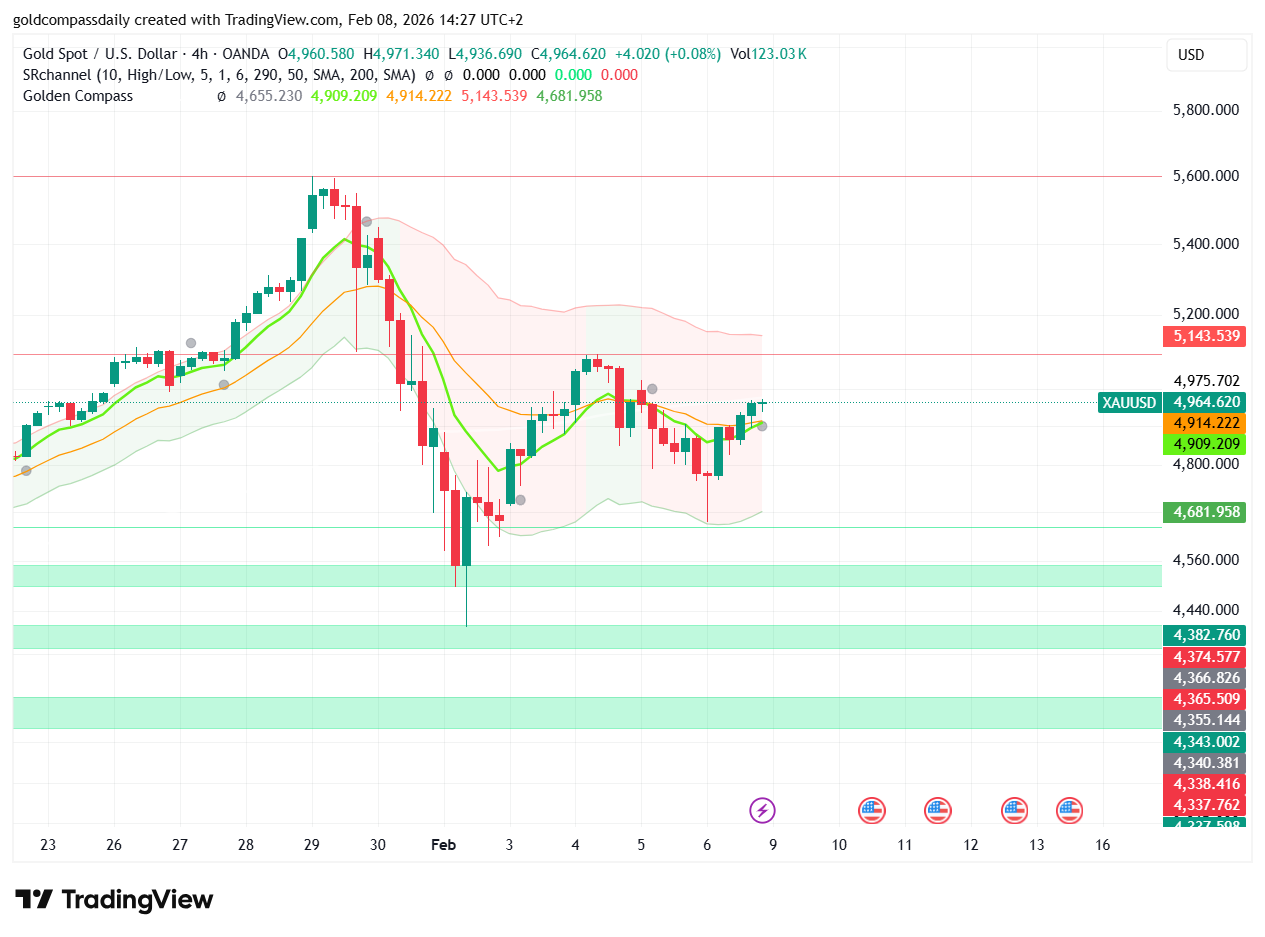
The 4-Hour Technical Breakdown
On the 4-hour chart, gold is currently exhibiting a tense period of consolidation. Following the “flash crash” initiated by the nomination of Kevin Warsh as Fed Chair—a move markets interpreted as a hawkish shift toward higher interest rates—prices have found significant demand near the $4,718 support zone.
- The Pivot Zone ($4,940 – $4,980): This is the most critical range for the upcoming week. Gold must hold this level to maintain a bullish continuation thesis.
- Resistance Barriers: The first major hurdle is at $5,057 (the 50 EMA), followed by the 61.8% Fibonacci retracement level at $5,170.
- RSI Recovery: The Relative Strength Index (RSI), which dropped below 20 during the height of the crash, has climbed back to a neutral 48, suggesting that the immediate selling panic has subsided.
Fundamental Drivers: Why the Meltdown Happened
The Gold Price Forecast 2026 was fundamentally reshaped this week by two primary shocks. First, the CME sharply increased margin requirements to 9%, effectively “flushing out” high-leverage retail participants and leaving the market structurally sounder but thinner in liquidity.
Second, the “debasement trade”—the flight from fiat currencies—hit a temporary wall as the U.S. Dollar Index (DXY) surged above 97. Despite this, institutional appetite remains fierce. Emerging markets and central banks, including the National Bank of Poland, continue to buy gold on these deep pullbacks, viewing the “crash” as a generational entry point.
Looking Ahead: The Path to $6,300
While the short-term outlook requires extreme caution, the long-term Gold Price Forecast 2026 remains overwhelmingly positive. Major financial institutions, including J.P. Morgan and Deutsche Bank, have maintained their year-end price targets of $6,000 to $6,300. They argue that the core drivers—geopolitical instability, sovereign debt expansion, and trade frictions—are unchanged.
Trade Strategy: Traders should look for stability above the $4,900 mark. A clean break above $5,100 would confirm the recovery phase and reopen the doors toward previous highs. Conversely, a daily close below $4,700 would invalidate the recovery and suggest a deeper correction toward $4,400.