

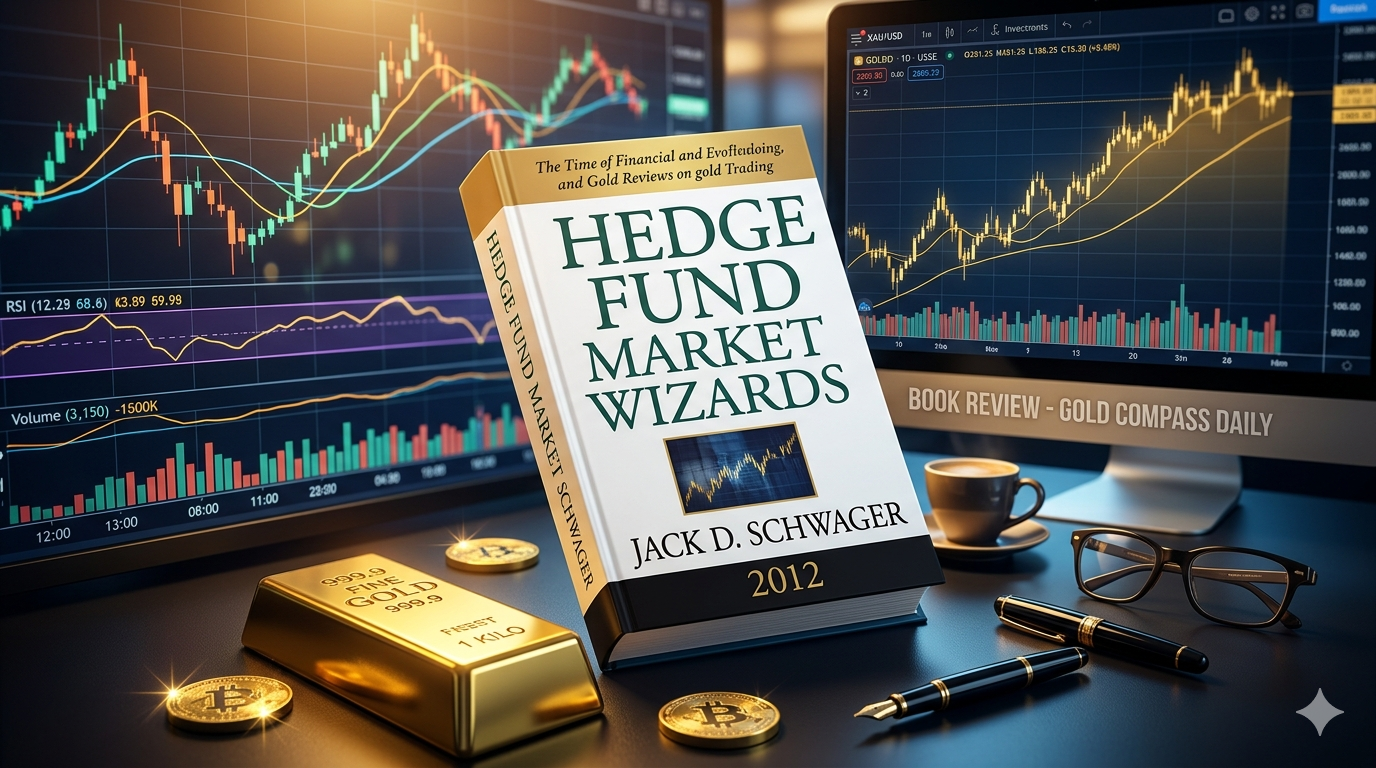
By 2012, Jack Schwager had spent more than two decades interviewing the best traders in the world. The original Market Wizards had established the template in 1988. The New Market Wizards had deepened it in 1992. Stock Market Wizards had turned its attention exclusively to equities in 2001. With Hedge Fund Market Wizards, Schwager returned after an eleven-year gap with a fourth volume — and the most sophisticated set of interviews in the series.
The gap matters. The decade between Stock Market Wizards and this volume included the dot-com collapse, the 2008 financial crisis, the European sovereign debt crisis, and the post-crisis era of central bank intervention that fundamentally altered the behaviour of every major asset class. The traders Schwager interviewed for this book had navigated all of it. They speak with the authority of people who have been stress-tested repeatedly — not in a single crash but across a decade of consecutive crises, each with different mechanics and different lessons.
This article is part of the full summary series based on the 10 trading books every serious trader must read. Read the previous volumes first — the principles established in Market Wizards, refined in The New Market Wizards, and applied to equities in Stock Market Wizards — form the foundation on which this volume builds.
What Makes This Volume Different
The hedge fund context introduces dynamics that the previous three volumes did not fully address. Futures traders, currency specialists, and equity managers — the subjects of the earlier books — operate primarily in markets that are transparent, liquid, and governed by relatively simple rules. Hedge fund managers operate across all of these markets simultaneously, with leverage, with short positions, with derivatives, and often with significant operational complexity layered on top of the trading itself.
This means the traders in Hedge Fund Market Wizards face a qualitatively different set of problems from their predecessors in the series. It is not enough to have a valid edge — the edge must survive leverage, survive redemption pressure from investors during drawdowns, survive the operational demands of running a business alongside running a portfolio, and survive the increasingly competitive landscape of professional capital. Schwager’s interviews probe all of these dimensions, and the result is the most institutionally complete picture of high-level trading that the series has produced.
The other significant difference is the post-2008 environment. Every trader in the book has a 2008 story — either how they profited from the crisis, how they survived it, or how they were nearly destroyed by it. Those stories, and what the traders learned from them, form the emotional core of the volume in the way that the 1987 crash did for the first book and the dot-com collapse did for the third.
Ray Dalio: The Man Who Mapped the Machine
The Dalio interview is the most conceptually ambitious in the book — and arguably in the entire Wizards series. Dalio’s approach to markets is not a trading methodology in the conventional sense. It is an attempt to build a complete model of how the economic machine works: how debt cycles interact with productivity growth, how central bank policy responds to economic conditions, how credit expansion and contraction drive asset prices across decades rather than months. The portfolio that emerges from this model — Bridgewater’s Pure Alpha and All Weather strategies — is designed not to beat the market in any given year but to perform across every economic environment that the model identifies as possible.
Dalio’s central insight is that most investors and traders are implicitly betting on a single economic environment — usually the environment they have most recently experienced — without recognising that they are doing so. A portfolio that performs well in growth with low inflation will perform poorly in stagflation. A strategy that profits from falling rates will be destroyed by rising ones. The question he asks before constructing any portfolio is not “what do I expect to happen?” but “what is the full range of environments that might occur, and how does my portfolio behave in each of them?”
The practical application of this thinking is radical diversification — not across asset classes in the conventional sense, but across return drivers. Dalio distinguishes between assets that do well when growth surprises to the upside, assets that do well when inflation surprises to the upside, assets that do well when growth disappoints, and assets that do well when deflation arrives. A truly balanced portfolio holds meaningful exposure to all four categories simultaneously, weighted by risk contribution rather than capital allocation. This is the intellectual foundation of the risk parity approach that Bridgewater pioneered and that has since become one of the most widely discussed frameworks in institutional investing.
The most personally revealing section of Dalio’s interview is his account of 1982 — the year he was so certain of his macroeconomic forecast that he bet everything on it, was spectacularly wrong, nearly lost his firm, and had to borrow money from his father to pay his bills. The experience did not break him. It rebuilt him. The systematic, principle-based approach to decision-making that Dalio subsequently developed — captured in Bridgewater’s famous Principles document — emerged directly from his determination never again to be destroyed by the combination of conviction and certainty. The lesson he drew: strong opinions must always be held with explicit acknowledgement of what would prove them wrong.
Colm O’Shea: The Macro Trader’s Macro Trader
O’Shea’s interview is the most methodologically precise discussion of global macro trading in any of the Wizards books. Where many macro traders describe their process in terms of themes and narratives — “I was long commodities because China was industrialising” — O’Shea articulates the specific logical structure that connects a macroeconomic thesis to a trade, and the specific conditions that would invalidate the connection.
His central principle is the distinction between a correct macroeconomic view and a correctly structured trade. These are not the same thing, and conflating them is one of the most common and costly errors in macro trading. A trader can be completely correct that the Federal Reserve will cut rates — and still lose money if the rate cuts are already priced into the bond market, if the currency move that should accompany the rate cuts is offset by capital flows from another direction, or if the timing of the thesis playing out extends beyond the cost of carrying the position. The trade must be structured so that the instrument being used, the entry point, the position size, and the exit criteria all align with the specific mechanism by which the thesis is expected to generate profit.
O’Shea also provides the clearest articulation in the book of how a macro trader manages being wrong. His framework distinguishes between positions that are losing because the thesis is wrong and positions that are losing because the market has not yet moved to reflect a thesis that remains correct. The first type requires immediate exit. The second type requires patience — but with a strict limit on how much patience, because a thesis that does not play out within a reasonable timeframe is functionally equivalent to a wrong thesis regardless of whether it eventually proves correct. Time is a cost in macro trading, and a thesis that is correct in three years but costs two years of carry to hold is not necessarily a profitable trade.
Michael Platt: Managing Risk at BlueCrest
Platt’s chapter is the most operationally focused in the book — and the most instructive for anyone thinking about the institutional mechanics of running a hedge fund rather than simply trading a personal account. BlueCrest, the firm Platt founded after leaving JPMorgan, was built around a specific philosophy of risk management that is different in important ways from the individual trader approaches described in the rest of the series.
The core of Platt’s risk management framework is the automatic stop. Every portfolio manager at BlueCrest has a predefined drawdown limit — if a PM loses a set percentage of their allocated capital, that capital is automatically removed and the PM is taken off risk. No exceptions, no discussions, no opportunity to “trade through” the drawdown on the theory that the thesis remains valid. The automatic removal is not a punishment — it is a structural protection against the psychology of loss, which Platt identifies as the primary mechanism through which small losses become catastrophic ones. A PM who is down significantly and knows they have the capital to recover will almost always increase risk in an attempt to recover quickly. That is the moment when manageable losses become unmanageable ones.
Platt also discusses the specific challenge of managing other people’s capital in an environment where investor behaviour is itself a risk factor. The 2008 crisis produced not just market losses but redemption requests — investors withdrawing capital at the worst possible moment, forcing funds to sell positions into illiquid markets at distressed prices. Platt’s response was to build a portfolio specifically designed to be liquidated at any point without significant market impact — prioritising liquidity over return in a way that most managers resist because it appears to leave returns on the table during normal market conditions. The 2008 crisis vindicated the approach: BlueCrest was able to meet all redemptions without forced selling, while competitors who had taken less liquid positions were permanently impaired.
Steve Clark: Doing More of What Works
Clark’s interview is the most psychologically direct in the book — and contains one principle so simple that it is easy to dismiss and so important that dismissing it is catastrophic. After decades of trading, Clark’s primary framework for improving performance reduces to a single question: which of your trades are making money, and are you doing enough of them? Which of your trades are losing money, and are you still doing them?
The application of this principle sounds obvious. In practice it is almost never applied correctly, for a specific psychological reason: the trades that are losing money are almost always the trades the trader has the highest conviction about, because conviction is what allowed the trader to hold the position long enough to accumulate a significant loss. The trades that are making money are often the trades the trader feels least certain about — smaller positions, less intellectual investment, easier to exit. The natural psychological tendency is therefore to cut the winners (they feel like luck) and hold the losers (they feel like conviction). Clark’s framework forces the opposite: systematic documentation of what is actually working and reallocation toward it, regardless of the trader’s feelings about why it is working.
His account of his own worst period — a multi-year stretch where he was doing precisely the wrong things with full awareness that he was doing them but an inability to stop — is the most honest description of the grip of psychological trading errors available in any of the four volumes. The way out was not a new methodology but a return to the discipline of asking the simple question: what is actually working, and am I doing enough of it?
Jamie Mai: The Asymmetric Bet Specialist
Mai’s interview is the most technically distinctive in the book — and the one most directly relevant to traders who think about options and convex payoff structures. The firm Mai co-founded, Cornwall Capital, became famous (after Michael Lewis described it in The Big Short) for identifying situations where the options market was dramatically mispricing tail risk — charging very little for options that should have been very expensive given the true probability of the underlying event occurring.
The intellectual framework behind Cornwall’s approach is the identification of what Mai calls “miscategorised risk” — situations where a market has placed an asset or scenario into the wrong reference class. The subprime mortgage trade that The Big Short describes is the canonical example: the market was pricing subprime mortgage securities as if they were diversified credit instruments with uncorrelated default risk, when in fact they were highly correlated instruments whose defaults would cluster in the same economic scenario. The options market was therefore dramatically underpricing the tail risk of a correlated collapse.
But the subprime trade, as Mai explains, was not unique — it was one instance of a general pattern that recurs across markets whenever conventional categorisation fails to capture the true structure of the risk. The skill is identifying when this miscategorisation has occurred, finding the cheapest instrument through which to express the thesis, and sizing the position so that the cost of being wrong (the option premium paid) is small relative to the payoff if correct. The asymmetry — small loss if wrong, very large gain if right — is the defining characteristic of Cornwall’s approach and the reason it produced returns that appeared impossible to observers using conventional risk-adjusted metrics.
Edward Thorp: The Quantitative Pioneer
The Thorp interview is the most historically significant in the book. Thorp — the mathematician who wrote Beat the Dealer in 1962 and effectively invented card counting, then went on to run one of the most successful quantitative hedge funds of the 1970s and 1980s — represents the intellectual origin point of the entire quantitative finance industry. His account of how he moved from blackjack to options to statistical arbitrage is not just biographical interest; it is the story of how a specific way of thinking about probability, edge, and position sizing was translated from the casino to the financial markets.
Thorp’s discussion of the Kelly Criterion — the mathematical formula for optimal position sizing given a known edge and known odds — is the most precise treatment of the concept available in the Wizards series. The Kelly formula maximises long-run capital growth but produces position sizes that are psychologically difficult to hold because they imply significant short-term volatility. Thorp’s practical recommendation: use half-Kelly or less in real trading, accepting a somewhat lower long-run growth rate in exchange for a dramatically more manageable drawdown profile. The full-Kelly sizing that is theoretically optimal is practically destructive because most traders cannot maintain the discipline required to hold through the volatility it generates.
His assessment of Warren Buffett — whom he encountered in the early days and whose edge he identified before almost anyone else — is a rare outside perspective on one of the most studied investors in history. Thorp’s framing of Buffett as a practitioner of essentially the same probability-and-edge thinking that drives quantitative trading, applied to business valuation rather than statistical arbitrage, is one of the most intellectually satisfying passages in any of the four volumes.
The 2008 Crisis as the Defining Test
More than any previous volume in the series, Hedge Fund Market Wizards is shaped by a single event: the 2008 financial crisis. Nearly every interview contains a detailed account of how the subject navigated the crisis — and those accounts reveal more about the true quality of a trading methodology than any description of a successful period could.
The traders who performed best in 2008 shared a specific characteristic: they had thought carefully, before the crisis, about the conditions under which their current positioning would fail catastrophically, and they had structured their portfolios to limit the damage from those conditions even at the cost of lower returns in normal environments. Dalio’s all-weather framework. Platt’s liquidity-first approach. Mai’s asymmetric options positions. These were not crisis trades — they were structural decisions made years earlier that happened to perform well when the crisis arrived.
The traders who suffered most in 2008 — including several who are honest enough in the interviews to describe their own failures — made the opposite error: they had optimised their portfolios for the environment they had experienced most recently, without adequately considering the possibility of a regime change. The 2004–2007 environment of low volatility, high liquidity, and compressed credit spreads had been so consistent and so profitable that the risk models calibrated to it assigned near-zero probability to the scenario that actually occurred.
The Recurring Themes: What the Fourth Volume Adds
Read as the fourth instalment in the series, Hedge Fund Market Wizards confirms and extends the principles that the previous three volumes established — while adding institutional dimensions that individual traders rarely consider.
The confirmation: every trader with a sustained track record has a precisely defined edge, a methodology for identifying when that edge is present, and a risk management framework that limits losses when the edge is absent. The discipline to follow the methodology when it is producing losses — because the losses are within the expected range of a valid methodology — and to stop when the losses suggest the methodology has stopped working, remains the central psychological challenge of professional trading regardless of whether the trader manages a personal account or a multi-billion dollar fund.
The addition: at institutional scale, the methodology itself is not enough. The business must be structured to survive the periods when the methodology underperforms. Investor relations, liquidity management, operational infrastructure, and the psychological demands of managing other people’s capital under drawdown pressure — these are not peripheral concerns. They are the conditions under which the methodology must operate, and a methodology that cannot survive those conditions will eventually fail regardless of its theoretical validity.
Dalio’s comment that the biggest mistake an investor can make is to believe that what has worked well recently will continue to work — rather than seeking to understand what conditions made it work and whether those conditions still exist — is the most important single idea in the book. It is also the idea most consistently violated by traders at every level of sophistication, from retail accounts to multi-billion dollar funds.
Why This Book Belongs at the End of the Series
The four Wizards volumes should be read in order. The original Market Wizards establishes that extraordinary trading performance exists and identifies the principles that underlie it. The New Market Wizards tests those principles against adversity and reveals where they require refinement. Stock Market Wizards applies them to the equity market with its specific challenges and opportunities. Hedge Fund Market Wizards places all of it in the institutional context — the context in which most of the world’s serious capital is actually managed — and adds the dimension of sustained performance across multiple market crises.
Together, the four books form the most comprehensive public account of what it actually takes to trade and invest at the highest level across four decades of market history. The principles do not change. The markets do. The traders who sustain exceptional performance across changing markets are those who understand the difference between a principle — which is durable — and its application — which must evolve.
For the complete reading list that this series is part of, visit the 10 trading books every serious trader must read.
This article is part of an ongoing series of full summaries of the most important books in trading. Each title on the list receives its own dedicated review covering the key ideas, the trader profiles, and the practical lessons applicable to active market participants.