

Every name on a serious August 2026 equity watchlist carries some version of the same story: artificial intelligence, semiconductors, data centre infrastructure, the supercycle. Neurocrine Biosciences belongs to none of those categories. It is a San Diego-based biopharmaceutical company that has been building, quietly and methodically, a commercial neuroscience franchise that now spans three first-in-class products, a late-stage pipeline with two Phase 3 readouts scheduled for 2027, zero debt, and a Q2 2026 earnings report that beat non-GAAP EPS expectations by 44%. The market responded by sending the stock down 5%. That disconnect — exceptional fundamental performance, a reflexive near-term selloff, and a consensus analyst price target implying more than 30% upside — is the NBIX investment thesis in August 2026.
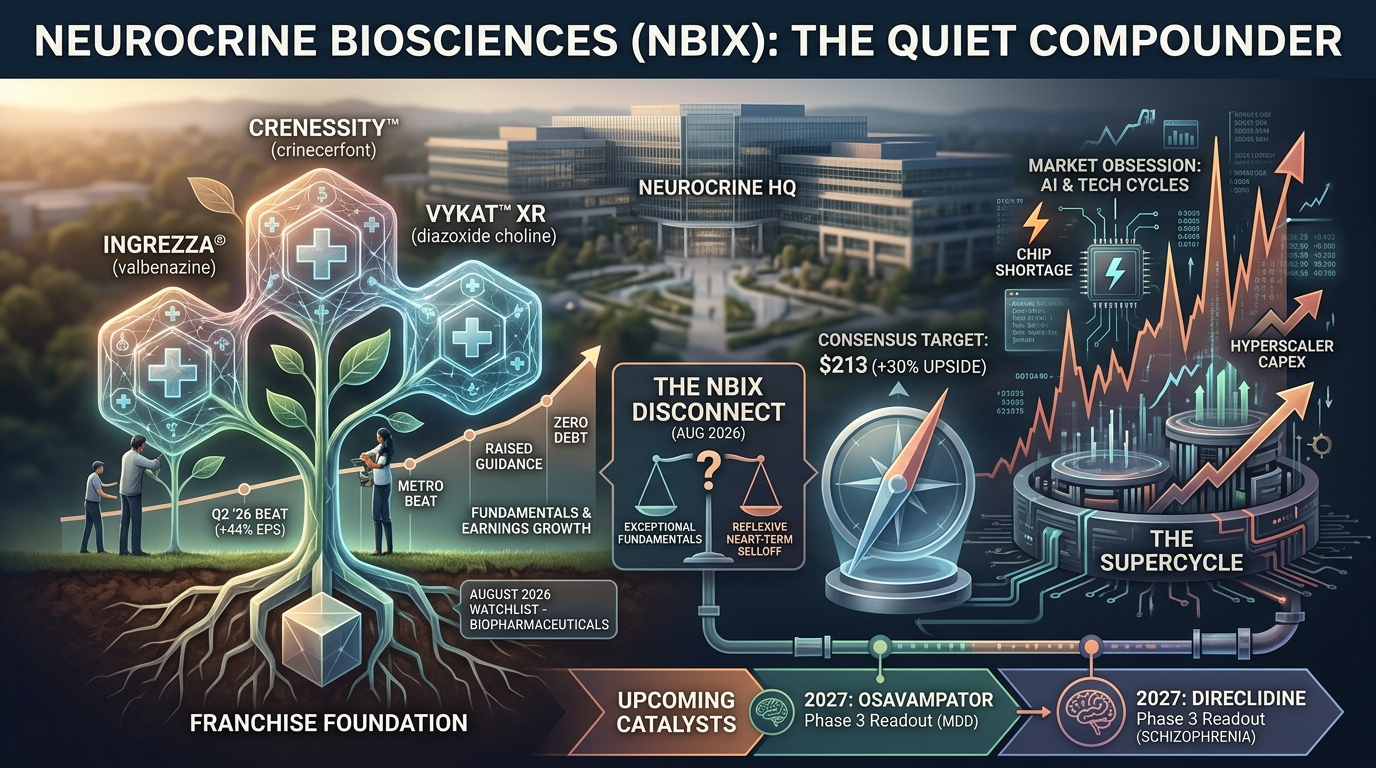
For investors seeking portfolio diversification away from the AI hardware concentration that defines the other picks in this series, Neurocrine offers something rare: above-market earnings growth, a defensible commercial moat, a balance sheet carrying no debt, and catalysts extending well into 2027 that are entirely independent of Federal Reserve policy, hyperscaler capital expenditure decisions, or semiconductor export controls. The stock has been range-bound near $175 since the post-earnings selloff. The 27-analyst consensus 12-month target is $213, and the most recent Seeking Alpha DCF model yields $224 per share as fair value. The gap between where the stock is trading and where the fundamentals suggest it should be is the opportunity.
Q2 2026: A Record Quarter That the Market Misread
Neurocrine reported its fiscal second quarter 2026 results on July 30, 2026, delivering the strongest quarterly performance in the company’s history across virtually every financial metric. Total revenue exceeded $950 million, representing nearly 40% year-over-year growth, driven by three commercial products each in different stages of their launch trajectories. Non-GAAP EPS improved to $2.85 per share from $1.65 per share in the prior year, while GAAP net income rose to $144.4 million from $107.5 million. The company demolished EPS expectations by 44% — a beat of that magnitude in a quarter where the company simultaneously raised full-year guidance and closed a $2.9 billion acquisition is not a routine result. It reflects operating leverage across a commercial infrastructure that is now capable of launching and scaling multiple products simultaneously without proportional increases in selling, general, and administrative spend.
The stock fell 5.1% following the report despite the earnings beat and higher INGREZZA guidance, a reaction that several analysts characterised as overdone. Wells Fargo explicitly stated that the post-earnings weakness was excessive given what it described as a “solid beat and raise quarter.” The selloff’s primary trigger appears to have been concern about near-term GAAP earnings headwinds from the Soleno acquisition costs — approximately $130 million of a total $150 million in acquisition-related charges recognised in Q2 — and uncertainty about the pace of VYKAT XR launch ramp. Neither represents a structural deterioration in the underlying business. The acquisition charges are non-recurring. VYKAT XR is on track, with management affirming sequential growth expectations as the company exits 2026.
INGREZZA: The Anchor That Gets Stronger With Age
INGREZZA (valbenazine) is the commercial foundation on which Neurocrine’s entire enterprise is built. Approved in 2017 for tardive dyskinesia — an involuntary movement disorder caused by long-term antipsychotic use — and subsequently for chorea associated with Huntington’s disease, INGREZZA is now the standard of care in both indications. INGREZZA generated net sales of $716 million in Q2 2026, up 15% year-over-year, driven by record new patient additions. Management raised the full-year INGREZZA guidance from $2.7 billion–$2.8 billion to a new range of $2.825 billion–$2.875 billion, representing approximately 13% year-over-year growth at the midpoint.
What makes INGREZZA’s commercial durability exceptional is not merely its revenue trajectory but the structural characteristics that protect it. The drug benefits from U.S. patent exclusivity extending until 2038 — twelve more years of protected commercial runway from a product already generating nearly $3 billion in annual revenue. Seeking Alpha’s valuation model projects peak INGREZZA sales of $3.3 billion, suggesting the current guidance raise captures only a portion of the total commercial opportunity as prescriber penetration continues to expand in both tardive dyskinesia and Huntington’s disease chorea. Medicare coverage stands at 70% of lives covered under existing payer contracts, and reimbursement access across commercial payers remains strong, with the product’s established clinical profile reducing formulary resistance at renewal.
The primary INGREZZA risk on a 2–3 year horizon is the Inflation Reduction Act’s Medicare drug price negotiation framework, which management has flagged as a potential pricing headwind beginning in 2029. The timeline is sufficiently distant that it does not affect the near-term investment thesis, and Neurocrine has noted that the negotiated price — when it arrives — will apply only to Medicare volume, not to the commercial payer book. The more immediate dynamic is positive: record new patient additions in Q2 represent prescriber expansion into patient populations that were previously untreated or undertreated, a signal that market penetration in tardive dyskinesia has not reached a ceiling despite years of commercial execution.
CRENESSITY: The Second Blockbuster in Progress
CRENESSITY (crinecerfont) is Neurocrine’s second commercial product and its most significant near-term growth driver. Approved in 2025 for congenital adrenal hyperplasia — a rare genetic disorder affecting cortisol production that has historically been managed with high-dose corticosteroids carrying significant long-term side effects — CRENESSITY is the first new therapeutic option for classic CAH in decades. CRENESSITY net sales reached $184 million in Q2, with approximately 15% of the estimated diagnosed patient population now prescribed the treatment, reflecting continued strong launch execution and a prescriber base that has nearly tripled year-over-year.
The CAH market dynamics are favourable for continued penetration. The condition affects an estimated 30,000 patients in the United States with classic CAH, a well-defined patient population that is currently managed by a relatively concentrated specialist prescriber base — primarily endocrinologists and paediatric endocrinologists. Physician survey data suggest CRENESSITY penetration in congenital adrenal hyperplasia could climb from approximately 23% today to 37% by end-2026 and above 50% in five years, a trajectory that, if accurate, would establish CRENESSITY as a genuine blockbuster product by conventional pharmaceutical standards. Management expresses high confidence in CRENESSITY achieving blockbuster status, with anticipated revenue nearly doubling to $632 million in fiscal year 2026 from approximately $300 million in 2025.
Reimbursement access for CRENESSITY is robust, with more than 90% of patients paying $10 or less per month — a patient affordability outcome that removes one of the traditional barriers to rare disease drug adoption and supports the persistency rates necessary for durable revenue. The prescriber fragmentation noted by management — many CAH-treating physicians see only one or two patients — is the primary commercial execution challenge, requiring a field force capable of efficiently reaching a geographically dispersed, low-volume prescriber universe. Neurocrine’s commercial infrastructure, already scaled for INGREZZA’s broader tardive dyskinesia market, provides cost leverage for the CRENESSITY launch that a standalone specialty company could not achieve.
VYKAT XR: The Third Pillar and the Soleno Acquisition
The most recent addition to Neurocrine’s commercial portfolio is VYKAT XR (diazoxide choline extended-release), acquired through the $2.9 billion cash purchase of Soleno Therapeutics, which closed on May 18, 2026. VYKAT XR is the first FDA-approved treatment for hyperphagia — pathological, insatiable hunger — in patients with Prader-Willi syndrome, a rare genetic disorder. Q2 pro forma VYKAT XR net sales were $94 million, with $54 million recognised by Neurocrine from the acquisition close date through June 30.
The strategic rationale for the acquisition is compelling. VYKAT XR addresses an unmet need in a rare disease indication with no prior approved pharmacotherapy for its primary symptom. The product carries U.S. patent protection extending into the mid-2040s — providing an exclusivity window that exceeds INGREZZA’s by several years. Neurocrine’s Chief Commercial Officer stated that VYKAT XR has the potential to become the third blockbuster in the portfolio, alongside INGREZZA and CRENESSITY. The $2.9 billion acquisition was financed entirely from cash on hand, leaving the company with approximately $500 million in cash and, critically, zero debt following the transaction — a balance sheet position that is exceptional for a company that just spent nearly $3 billion on an acquisition and reflects the cash generation capacity of the INGREZZA franchise.
The near-term VYKAT XR execution challenge is managing discontinuation rates through the initial launch period. Management expects discontinuation rates to eventually settle into the 25–30% range typical for orphan medicines once the initial launch bolus effects subside — a standard dynamic for rare disease products where early adopters include patients at varied disease stages and the initial commercial cohort includes some who were enrolled in the pivotal trial and have strong pre-existing product familiarity. The ex-U.S. strategy for VYKAT XR has been deprioritised, with the EMA filing withdrawn, as Neurocrine focuses on completing U.S. integration before pursuing international expansion — a disciplined sequencing decision that limits near-term upside but reduces execution risk.
The Pipeline: Two Phase 3 Readouts in 2027
Beyond the three commercial products, Neurocrine carries one of the more substantive late-stage neuropsychiatry pipelines among mid-large cap biopharma. Two programmes are approaching pivotal readouts that could significantly expand the company’s addressable market.
Osavampator is an investigational oral antidepressant for major depressive disorder, targeting the AMPA receptor — a mechanism of action distinct from all existing approved antidepressants and with a differentiated side effect profile. Phase 3 topline data for osavampator are expected in the second half of 2027. Major depressive disorder affects approximately 21 million adults in the United States annually, making it one of the largest addressable markets in psychiatry. A successful Phase 3 readout would position Neurocrine for an NDA submission in 2028 and a potential approval and launch in 2029 — a timing that would coincide with INGREZZA approaching the later stages of its commercial lifecycle, providing a natural revenue succession dynamic.
Direclidine is an M4 selective muscarinic agonist in Phase 3 for schizophrenia — a disease area where existing treatments carry significant tolerability burdens, and where the muscarinic mechanism has generated substantial clinical interest following positive data from KarXT (now commercialised by Bristol Myers Squibb as Cobenfy). Phase 3 topline data for direclidine are also expected around the second half of 2027. Neurocrine has explicitly differentiated its muscarinic approach by utilising orthosteric agonists that do not require add-back muscarinic antagonists to manage side effects — a potential tolerability and dosing advantage over Cobenfy’s xanomeline-trospium combination that, if confirmed in Phase 3, could distinguish direclidine commercially. The schizophrenia market is estimated at approximately $8 billion annually in the United States, and the muscarinic mechanism has renewed commercial interest in a space that has been dominated by dopamine-targeting antipsychotics for decades.
The 2027 readout timing for both programmes is beyond the immediate August 2026 investment horizon but is relevant to the valuation framework. Seeking Alpha’s analysis notes that pipeline optionality is significant but difficult to quantify, with even conservative assumptions supporting the view that current business fundamentals justify a bullish stance independently of the pipeline — and that successful Phase 3 outcomes in either major depressive disorder or schizophrenia would represent upside that is not captured in consensus valuation models.
Analyst Consensus and Valuation
The post-Q2 analyst response to NBIX was broadly constructive, with multiple firms raising price targets. TD Cowen analyst Phil Nadeau raised his price target to $220 from $200 and maintained a Buy rating, while Guggenheim raised its target to $222 from $200 and kept its Buy rating, continuing to view Neurocrine as well-positioned for sustained growth. Needham raised its price target to $204 from $200, Wedbush increased its target from $185 to $194 with an Outperform rating, and Citigroup boosted its objective from $246 to $249. BofA raised its target to $214 from $199, noting that back-to-back record quarters de-risked the commercial execution story. According to 27 analysts, the average rating for NBIX stock is Strong Buy, with a 12-month consensus price target of $213.13 — implying approximately 30% upside from the stock’s current trading level near $175.
The more bearish notes have centred on near-term VYKAT XR execution uncertainty and INGREZZA pricing risk under the IRA. Deutsche Bank lowered its price target to $165 from $190 in mid-August, and Morgan Stanley lowered its target to $182 from $196, while Bernstein reduced its target to $218 from $221. BMO Capital issued a Hold rating. The pattern suggests a minority of analysts are pricing in near-term commercial headwinds, while the majority maintain buy-side conviction anchored in the multi-product growth trajectory and pipeline optionality. The divergence between the Citigroup $249 high target and the Deutsche Bank $165 low target reflects genuine uncertainty about VYKAT XR’s ramp pace and CRENESSITY’s prescriber penetration speed — both of which will become clearer in the Q3 report scheduled for November 3, 2026.
The Seeking Alpha DCF valuation model yields $224 per share, while a model incorporating full research costs produces $167 per share — both above recent market prices, suggesting undervaluation across a range of assumptions. At approximately $175, the stock trades at roughly 16–17 times forward non-GAAP earnings for a company delivering 40% revenue growth, 44% EPS beats, three commercial products, zero debt, and two Phase 3 catalysts in 2027. The sector comparison is instructive: specialty pharma companies with comparable revenue growth profiles and commercial product depth typically trade at 20–25 times forward earnings. The discount to that range represents the valuation gap the bull case identifies as the opportunity.
Key Metrics Summary
- Current stock price (mid-August 2026): approximately $175
- Market capitalisation: approximately $17.7 billion
- Q2 2026 total revenue: $959 million (+39% YoY)
- Q2 2026 INGREZZA net sales: $716 million (+15% YoY)
- Q2 2026 CRENESSITY net sales: $184 million
- Q2 2026 VYKAT XR net sales: $54 million (partial quarter, post-May 18 close)
- Q2 2026 non-GAAP EPS: $2.85 (+73% YoY; +44% vs. consensus)
- Full-year INGREZZA guidance: $2.825 billion–$2.875 billion (+13% YoY at midpoint)
- Expected FY2026 CRENESSITY revenue: approximately $632 million
- Cash position (end Q2): approximately $500 million
- Debt: zero
- INGREZZA patent exclusivity: through 2038
- VYKAT XR patent exclusivity: through mid-2040s
- Phase 3 pipeline readouts: osavampator (MDD) and direclidine (schizophrenia) — H2 2027
- Forward P/E: approximately 16–17x non-GAAP earnings
- Analyst consensus: Strong Buy; 27 analysts; consensus 12-month target $213.13
- Next earnings date: November 3, 2026
Risks to the Investment Thesis
INGREZZA’s IRA exposure is the most significant long-horizon structural risk. The Inflation Reduction Act’s Medicare drug price negotiation provisions will apply to INGREZZA beginning in 2029, and the magnitude of the negotiated price reduction is not yet determinable. Management has acknowledged the uncertainty and noted that the 2029 timeline provides meaningful runway for commercial execution before the pricing impact materialises. The risk is real but is a 2029 problem, not an August 2026 problem — and Neurocrine’s diversification into CRENESSITY and VYKAT XR is a deliberate hedge against over-concentration in INGREZZA’s revenue trajectory.
VYKAT XR discontinuation rates represent the most immediate commercial execution risk. Prader-Willi syndrome is a complex, lifelong condition, and hyperphagia management requires patient and caregiver education that is more intensive than for most neurological disorders. Management expects discontinuation rates to settle in the 25–30% orphan medicine range, but achieving that outcome requires consistent execution from a field force that is simultaneously managing INGREZZA and CRENESSITY commercial responsibilities. If VYKAT XR discontinuation rates remain elevated through Q3 and Q4, revenue will track below the pro forma $94 million quarterly run rate from Q2, creating a headwind to the multi-product growth thesis.
Pipeline failure risk in 2027 is binary and substantial. Osavampator and direclidine are each targeting large markets with significant commercial potential. A Phase 3 failure in either programme — which is the modal outcome for any individual late-stage trial in neuropsychiatry, a notoriously difficult development environment — would remove meaningful upside optionality from the valuation framework without, however, impairing the core commercial business. The antidepressant and schizophrenia pipeline is additive to the thesis, not foundational to it, but its failure would likely produce negative sentiment-driven price pressure. The CRENESSITY competitive landscape has also intensified, with a potential competitor’s acquisition signalling broader commercial interest in the CAH space — a dynamic that bears monitoring through 2026 clinical conference disclosures.
Conclusion
Neurocrine Biosciences enters the second half of August 2026 as a fundamentally strong business in a temporary valuation trough. Three commercial products in growth mode. Zero debt following a $2.9 billion acquisition closed in May. A 44% EPS beat in Q2. INGREZZA guided to nearly $2.85 billion for full-year 2026. CRENESSITY on track for blockbuster status. VYKAT XR contributing immediately to earnings. Two Phase 3 readouts in 2027 that represent genuine pipeline optionality not captured in current consensus models. A 27-analyst Strong Buy consensus with a $213 price target implying 30% upside from $175. For investors seeking a portfolio anchor that compounds independently of the AI semiconductor cycle — with its own product catalysts, its own earnings timeline, and its own fundamental logic — NBIX in August 2026 is the most straightforward value proposition in this series.
This article is for informational purposes only and does not constitute investment advice. All investors should conduct their own due diligence and consider their individual risk tolerance before making any investment decisions. Past performance is not indicative of future results.