

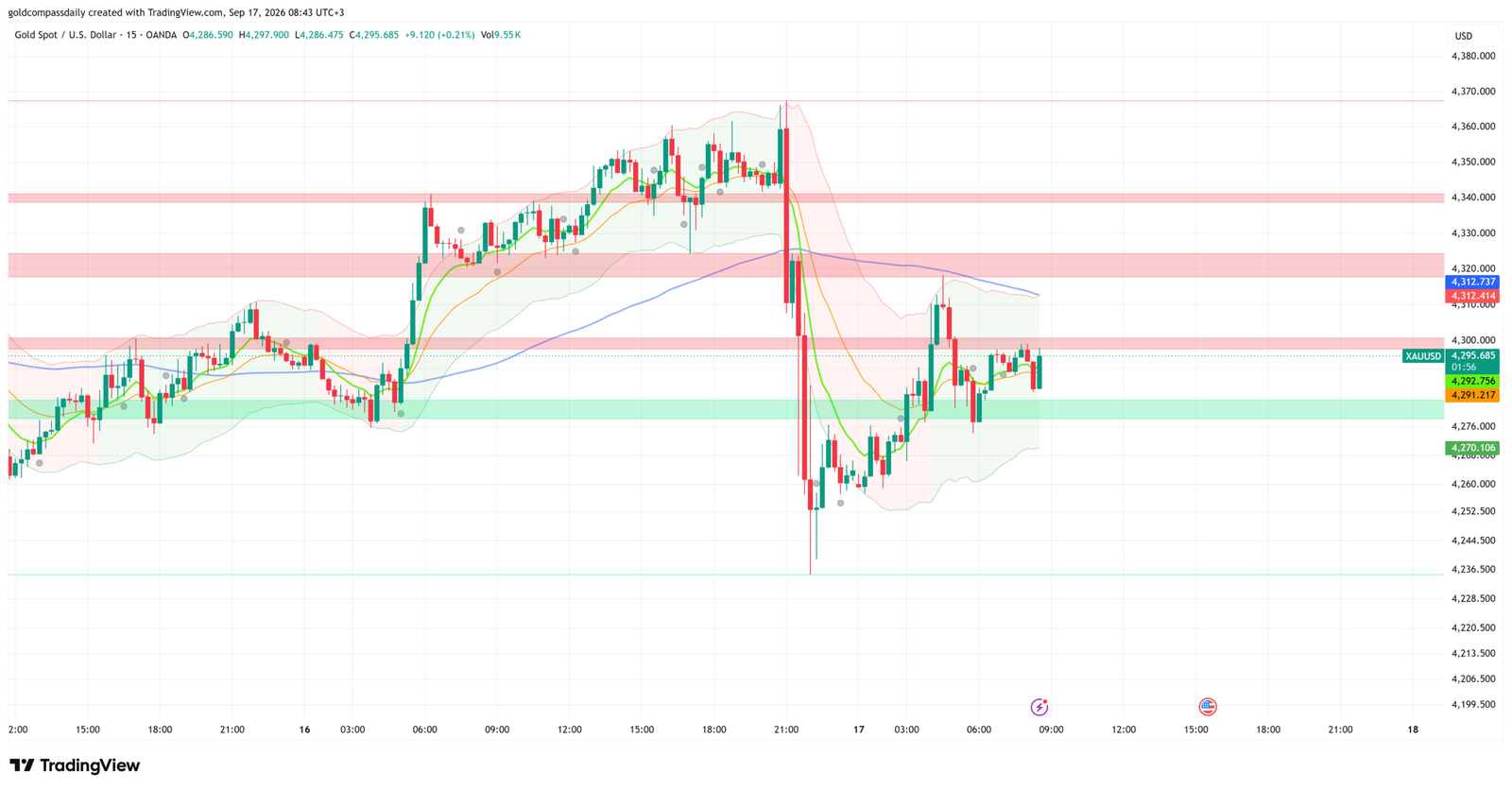
Gold trades cautiously bullish at $4,295 as markets digest Wednesday’s FOMC decision and shift focus to the Bank of England rate call and a dense slate of US data. The yellow metal staged a violent post-FOMC reversal — spiking to $4,370 before crashing to $4,245 — before recovering into a tight $4,280–$4,320 consolidation range. Price is now attempting to reclaim the $4,312–$4,320 resistance zone, a break above which would open the path to fill Wednesday’s structural imbalance.
Read the Gold Week Ahead: Sep 14–18, 2026 for full context on this week’s macro setup. Yesterday’s analysis is available here: XAU/USD at $4,323 — Gold Pulls Back From $4,340 as Markets Brace for FOMC.
Key Levels
- Bias: Cautiously Bullish above $4,280
- Support: $4,280–$4,291 (green demand zone) → $4,250
- Resistance: $4,312 → $4,320 → $4,340 (structural imbalance top)
- Session target: $4,340 — conditional on a confirmed close above $4,320 and a softer-than-expected BoE tone
- Invalidation: A sustained break below $4,270 reopens the $4,245 FOMC flash-crash low and signals the corrective structure is resuming
Catalyst of the Day: Bank of England Rate Decision (2:00 PM London)
The Bank of England’s September MPC decision is today’s primary catalyst for gold. Markets consensus prices the rate at 3.75% (no change), with the vote split expected at 6-0-3 — six holds, zero cuts, three hikes. The critical variable is not the decision itself but the vote distribution and the accompanying Monetary Policy Summary. A narrower majority for holding — say, a 5-0-4 split or language that tilts toward near-term easing — would weaken the British pound, lift risk appetite, and reduce the dollar’s relative safe-haven bid, providing a net tailwind for gold. Conversely, a hawkish surprise (four or more hike votes, or strong language about persistent inflation at 3.3% CPI) would strengthen sterling and reinforce the dollar, pressuring gold back toward the $4,280 support zone. The MPC statement publishes at 2:00 PM London time; watch the vote count first, language second.
Fundamental Context
Wednesday’s FOMC outcome was the defining event of the week for gold — and the aftermath is still playing out Thursday morning. The Federal Reserve, under Chair Kevin Warsh, held the federal funds rate steady at 3.50%–3.75%, matching market expectations. The shock was delivered not by the rate decision but by the updated Summary of Economic Projections and Warsh’s press conference tone. The median 2026 PCE inflation forecast was revised higher, and the dot plot continued to signal that a rate hike remains possible before year-end. Warsh has consistently emphasized price stability above all else, and his posture at Jackson Hole — where he explicitly stated he would be “hard pressed to describe broad financial conditions as restrictive” — raised the policy bar for gold. Higher-for-longer rates increase the opportunity cost of holding non-yielding bullion and strengthen the dollar. Gold’s violent $125 post-FOMC swing — up to $4,370, then down to $4,245 within minutes — reflects precisely this tension between relief at the hold and fear of the dot plot.
Thursday’s US data slate now takes over as the marginal price driver. The Philly Fed Manufacturing Index (forecast 31.3, previous 47.4) is expected to show a significant month-over-month deceleration. A reading near or below the forecast signals manufacturing softness — which is gold-positive as it reduces pressure on the Fed to hike. Weekly Unemployment Claims (forecast 207K) are near multi-month lows; a beat would reinforce labor market resilience and keep hike odds alive, capping gold’s upside. Building Permits and Housing Starts round out the housing picture, but their direct impact on gold is secondary unless the data materially shifts the real-rate outlook. The EUR Final CPI at 3.3% y/y (in line with expectations) confirms that European inflation remains stubbornly elevated, keeping the ECB in a similar bind and broadly supporting the case for real-asset hedges.
The structural floor for gold remains robust. Central bank demand — led by the PBoC and RBI — has consistently cushioned dips throughout 2026, most recently absorbing the sharp correction from the January all-time high of $5,405 down to the late-June low near $3,994. Gold has since stabilized in the $4,300–$4,600 range. Geopolitical risk premia tied to the Middle East continue to provide a baseline bid. The August CPI showed headline inflation near 3.3% and core at 2.4% y/y — the core trend decelerating is the one Warsh cited as a partial restraint on action. A continued core CPI slowdown is the single most bullish fundamental development available to gold over the coming month.
Chart Analysis
The 15-minute XAU/USD chart shows gold trading at $4,295 as of the European morning session on September 17, well within the post-FOMC consolidation range. Wednesday’s session created a textbook spike-and-reverse pattern: a sharp impulse to $4,370 — breaking above the prior $4,340 resistance band — immediately followed by a cascade to $4,245 as traders unwound post-decision positioning. Price has since retraced approximately 60% of that decline, stalling at the $4,312 resistance level, which aligns with the lower boundary of the red supply zone clearly visible on the chart. The green demand zone at $4,270–$4,291 provided the recovery base and remains the nearest structural support. The three moving averages have converged sharply and are now beginning to re-stack in a bullish sequence — short-term above medium, medium approaching long-term from below. Bollinger Bands re-expanded during the volatility event and are now contracting, suggesting the market is compressing before its next directional move. The unmitigated structural imbalance between $4,315 and $4,340 — created by the FOMC gap — represents the natural magnetic target for any sustained push above current resistance. A failure to break $4,320 by the US session open would increase the probability of a retest of the $4,280–$4,291 demand zone.
Bull and Bear Scenarios
Bull Trigger
A confirmed 15-minute close above $4,320, supported by a softer-than-expected BoE vote count or Philly Fed below 25, targets $4,340 in the European afternoon and $4,370 (Wednesday’s FOMC spike high) on continuation.
Bear Trigger
A break and sustained close below $4,270 — particularly if the BoE delivers a hawkish surprise (four or more hike votes) or Unemployment Claims print below 200K — targets $4,245 (Wednesday’s flash-crash low) and opens $4,220–$4,200 on an extended move.
Events Ahead This Week
- Thu Sep 17, 2:00 PM (London) — BoE Monetary Policy Summary / Official Bank Rate (forecast 3.75%, no change): Vote split and inflation language are the key variables; a dovish tone weakens GBP and is net gold-positive.
- Thu Sep 17, 2:00 PM (London) — MPC Vote Count (forecast 3-0-6): Any increase in hike votes beyond three signals the BoE is moving toward tightening and would support the dollar.
- Thu Sep 17, 3:30 PM (NY) — Philly Fed Manufacturing Index (forecast 31.3, prev 47.4): A sharp miss flags demand softness, reducing Fed hike pressure and supporting gold.
- Thu Sep 17, 3:30 PM (NY) — US Unemployment Claims (forecast 207K): A print above 215K signals labor market loosening, reducing hike odds and supporting gold.
- Thu Sep 17, 3:30 PM (NY) — Building Permits / Housing Starts: Secondary driver; watch for signs that rate-sensitivity is deepening in the housing sector.
- Thu Sep 17, 5:00 PM (NY) — Pending Home Sales m/m (forecast -0.2%): Tertiary data point; meaningful only if it compounds a weak Philly Fed print to build a broader US slowdown narrative.
New York Session Update
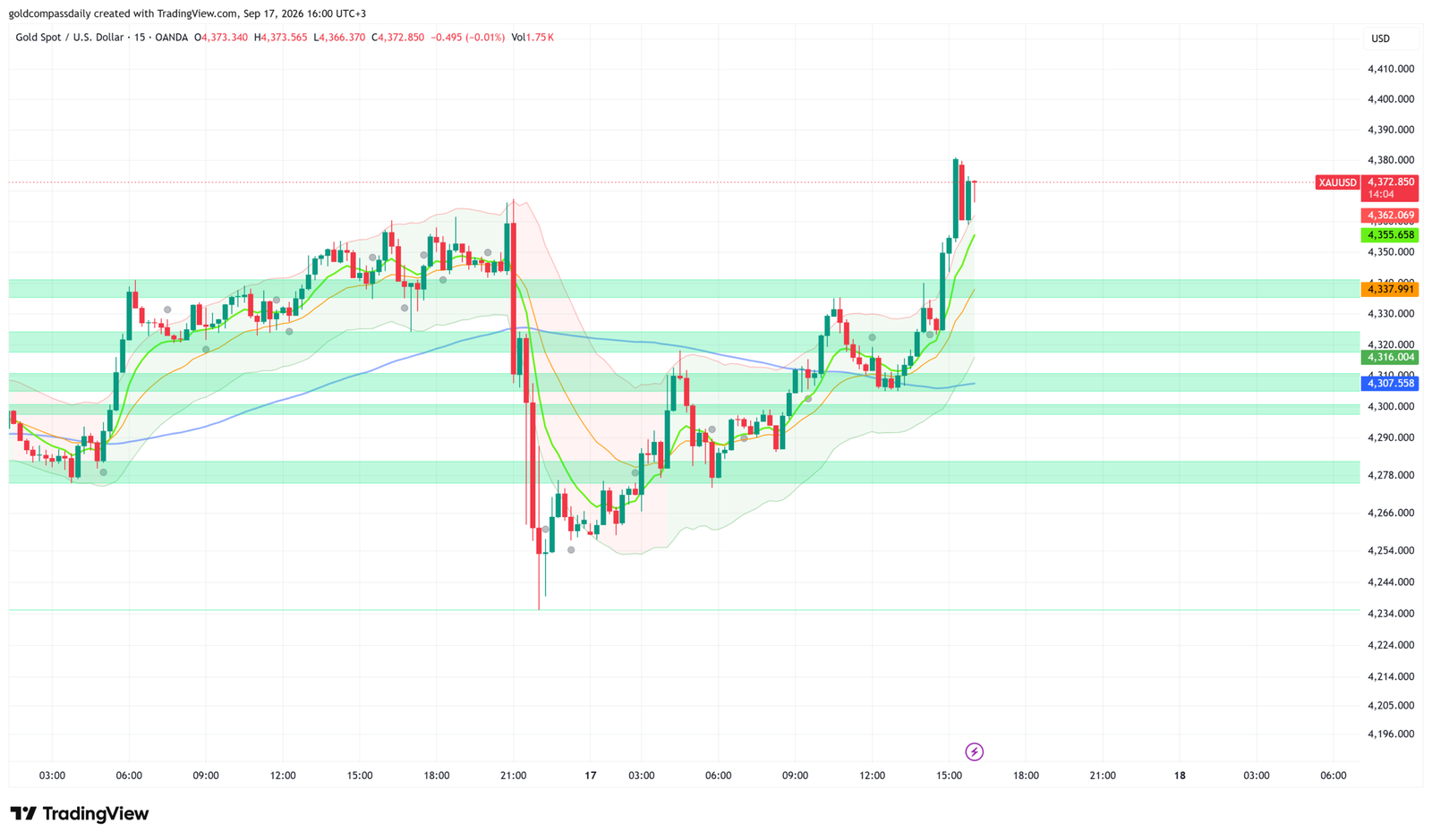
Gold Compass Daily’s morning analysis projected a cautiously bullish session with a bull trigger at a confirmed close above $4,320 — that trigger fired, and price has not looked back. XAU/USD is trading at $4,372 as of the New York afternoon, having reclaimed the entirety of Wednesday’s post-FOMC losses and returned to the prior-session highs.
What Changed
Two events drove the afternoon surge. First, the Bank of England MPC delivered a holding vote as expected at 3.75%, but the Monetary Policy Summary struck a notably cautious tone on the growth outlook, reducing the probability of a near-term hike and relieving pressure on the dollar. Second, the Philly Fed Manufacturing Index printed at 31.3 against a prior reading of 47.4 — a sharp deceleration that validated the manufacturing softness thesis outlined in the morning analysis and materially reduced expectations for a Fed hike before year-end. Unemployment Claims came in at 207K, in line with the forecast, providing no offsetting hawkish catalyst. The combination — a softer BoE and a weak Philly Fed — was precisely the dual-catalyst scenario the morning analysis flagged as the highest-conviction bull path.
Updated Levels
- Current price: $4,372
- Bias now: Bullish — upgraded from cautiously bullish; all morning conditions for the bull case have been met
- Updated support: $4,337 (first demand zone) → $4,316 → $4,307 (base of NY breakout)
- Updated resistance: $4,375–$4,380 (current supply band) → $4,385 (open structure)
- NY session target: $4,380 — conditional on holding above $4,355 into the close
Chart Analysis
The 15-minute chart as of 16:00 UTC+3 shows a clean impulsive structure off the $4,307 base, with price accelerating through every green demand zone identified in the morning analysis and printing a session high at $4,382 before pulling back fractionally to $4,372. All three moving averages — short-term green, medium orange, long-term blue — are now stacked in a bullish sequence and pointing sharply higher, confirming the trend has shifted decisively. The Bollinger Bands are expanding aggressively upward, consistent with a momentum-driven move rather than a fade. The structural imbalance between $4,315 and $4,370 — flagged in the morning analysis as the natural magnetic target — has been fully filled. The nearest supply zone now sits at $4,375–$4,380; a clean 15-minute close above this level opens uncharted structure toward $4,385 and beyond. A rejection here and a pullback below $4,337 would signal the move is pausing rather than reversing, with $4,316–$4,307 remaining the structural floor for any NY session dip.
Scenarios Into the Close
Bull: A 15-minute close above $4,380 on sustained volume targets $4,385–$4,390 into the late New York session.
Bear: A rejection at $4,375–$4,380 and a break below $4,337 signals a consolidation move back toward $4,316, keeping the broader bullish structure intact but ending the session’s directional push.
New York Close & Asian Session Outlook
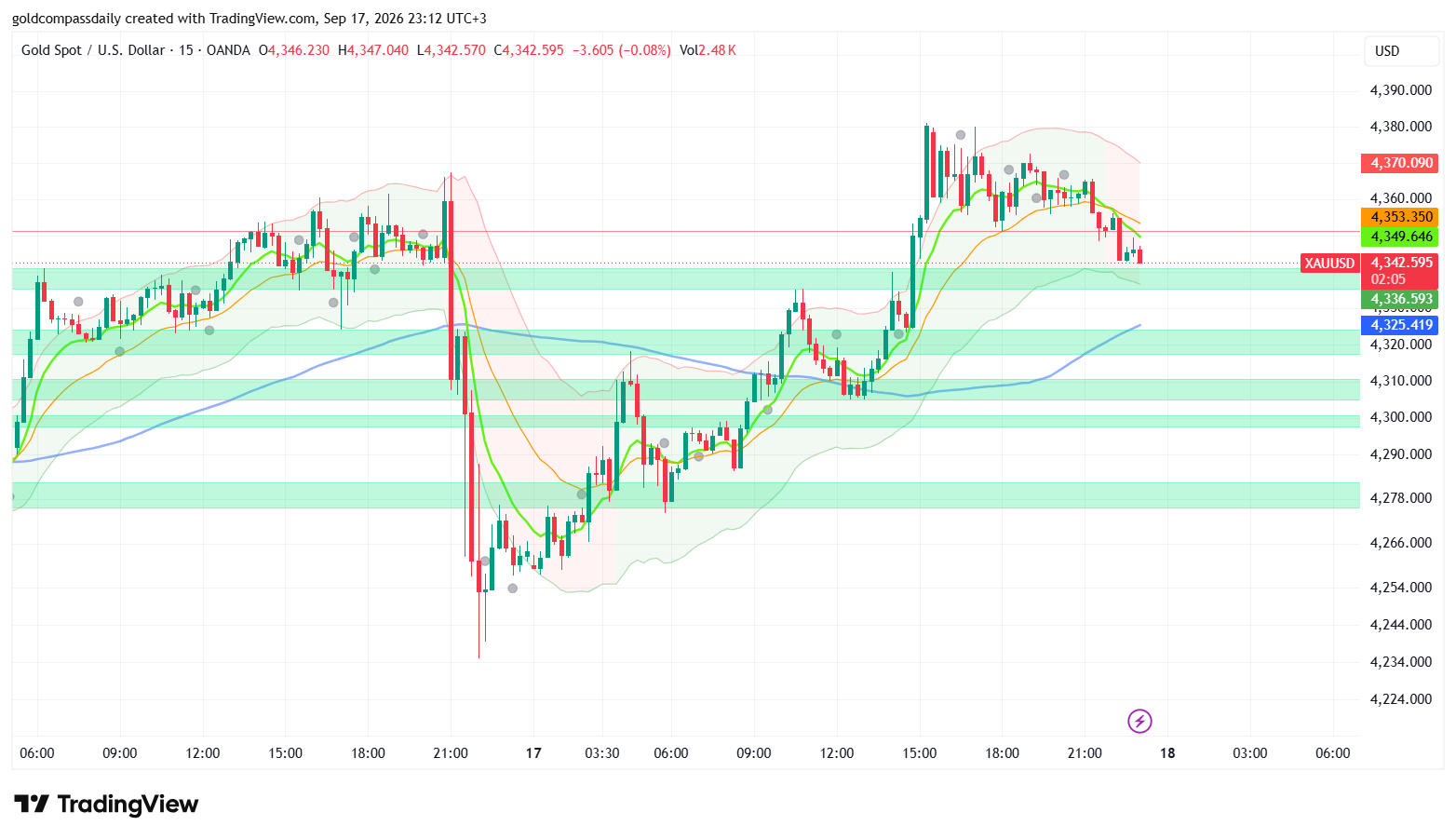
Gold closed the New York session at approximately $4,342 — bullish on the day, but with sellers taking control into the close — confirming the morning thesis in full while flagging a natural consolidation phase ahead. Gold Compass Daily’s morning analysis projected a bull trigger at $4,320 and a session target of $4,340; both were exceeded, with price reaching a session high of $4,382 before profit-taking trimmed gains into the close.
Updated Key Levels
- NY Close: ~$4,342
- Session high: $4,382 / Session low: $4,245 (FOMC flash-crash, early Asian)
- Bias into Asian session: Cautiously Bullish above $4,320
- Asian session support: $4,336 (current demand zone) → $4,320 → $4,308
- Asian session resistance: $4,353 (short-term MA cluster) → $4,370 (red supply band)
Chart Read at Close
The 15-minute chart at 23:12 UTC+3 shows gold pulling back from the $4,382 high into the $4,336–$4,349 green demand zone, closing at $4,342 with a sequence of bearish candles confirming seller control in the final hour of the New York session. The short-term green moving average has crossed below the orange, signaling the intraday momentum shift, while the long-term blue MA continues rising from below at $4,325 — preserving the broader bullish structure. Bollinger Bands are contracting after the explosive NY expansion, with price settling near the midline, consistent with a mean-reversion and compression phase rather than a trend reversal. The closing candle prints inside the upper green demand zone ($4,336–$4,349), which is the first structural test the Asian session must defend. A hold here keeps the day’s bullish structure intact; a breach shifts short-term bias neutral and exposes $4,320 and $4,308.
Asian Session Outlook
The Asian session (00:00–09:00 UTC+3) is expected to be range-bound between $4,336 and $4,370, with a bias toward a liquidity sweep before the London open. Given the extended NY rally from $4,280 to $4,382 — a $102 range in a single session — Asian participants are likely to test the sell side first, probing the $4,336–$4,320 zone for unfilled buy orders before any attempt at continuation. A sweep of NY session lows below $4,336 followed by a sharp recovery would be the highest-probability setup into the London open, and the most favorable entry condition for a continuation toward $4,370 during Friday’s European morning.
Next Day Bull / Bear Scenarios
Bull trigger: Asian session holds $4,336, followed by a London open reclaim above $4,353 — targets $4,370 and a potential retest of $4,382 into the Friday NY session.
Bear trigger: A sustained break below $4,320, particularly if the Asian session closes a 15-minute candle below that level — targets $4,308 and opens $4,278 as the next structural support, signaling that the post-FOMC recovery has entered a deeper consolidation.
Friday’s Key Events
- Tentative (Asian session) — BOJ Policy Rate (<1.25% expected): The primary overnight risk event for gold. A surprise hold below 1.00% or a hawkish shift in the Monetary Policy Statement would strengthen JPY and reduce safe-haven demand for gold; any dovish language keeps the yen soft and maintains gold’s bid.
- 2:30am UTC+3 — RBA Gov Bullock Speaks: AUD-centric but watched for global rate-path signals; a cautious tone on Australian growth supports the broader case against further tightening and is marginally gold-positive.
- 2:30am UTC+3 — Japan National Core CPI y/y (forecast 1.8%): In line with expectations; only moves gold meaningfully if it prints above 2.0% and triggers BOJ repricing.
- 9:00am UTC+3 — GBP Retail Sales m/m (forecast -0.2%, prev -0.5%): A second consecutive miss would reinforce the BoE’s cautious tone from Thursday, mildly supporting gold by reducing sterling and adding to the soft-growth narrative.
- 1:30pm UTC+3 — ECB President Lagarde Speaks: Any dovish pivot language on the eurozone growth outlook would weaken the euro, lift the dollar, and cap gold’s upside heading into the NY open.
- 4:15pm UTC+3 — USD Capacity Utilization (76.4%) + Industrial Production m/m (0.3%): The day’s primary US data. A beat on both — particularly Industrial Production above 0.3% — would signal resilient US output and reinforce the case for Fed restraint in cutting, pressuring gold. A miss extends the manufacturing weakness theme flagged by Thursday’s Philly Fed.
- 4:30pm UTC+3 — FOMC Member Bowman Speaks: First Fed communication post-Wednesday decision. Bowman has historically leaned hawkish; any signal supporting the dot plot’s hike-before-year-end scenario would be the sharpest gold headwind of the session.
- 6:45pm UTC+3 — FOMC Member Schmid Speaks: Second post-FOMC Fed voice. Watch for whether Schmid corroborates or softens Bowman’s tone; a divergence within the committee on the next move would create intraday volatility into the weekly close.
Analysis based on the XAU/USD 15-minute chart as of September 17, 2026, 08:43 UTC+3. This article is for informational and educational purposes only and does not constitute financial advice.