

Weekly Thesis
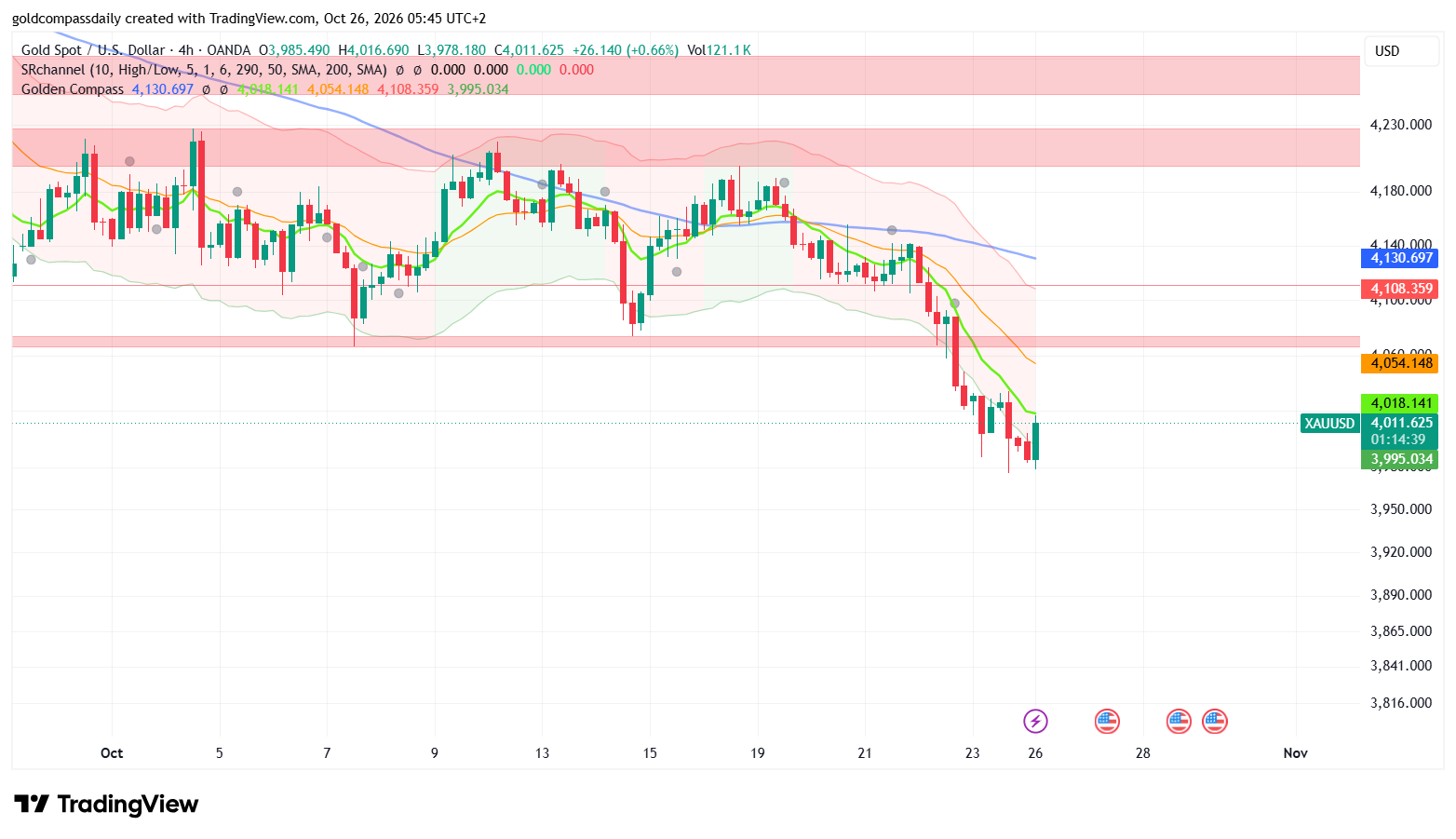
Gold enters the week of October 26–30 at $4,011.63 — a Bearish chart structure of lower highs and lower lows meets the heaviest central bank calendar of the month, and the Wednesday FOMC decision will determine whether Friday’s $3,976 low holds or breaks.
Gold Compass Daily reports that spot gold has fallen roughly 6% from the early-October peak near $4,225 and is trading below every major trend line on the 4-hour chart except the fastest. Monday’s early bounce of 0.66% is a test of overhead resistance, not a confirmed reversal, because price has yet to recover the $4,060–$4,075 band that gave way last Thursday.
The weekly bias is Bearish below $4,143. A recovery into the $4,054–$4,108 zone is the area where that bias is either confirmed by rejection or cancelled by acceptance.
Key Levels for the Week
- Weekly bias: Bearish below $4,143
- Key support: $3,976 → $3,950
- Key resistance: $4,054 → $4,108 → $4,143
- Weekly bull target: $4,143 (conditional on a non-hawkish FOMC press conference on Wednesday and Core PCE at or below 0.2% on Thursday)
- Weekly bear risk: $3,920 (conditional on a hawkish FOMC hold and Core PCE above the 0.3% forecast on Thursday)
- The floor: $3,976 — break below = the last chart-defined support is gone and gold trades in open space toward $3,950, $3,920 and $3,890
The $3,976 floor is the Friday, October 23 low, visible as the lowest wick on the 4-hour chart. The $4,143 ceiling sits just above the slow Golden Compass line at $4,130.70 and at the top of the $4,100–$4,155 consolidation shelf that held on October 21–22 before the breakdown. Both levels were checked against the chart and require no adjustment.
The $4,054 level is the Golden Compass mid line, and $4,108 is the flat reference line that capped price during the October 19–21 rebound attempts. The immediate pivot is $4,018, the fast line, which price is pressing from below at the time of writing. Below $3,976 the chart holds no price history, so the round-number markers at $3,950, $3,920 and $3,890 serve as working references rather than structural levels.
The Week’s Defining Event
The defining event of the week is the Federal Reserve decision on Wednesday, October 28 at 18:00 UTC, followed by the press conference with Fed Chair Kevin Warsh at 18:30 UTC. The consensus calls for the federal funds rate to stay at 4.00%, so the rate itself carries no surprise value and the entire market reaction will come from the statement wording and the tone of the press conference. That matters for gold because the metal is trading as a rate-sensitive asset at the moment: it broke its structural support while central banks elsewhere are expected to tighten, and any signal that the Fed intends to hold rates higher for longer would push the dollar and real yields up against a market that is already short of structure below $4,018. A softer message would give an oversold chart the catalyst it currently lacks. The FOMC also sets the frame for everything that follows, because Thursday’s Core PCE and GDP data arrive 18.5 hours after the Fed speaks and will either validate or contradict whatever the Fed signals. On Friday, FOMC members Daly and Musalem speak and can reinforce or soften the message. No other event this week touches US rate expectations, the dollar and inflation expectations at once, which is why the Fed outranks the ECB, the BOJ and the US GDP release.
Macro Context
Gold ends last week with a clean technical failure. The 4-hour chart shows a sequence of lower highs through October: the $4,225 area in the first days of the month, then roughly $4,210 around October 12–13, about $4,195 around October 19, and about $4,155 on October 21. The matching lows were $4,065 on October 7 and $4,072 on October 14, and that twin-low base gave way between Thursday, October 22 and Friday, October 23 in a run of large red candles that ended at $3,976. The market has therefore moved from a range to a downtrend, and the former support band at $4,060–$4,075 now acts as resistance. Price is trading between the Golden Compass lower band at $3,995.03 and the fast line at $4,018.14, while the mid line ($4,054.15), the flat reference line ($4,108.36) and the sloping slow line ($4,130.70) stack above it in a descending order that favors sellers on every rally.
The macro calendar leans toward tighter policy, which is the main pressure on a non-yielding asset. The consensus expects the Reserve Bank of New Zealand to lift its cash rate to 3.00% from 2.75% and the Bank of Canada to raise its overnight rate to 2.50% from 2.25%, both on Wednesday. Inflation data on the schedule point the same way: Australian CPI is forecast at 4.2% year on year against 4.0% prior, Spanish flash CPI at 4.9%, and US Core PCE at 0.3% month on month against 0.2% previously. If these readings land as expected, the data shows a global inflation backdrop in which rate cuts are not being priced in, and that lifts the opportunity cost of holding gold. The counterweight is that gold has already fallen about 6% from its early-October high, so a hawkish outcome may be partly priced in and a mild surprise can trigger sharp short covering.
Central bank exposure is unusually concentrated. Gold Compass Daily counts five policy decisions in five days: RBNZ and BoC on Wednesday, the Fed on Wednesday evening, the ECB on Thursday, and the BOJ on Friday, plus RBA Governor Bullock speaking early Wednesday. The ECB main refinancing rate is expected to stay at 2.65% and the BOJ policy rate is forecast to remain unchanged, so the cross-currency effect on the dollar depends on whether the ECB and BOJ sound more hawkish than expected. A weaker dollar from a firm ECB or BOJ would support gold, while the reverse would add to the Fed-driven pressure. US data adds a growth dimension, with Advance GDP forecast at 3.2% against 2.2% prior and the Employment Cost Index due Friday at 0.8%. Strong growth combined with sticky wage costs is the combination that would reinforce a hawkish Fed reading and keep gold capped.
Daily Event Calendar
All times are UTC. Events are listed with the consensus forecast and the previous reading. Events that fall on the next calendar date in Asia are flagged.
Monday, October 26
Monday offers little scheduled US data, so price action will be driven by positioning ahead of the central bank cluster.
- Monday, Oct 26 — 09:00 UTC — German ifo Business Climate (forecast 90.0, previous 89.9): a stronger print would support the euro and trim dollar strength, a small tailwind for gold, while a miss would reinforce a stronger-dollar tone that weighs on the metal.
Tuesday, October 27
Tuesday delivers the first US activity data of the week and sets expectations before the Fed.
- Tuesday, Oct 27 — 05:00 UTC — BOJ Core CPI y/y (forecast 1.9%, previous 1.8%): firmer Japanese inflation raises the odds of a hawkish BOJ on Friday, which can strengthen the yen against the dollar and ease pressure on gold.
- Tuesday, Oct 27 — 12:15 UTC — ADP Weekly Employment Change (previous 18.5K, no forecast): a weekly private-payroll reading offers an early look at labor market momentum, and a weak number would lift Fed-easing hopes ahead of Wednesday.
- Tuesday, Oct 27 — 12:30 UTC — Core Durable Goods Orders m/m (forecast 0.6%, previous 0.2%): a strong core reading supports the case for resilient US growth and a firmer dollar, which is a headwind for gold.
- Tuesday, Oct 27 — 12:30 UTC — Durable Goods Orders m/m (forecast 1.8%, previous -0.1%): the large swing from the prior month makes this headline number volatile, and a miss would be one of the few softer-growth signals of the week.
- Tuesday, Oct 27 — 14:00 UTC — CB Consumer Confidence (forecast 80.5, previous 81.9): a lower reading would show weakening household sentiment and support the bull case that the Fed has less room to stay hawkish.
- Tuesday, Oct 27 — 14:00 UTC — New Home Sales (forecast 649K, previous 684K): a forecast decline signals rate-sensitive housing is under pressure, and a larger drop would reinforce the soft-landing narrative that helps gold.
Wednesday, October 28
Wednesday is the highest-risk day of the week, with three central bank decisions, a UK fiscal statement and the Fed.
- Wednesday, Oct 28 — 00:15 UTC — RBA Governor Bullock speaks: her tone on inflation will shape global rate expectations before the Australian data and can move the dollar in the Asian session.
- Wednesday, Oct 28 — 00:30 UTC — Australia CPI y/y (forecast 4.2%, previous 4.0%) and CPI m/m (forecast 0.7%, previous 0.4%): hotter inflation feeds the global tightening narrative and keeps real yields supported, which weighs on gold.
- Wednesday, Oct 28 — 01:00 UTC — RBNZ Official Cash Rate (forecast 3.00%, previous 2.75%): the expected hike confirms that tightening is not confined to one region, and a surprise hold would soften the dollar and give gold a lift.
- Wednesday, Oct 28 — 12:30 UTC — UK Annual Budget and Autumn Forecast Statement: fiscal surprises can move sterling and gilt yields, which feed into the dollar and global bond yields that gold tracks.
- Wednesday, Oct 28 — 12:30 UTC — US Goods Trade Balance (forecast -130.8B, previous -132.1B): a wider deficit is a minor dollar headwind, but the release matters mostly as a warm-up for the Fed.
- Wednesday, Oct 28 — 13:45 UTC — BoC Overnight Rate (forecast 2.50%, previous 2.25%) and rate statement, with the press conference at 14:30 UTC: another expected hike would add to the global tightening picture, so a dovish BoC tone is the sort of surprise that could weaken the dollar.
- Wednesday, Oct 28 — 14:30 UTC — US Crude Oil Inventories (forecast -0.3M, previous -3.1M): the energy complex feeds inflation expectations, and gold reacts to any oil move that changes the inflation or rate outlook.
- Wednesday, Oct 28 — 18:00 UTC — FOMC Federal Funds Rate (forecast 4.00%, previous 4.00%) and statement: the rate is expected to hold, so the wording on inflation and the policy path is the real signal for dollar and yield direction.
- Wednesday, Oct 28 — 18:30 UTC — FOMC Press Conference: the most important event of the week, since any hint of future hikes or extended restraint will resolve whether $3,976 holds.
Thursday, October 29
Thursday is the data confirmation day, with the Fed’s preferred inflation gauge and the ECB decision both landing within about an hour.
- Thursday, Oct 29 — 12:30 UTC — US Advance GDP q/q (forecast 3.2%, previous 2.2%): a beat points to resilient growth that supports the dollar and challenges gold, while a miss would help recovery attempts.
- Thursday, Oct 29 — 12:30 UTC — US Core PCE Price Index m/m (forecast 0.3%, previous 0.2%): this is the Fed’s preferred inflation measure and the key data point of the week, because 0.4% or higher would confirm the hawkish case and 0.2% or lower would challenge it.
- Thursday, Oct 29 — 12:30 UTC — US Advance GDP Price Index q/q (forecast 3.5%, previous 6.1%): the forecast shows a sharp slowdown in the price component, and a result above 3.5% would undermine the disinflation story.
- Thursday, Oct 29 — 12:30 UTC — US Personal Income m/m (forecast 0.3%, previous 0.2%) and Personal Spending m/m (forecast 0.6%, previous 0.9%): spending that comes in above forecast reinforces consumer strength and the dollar, while a miss supports the soft-landing case.
- Thursday, Oct 29 — 12:30 UTC — US Unemployment Claims (forecast 198K, previous 194K): a reading well above forecast would hint at labor-market cooling and revive Fed-easing expectations, which would help gold.
- Thursday, Oct 29 — 13:15 UTC — ECB Main Refinancing Rate (forecast 2.65%, previous 2.65%) and policy statement, with the ECB press conference at 13:45 UTC: a hold is expected, so the tone on inflation drives the euro and, through it, the dollar index that gold trades against.
Friday, October 30
Friday closes the week with Japanese data, the BOJ decision, European inflation and growth prints, and two Fed speakers who can move the market after the FOMC.
- Friday, Oct 30 — 23:30 UTC (Oct 29) — Japan Tokyo Core CPI y/y (forecast 2.6%, previous 2.7%) and Unemployment Rate (forecast 2.5%, previous 2.5%): a cooler Tokyo CPI would lower the odds of a hawkish BOJ and could weaken the yen, a mild negative for gold.
- Friday, Oct 30 — 23:50 UTC (Oct 29) — Japan Prelim Industrial Production m/m (forecast 1.3%, previous -2.4%) and Retail Sales y/y (forecast 3.4%, previous 2.9%): the data adds to the BOJ’s decision backdrop and can move the yen in the Asian session.
- Friday, Oct 30 — Tentative, time to be confirmed — BOJ Policy Rate (forecast below 1.25%, previous below 1.25%), policy statement, Outlook Report and press conference: an unchanged rate is expected, and any hawkish shift in the outlook would support the yen and weigh on the dollar, which would lift gold.
- Friday, Oct 30 — 06:30 UTC — French Flash GDP q/q (forecast 0.1%, previous 0.0%): the first of the eurozone growth prints can set the tone for the euro ahead of the aggregate figure.
- Friday, Oct 30 — 08:00 UTC — Spanish Flash CPI y/y (forecast 4.9%, previous 4.9%): inflation near 5% keeps the ECB under hawkish pressure and supports the euro against the dollar.
- Friday, Oct 30 — 09:00 UTC — German Prelim GDP q/q (forecast 0.1%, previous 0.3%): a weaker figure points to eurozone growth risk, which can pressure the euro and lift the dollar, a headwind for gold.
- Friday, Oct 30 — All day, time to be confirmed — German Prelim CPI m/m (forecast 0.1%, previous 0.6%): a drop from the previous reading would ease ECB tightening bets and soften the euro.
- Friday, Oct 30 — 10:00 UTC — Eurozone Prelim Flash GDP q/q (forecast 0.2%, previous 0.6%) and Unemployment Rate (forecast 6.4%, previous 6.4%): the slowdown in forecast growth is a direct input into euro direction after the ECB meeting.
- Friday, Oct 30 — 12:30 UTC — US Employment Cost Index q/q (forecast 0.8%, previous 0.9%): wage costs feed core inflation, and a reading above 0.8% would reinforce the hawkish Fed narrative one day after Core PCE.
- Friday, Oct 30 — 12:30 UTC — Canada GDP m/m (forecast 0.2%, previous 0.0%): the data follows the BoC decision and can shift the Canadian dollar, with a smaller second-order effect on the dollar index.
- Friday, Oct 30 — 13:45 UTC — US Chicago PMI (forecast 54.8, previous 58.8): a sharper fall than forecast would show manufacturing losing momentum, which supports gold at the week’s close.
- Friday, Oct 30 — 16:00 UTC — FOMC Member Daly speaks: the first Fed commentary after the decision and the data, so it either extends or tempers Wednesday’s market reaction.
- Friday, Oct 30 — 16:30 UTC — FOMC Member Musalem speaks: the last major event of the week, and any hawkish or dovish nuance will shape weekly closing levels around $3,976 and $4,054.
Weekly Bull / Bear Scenarios
Bull case
The bull case requires several things to line up. Tuesday’s activity data should miss, led by CB Consumer Confidence below 80.5 and New Home Sales below 649K, and the FOMC must hold at 4.00% without signaling further tightening. Thursday then needs to deliver Core PCE at or below 0.2% with GDP or personal spending below forecast. Under this combination, gold reclaims the $4,018 fast line, then pushes through the $4,054 mid line, and a close above $4,054 would signal that the Thursday–Friday breakdown has become a failed move. The next hurdle is the $4,108 flat reference line, followed by the weekly target at $4,143, where the slow line at $4,130.70 and the top of the October 21–22 shelf converge. A move beyond $4,143 would be needed to cancel the bearish structure, and that is beyond the base expectation for this week.
Bear case
The bear case starts with a hawkish Fed hold, such as language that keeps further hikes open or pushes back against easing, combined with Core PCE above 0.3% or GDP above 3.2%. Add a hot Employment Cost Index on Friday and an ECB or BOJ that fails to lift the euro or yen, and the dollar is likely to firm throughout the week. In that case, price rejects the $4,018–$4,054 zone, loses the $3,995.03 lower band and breaks $3,976. With no structure below, the next references are $3,950 and then the weekly downside risk at $3,920, with an extension toward $3,890 if Thursday’s data and the Fed message reinforce one another. A 4-hour close below $3,976 would be the confirmation signal, and until that happens a break remains a risk rather than a fact.
Base case
The base case, consistent with the chart structure and a Fed hold, is a range between $3,976 and $4,108 with rallies facing supply at $4,054 and $4,108. Gold Compass Daily expects the sharpest volatility between 18:00 and 19:00 UTC on Wednesday and again at 12:30 UTC on Thursday. Until price closes a 4-hour candle above $4,143 or below $3,976, the data shows a market that is oversold but not yet repaired.
Analysis based on the XAU/USD 4H chart as of October 26, 2026, 05:45 UTC+2. This article is for informational and educational purposes only and does not constitute financial advice.