

Weekly Thesis
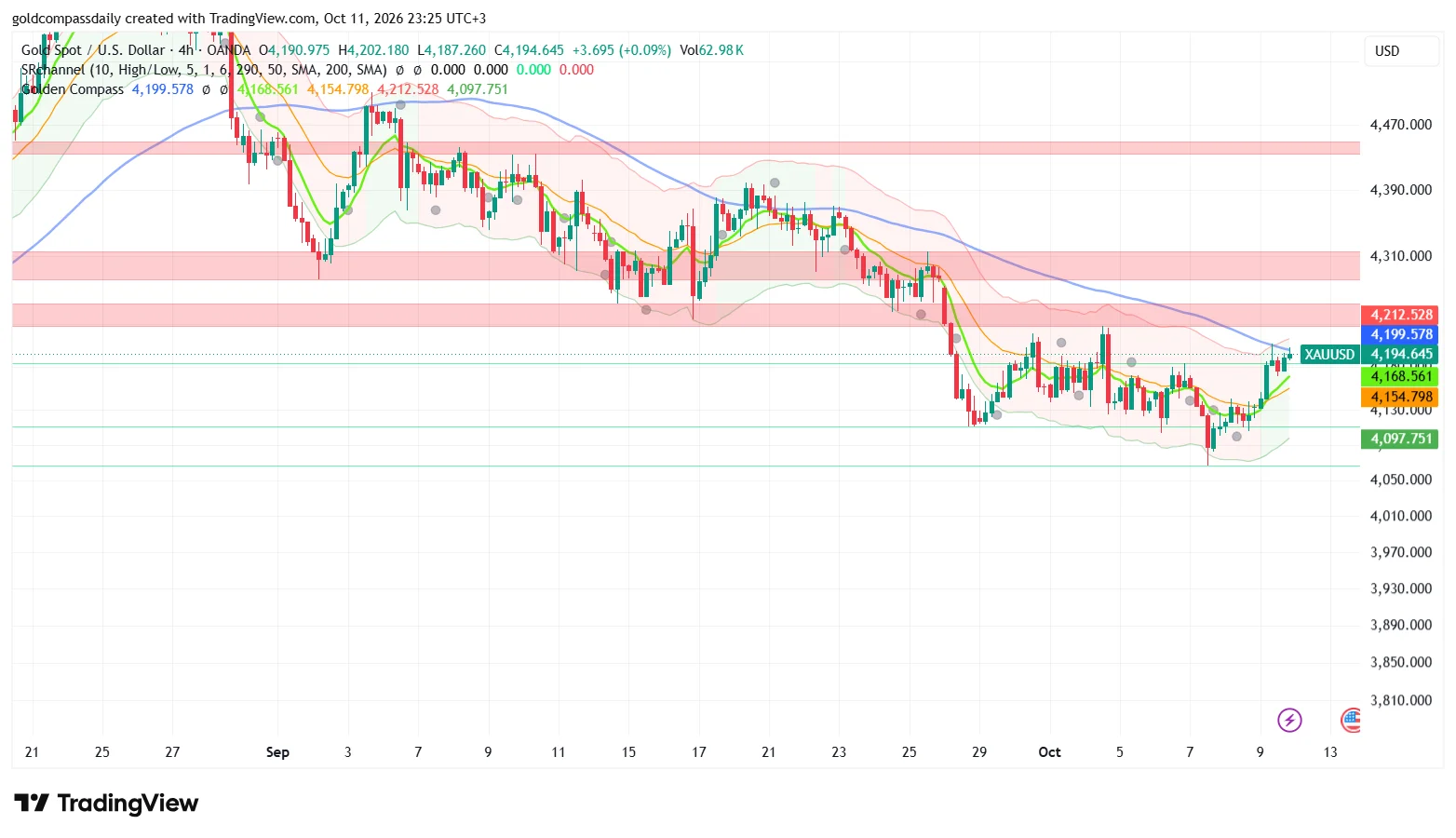
Gold enters the week of October 12-16 at $4,194.65 — a recovery from the October 7 low near $4,070 has pushed XAU/USD into the 200-period moving average at $4,199.58, and Wednesday’s U.S. CPI report will decide whether that barrier gives way or turns the bounce back down.
The weekly bias is Cautiously Bullish. The 4-hour chart shows momentum has turned up: price sits above the 50-period average at $4,154.80, and the faster average at $4,168.56 is rising beneath it. The caution comes from structure. The 200-period average is still sloping lower, price is pressed against its underside, and the sequence of lower highs from early September has not been broken. A 4-hour close above $4,225 would be the first chart evidence that it has.
Key Levels for the Week
- Weekly bias: Cautiously Bullish above $4,155 (50-period average). Neutral between $4,155 and $4,111. Bearish on a 4-hour close below $4,111.
- Key support: $4,168 → $4,155 → $4,111. The first two levels are the fast and 50-period averages, which now sit close together. $4,111 is the zone that held on September 29 and, within a few dollars, matches last week’s $4,120 floor.
- Key resistance: $4,200 → $4,225 → $4,250. The 200-period average at $4,199.58 and the channel’s upper band at $4,212.53 sit inside the first leg. The $4,225–$4,250 supply zone capped the October 4 spike.
- Weekly bull target: $4,280 (conditional on core CPI printing at or below 0.2% m/m on Wednesday and price holding above $4,155). The extension is $4,315, the top of the next supply zone.
- Weekly bear risk: $4,068 (conditional on a hot core CPI reading and a hawkish tone from Fed Chair Warsh on Friday). That is a retest of the October 7 low.
- The floor: $4,050 — a break below it means the October 7 rejection has failed and the lower-low sequence resumes. The chart marks no support below that level until the $3,970–$3,930 area.
The $4,050–$4,200 range supplied for the week is confirmed. The $4,050 floor sits just under the October 7 low, and $4,200 coincides with the 200-period average. Two adjustments apply. The first is $4,212.53, the channel’s upper band, as a marker inside the first resistance leg. The second is the $4,225–$4,250 supply zone, which is the real test of whether the recovery has changed the trend.
The Week’s Defining Event: U.S. CPI, Wednesday, October 14, 12:30 UTC
The U.S. consumer price index is the one release that can move gold through its 200-period average, and it lands exactly where price is sitting. The forecasts show a wide gap between headline and core inflation. Headline CPI is expected at 0.6% m/m (previous 0.4%) and 3.6% y/y (previous 3.4%), while core is expected at 0.2% m/m (previous 0.3%) and 2.5% y/y (previous 2.4%). The Federal Reserve places more weight on core, so a core print at or below 0.2% would let gold look past the hot headline and could carry price above $4,225. A core print of 0.3% or more, with headline at or above 0.6%, would reinforce the rate-path pressure that drove the September decline, and the 200-period average would likely cap price again. The timing adds weight, because CPI arrives after a thin U.S. holiday session on Monday and sets the starting point for Thursday’s retail sales and PPI and for Chair Warsh’s remarks on Friday. Every other event on the calendar either prepares the market for CPI or reacts to it.
Macro Context
Gold Compass Daily reports that the 4-hour OANDA chart shows a market recovering inside a downtrend rather than reversing it. Last week’s hub, Gold Week Ahead: Oct 5-9 — FOMC Minutes Test $4,120 Floor, identified $4,120 as the level that mattered. The October 7 sell-off pushed through it and printed a low near $4,070, but buyers defended the zone. A large 4-hour candle on Friday, October 9 then lifted price above the 50-period average, and gold has since traded in a $4,187–$4,202 range. That is a gain of roughly $125, or about 3%, off the low. Against that, the highs are still falling: roughly $4,500 in early September, roughly $4,310 on September 25, and roughly $4,225 on October 4 (levels estimated from the chart). This matters for the week because the $4,200–$4,250 area is where the last rebound failed, and it is where this one must prove itself.
The calendar’s forecast numbers show inflation as the common thread across major economies. U.S. headline CPI is expected to accelerate to 3.6% y/y. Eurozone final CPI is forecast at 3.8% y/y on Friday, and German final CPI is forecast at 0.6% m/m on Tuesday. China’s PPI is expected to rise to 4.5% y/y from 3.8% on Wednesday. For gold, rising prices pull in two directions. They strengthen the case for holding gold as an inflation hedge, but if they push central banks toward tighter policy, they raise the cost of holding an asset that pays no yield. The September slide suggests the second channel has carried more weight recently. The U.S. activity data adds a twist: retail sales are forecast to cool sharply to 0.3% m/m from 1.2%, and core retail sales to 0.5% from 1.4%. The Philly Fed index is forecast at 26.5 (previous 37.8) and the Empire State index at 3.2 (previous 7.6). Hot prices combined with slowing demand is the mix most likely to produce a mixed gold reaction, so Wednesday and Thursday should be read together.
The central bank calendar is crowded. Six Fed officials — Hammack, Waller, Barkin, Collins, Bowman and Warsh — have nine scheduled appearances this week. The Beige Book arrives on Wednesday, two weeks ahead of the late-October FOMC meeting, and Warsh speaks on Friday, the last public window before the Fed’s customary pre-meeting blackout. The IMF meetings run all week, which puts Lagarde (twice on Wednesday), Bailey (Wednesday, Thursday and Friday), Macklem (Wednesday and Friday) and SNB Chairman Schlegel (Thursday) in front of microphones. Their comments move the euro, sterling, the Canadian dollar and the Swiss franc, and through them the dollar index, which gold tends to trade against. UK GDP on Thursday (forecast -0.1% m/m, previous 0.4%) adds a sterling catalyst. Taken together, the week carries more speaking risk than scheduled data risk until Wednesday, which favors a compressed range early in the week and a directional move once CPI is out.
Daily Event Calendar
All times are UTC. Source calendar times in UTC+3 were converted by subtracting three hours.
Monday, October 12
- Monday, Oct 12 — All Day — U.S. Bank Holiday (Japan and Canada also closed): Treasury trading is shut and liquidity thins, so Monday’s price action carries less conviction than a normal session.
- Monday, Oct 12 — 09:30 — BoE MPC Member Breeden Speaks (scheduled remarks): the first of three Breeden appearances this week, with any sterling move feeding the dollar index.
- Monday, Oct 12 — 12:50 — BoE MPC Member Mann Speaks (scheduled remarks): adds to the early-week UK policy signal that can move GBP/USD.
- Monday, Oct 12 — All Week — IMF Meetings, Day 1: central bank heads gather, and their remarks through Friday can move currencies and, through them, gold.
- Monday, Oct 12 — 16:10 — FOMC Member Hammack Speaks (scheduled remarks): the first Fed voice of the week, and the first read on how policymakers frame inflation before CPI.
Tuesday, October 13
- Tuesday, Oct 13 — 06:00 — German Final CPI m/m (forecast 0.6%, previous 0.6%): a print above forecast would feed the inflation theme before U.S. CPI.
- Tuesday, Oct 13 — 07:45 — FOMC Member Waller Speaks (scheduled remarks): a Fed governor’s view on inflation 29 hours before CPI can shift rate-cut pricing.
- Tuesday, Oct 13 — 10:00 — NFIB Small Business Index (forecast 98.0, previous 98.7): a further slide would add to the cooling-demand picture that matters for Thursday’s retail sales.
- Tuesday, Oct 13 — 12:15 — ADP Weekly Employment Change (previous 23.8K): a fresh read on U.S. hiring that feeds rate expectations ahead of CPI.
- Tuesday, Oct 13 — 14:00 — Existing Home Sales (forecast 3.96M, previous 3.98M): housing is the most rate-sensitive part of the economy, and weakness supports the case for easier policy.
- Tuesday, Oct 13 — 17:00 — FOMC Member Barkin Speaks (scheduled remarks): the first of two Barkin appearances this week, both close to CPI.
- Tuesday, Oct 13 — 20:00 — FOMC Member Collins Speaks (scheduled remarks): the last Fed voice before CPI and the final word on Tuesday.
- Tuesday, Oct 13 to Thursday, Oct 15 — Tentative — China M2 Money Supply y/y (forecast 7.5%, previous 7.5%) and New Loans (forecast 300B, previous 60B): China is a major physical gold buyer, and credit growth is a read on domestic liquidity.
Wednesday, October 14
- Wednesday, Oct 14 — 01:30 — China CPI y/y (forecast 1.0%, previous 0.8%) and PPI y/y (forecast 4.5%, previous 3.8%): rising factory-gate prices in the world’s largest gold-consuming market add to the global inflation theme.
- Wednesday, Oct 14 — Tentative — China Trade Balance (forecast 805B yuan, previous 809B) and USD-Denominated Trade Balance (forecast 118.1B, previous 119.1B): a sizable external surplus keeps the dollar-yuan relationship in focus.
- Wednesday, Oct 14 — 02:10 and 08:30 — ECB President Lagarde Speaks (scheduled remarks): two appearances can move the euro, the largest weight in the dollar index.
- Wednesday, Oct 14 — 05:30 — BoE Governor Bailey Speaks (scheduled remarks): sets the sterling tone going into U.S. CPI.
- Wednesday, Oct 14 — 06:05 — BoC Governor Macklem Speaks (scheduled remarks): the Canadian dollar is a dollar-index-adjacent move that can influence gold’s dollar leg.
- Wednesday, Oct 14 — 09:40 — FOMC Member Bowman Speaks (scheduled remarks): her last remarks before CPI and a read on how the Fed frames inflation risk.
- Wednesday, Oct 14 — 12:30 — U.S. CPI m/m (forecast 0.6%, previous 0.4%), CPI y/y (forecast 3.6%, previous 3.4%), Core CPI m/m (forecast 0.2%, previous 0.3%), Core CPI y/y (forecast 2.5%, previous 2.4%): the week’s defining release, arriving as gold tests the 200-period average.
- Wednesday, Oct 14 — 17:30 — FOMC Member Barkin Speaks (scheduled remarks): the first Fed commentary after CPI, so the first read on how the print is being interpreted.
- Wednesday, Oct 14 — 18:00 — Beige Book: anecdotal evidence on prices and activity ahead of the late-October FOMC meeting, adding context to the CPI reaction.
Thursday, October 15
- Thursday, Oct 15 — 00:30 — Australia Employment Change (forecast 20.0K, previous 39.5K) and Unemployment Rate (forecast 4.6%, previous 4.6%): sets the Asia-session tone for AUD, a commodity-linked currency.
- Thursday, Oct 15 — 04:30 — SNB Chairman Schlegel Speaks (scheduled remarks): the Swiss franc is a traditional safe-haven peer, and its moves can echo in gold.
- Thursday, Oct 15 — 06:00 — UK GDP m/m (forecast -0.1%, previous 0.4%), Industrial Production m/m (forecast -0.1%, previous 0.2%), Manufacturing Production m/m (forecast 0.1%, previous 0.9%): a contraction would pressure sterling and lift the dollar index.
- Thursday, Oct 15 — 07:30 — BoE Governor Bailey Speaks (scheduled remarks): his second appearance of the week, with GDP just out.
- Thursday, Oct 15 — 12:30 — U.S. Retail Sales m/m (forecast 0.3%, previous 1.2%) and Core Retail Sales m/m (forecast 0.5%, previous 1.4%): a soft print would support the stagflation-style bid for gold, while a strong one would reinforce the rate-path pressure.
- Thursday, Oct 15 — 12:30 — U.S. PPI m/m (forecast 0.5%, previous 0.4%) and Core PPI m/m (forecast 0.3%, previous 0.2%): producer prices a day after CPI either confirm or contradict Wednesday’s inflation signal.
- Thursday, Oct 15 — 12:30 — Unemployment Claims (forecast 195K, previous 197K), Philly Fed Manufacturing Index (forecast 26.5, previous 37.8), Empire State Manufacturing Index (forecast 3.2, previous 7.6): the survey readings are forecast to cool, and a sharper drop would feed the slowing-demand case.
- Thursday, Oct 15 — 20:30 — FOMC Member Hammack Speaks (scheduled remarks): her second appearance of the week, and the first Fed voice after retail sales and PPI.
Friday, October 16
- Friday, Oct 16 — 02:00 — BoE Governor Bailey Speaks (scheduled remarks): his third appearance of the week, in the Asian session.
- Friday, Oct 16 — 03:30 — Fed Chairman Warsh Speaks (scheduled remarks): the single most important policy voice, speaking ahead of the Fed’s customary pre-meeting blackout, which makes it the likeliest source of a weekly-closing move.
- Friday, Oct 16 — 04:15 — BoC Governor Macklem Speaks (scheduled remarks): his second appearance of the week, adding Canadian-dollar volatility to the Asian session.
- Friday, Oct 16 — 09:00 — Eurozone Final CPI y/y (forecast 3.8%, previous 3.8%) and Final Core CPI y/y (forecast 2.5%, previous 2.5%): a revision away from forecast would move the euro and the dollar index into the weekly close.
- Friday, Oct 16 — 12:30 — U.S. Import Prices m/m (forecast 0.6%, previous 0.7%): a last inflation data point of the week, with elevated prices keeping the rate debate alive.
- Friday, Oct 16 — 13:15 — U.S. Industrial Production m/m (forecast 0.4%, previous 0.0%) and Capacity Utilization Rate (forecast 76.5%, previous 76.3%): a stronger factory sector would reinforce the rate-path read, and a weaker one would soften it.
- Friday, Oct 16 — 20:00 — TIC Long-Term Purchases (forecast 125.7B, previous -27.9B): a swing in foreign demand for U.S. assets can move the dollar into the weekend close.
Weekly Bull / Bear Scenarios
Base Case: Compression Until CPI
With the U.S. closed on Monday and the Fed speaking more than data is released early in the week, the likeliest path is a $4,155–$4,215 range through Tuesday, with the 200-period average acting as the ceiling and the 50-period average as the floor. Wednesday’s CPI is the break point, and the direction of that break sets the scenario for the rest of the week.
Bull Case
Bull case: core CPI at or below 0.2% m/m on Wednesday, retail sales at or below forecast on Thursday, and no hawkish surprise from Warsh on Friday → weekly price target $4,280, with an extension to $4,315.
The sequence matters. A soft core print should lift price through the 200-period average at $4,199.58 and the upper band at $4,212.53. The decisive step is a 4-hour close above $4,225, because that would be the first higher high since September 4 and would break the pattern of failed rebounds. A close above $4,250 would clear the supply zone that capped the October 4 spike and open the path to $4,280, where the next supply zone begins. Throughout, the 50-period average at $4,155 is the line the bull case cannot lose. A 4-hour close below it would turn the recovery into a failed breakout.
Bear Case
Bear case: core CPI at 0.3% or above with headline at or above 0.6%, firm core retail sales on Thursday, and a hawkish Warsh on Friday → weekly downside risk $4,068, with $4,050 as the floor.
In this path, the 200-period average caps the rebound again, and price rolls back through $4,168 and $4,155, where the fast and 50-period averages sit close together. A 4-hour close below $4,155 would hand control back to sellers and expose $4,111, the zone that held on September 29. A close below $4,111 would target $4,068, the October 7 low. A break of $4,050 would mean the October 7 rejection has failed, and the chart shows no marked support until the $3,970–$3,930 area. The bear case does not require a collapse in any one data point. A slightly firm CPI, solid retail sales and a cautious Fed Chair would be enough to restore the lower-high pattern.
What Would Change the View
A hot headline CPI with a soft core is the mixed outcome to watch. Gold Compass Daily reports that the first reaction to that combination is likely to be volatile, so the 4-hour close after the release matters more than the initial spike. If price closes back inside the $4,155–$4,200 range after a spike in either direction, the base case of compression remains in force into Thursday.
Analysis based on the XAU/USD 4-hour chart as of October 11, 2026, 23:25 UTC+3. This article is for informational and educational purposes only and does not constitute financial advice.