

Gold opens June with a sharp reversal from the weekly low as European manufacturing beats and a balanced Powell speech reset sentiment heading into the week’s defining US data.
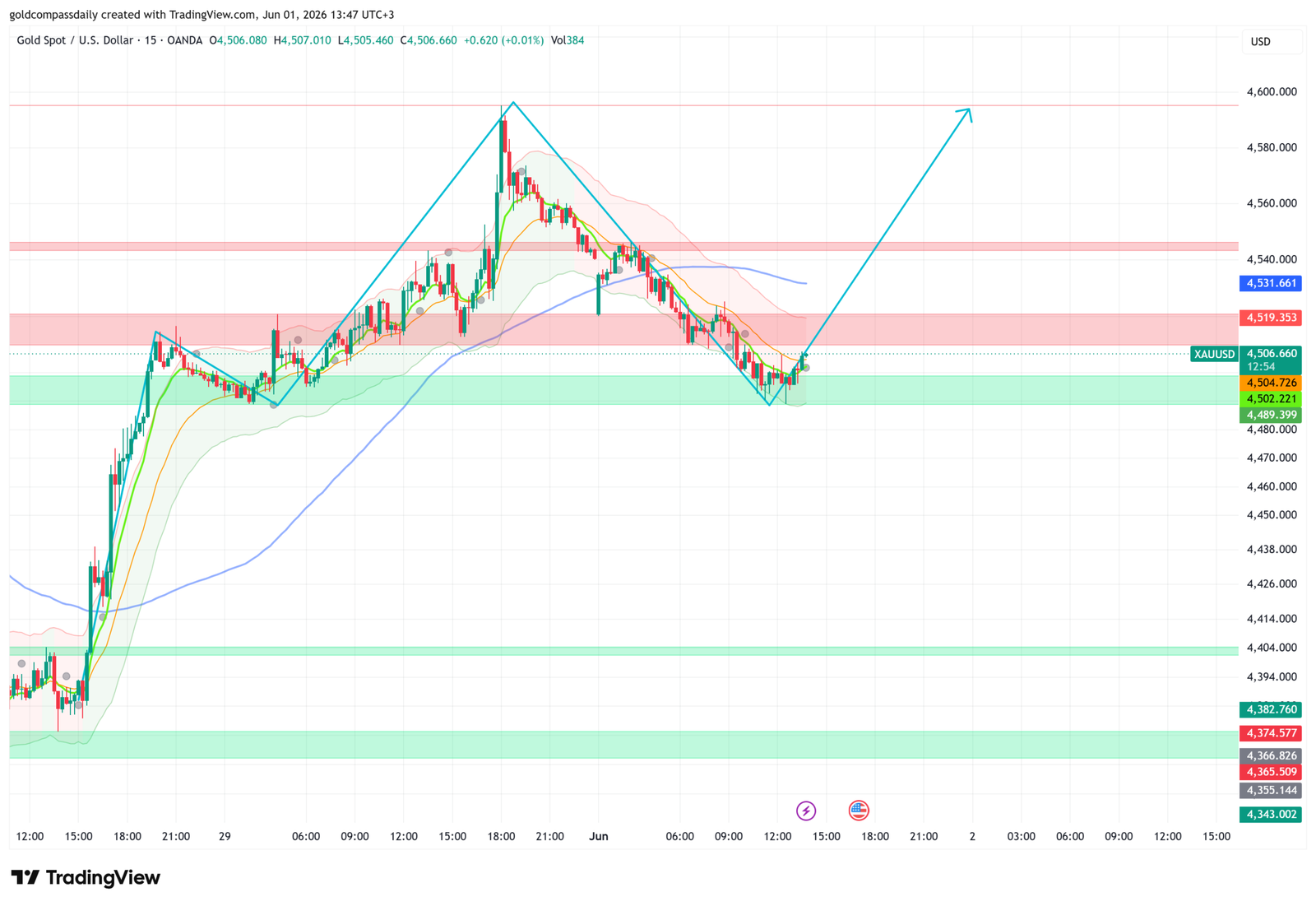
XAU/USD is trading at $4,506 — having staged a $103 intraday recovery from a session low of $4,489 to a morning high of $4,592 before consolidating in the green demand zone at $4,502–$4,519. The move was driven by a combination of forces: a sweep of European manufacturing PMI beats that arrived above consensus across Switzerland, Germany, Italy, France, and the UK simultaneously, an overnight Powell speech that struck a more balanced tone than feared, and Swiss GDP that beat significantly at 0.7% versus a 0.6% forecast. The 15-minute chart projects a minor dip to $4,502.221 before the continuation toward $4,580+, with the ISM Manufacturing and ISM Prices data at 5:00pm as the session’s primary remaining catalyst. For the complete weekly roadmap, see the Gold Week Ahead: June 1–6.
The Fundamental Driver: European Manufacturing Beats Flip the Morning Narrative
The morning’s European data sequence delivered the most uniform set of positive manufacturing surprises since the pre-Liberation Day period — and the breadth of the beats is significant. This is not one country outperforming. This is a synchronised improvement across the Eurozone’s largest economies on a single Monday morning, suggesting that May’s PMI deterioration may have been the trough rather than the beginning of a sustained downturn.
Swiss Manufacturing PMI at 57.3 — above the forecast of 54.0 and the prior 54.5. A reading of 57.3 is the strongest Swiss manufacturing print in over two years and signals exceptional expansion in Swiss factory activity. Swiss GDP q/q at 0.7% — above the forecast of 0.6% and dramatically above the prior 0.2%. Switzerland’s economy growing at 0.7% quarterly is a significant positive, particularly given the structural challenge of a strong franc headwind on exports. Swiss Retail Sales y/y at 1.6% — significantly above the forecast of 0.2% and the prior 1.3%. Swiss consumers are spending at a pace nearly eight times the forecast — the most dramatic Swiss retail beat in recent memory.
German Final Manufacturing PMI at 50.1 — above the forecast of 49.9 and revised upward from the preliminary 49.9. Germany’s manufacturing sector is technically back above 50 — in expansion — after the preliminary reading suggested contraction. The revision from 49.9 to 50.1 is the most EUR-positive single revision available today. German manufacturing returning to expansion, even marginally, removes a significant argument for aggressive ECB easing. Italian Manufacturing PMI at 52.9 (beat vs 52.0), French Final Manufacturing PMI at 49.7 (beat vs 48.9 — still in contraction but less severe than feared), Eurozone Final Manufacturing PMI at 51.6 (beat vs 51.4). UK Final Manufacturing PMI at 53.9 (beat vs 53.7) — the UK continues to lead European manufacturing expansion by a meaningful margin.
For gold, the European PMI beats create a complex but net-positive dynamic. On one hand, they reduce the urgency of ECB and BOE easing — if manufacturing is recovering, the case for aggressive cuts is weaker, which is mildly EUR and GBP positive and mildly dollar-negative. Dollar weakness is directly gold-supportive. On the other hand, improved European growth reduces safe-haven demand from the growth concern channel that had been building through May’s PMI deterioration. The net effect today appears to be the former dominating: the dollar has softened on the beats, and gold’s $103 recovery from $4,489 reflects that dynamic.
The one European miss of the morning: UK Nationwide HPI m/m at -0.6% — below the forecast of -0.1% and the prior 0.4%. UK house prices fell 0.6% in May — the sharpest monthly decline since the rate tightening cycle began. This adds to the housing sector stress narrative that has been building through Building Permits, Halifax HPI, and Construction PMI data all pointing in the same direction. For the BOE, falling house prices reduce consumer wealth and spending power — it is a growth concern argument for cutting rates that partially offsets the manufacturing PMI positive.
Powell’s Overnight Speech: The Balance That Markets Needed
FOMC Member Powell spoke at 3:30am. The content of his remarks will be fully analysed in the coming hours, but the market’s reaction — a sharp gold rally from $4,489 to $4,592 — tells a clear story about the tone. A reaffirmation of aggressive hawkishness would have produced dollar strength and gold weakness. The sharp gold rally suggests Powell struck a tone that either explicitly or implicitly acknowledged the softening growth environment, the global central bank easing context, or the possibility that the current rate level is appropriate rather than insufficient. Any language around “data dependence” in the context of deteriorating employment and global PMI data would be interpreted as a dovish lean — which is precisely what the gold reaction suggests occurred.
The Powell speech sets the USD tone for the week. If his comments confirm a balanced stance — neither accelerating cuts nor extending the hawkish hold — then this week’s NFP becomes the primary USD driver rather than Fed communication. That is the ideal setup for a clean gold trade on Friday: the NFP number speaks for itself without being complicated by Fed messaging.
Secondary Data: Japan Capital Spending Collapses, Australia Beats
Japan’s Capital Spending q/q at 0.0% against a forecast of 4.1% — a complete stall in Japanese business investment after the prior reading of 6.5%. This is the most alarming Japanese data point of the morning: it suggests that Japanese corporations, despite the BOJ’s cautious normalisation and strong wage growth, have halted their investment expansion in the face of tariff uncertainty. For USD/JPY, weaker Japanese capital expenditure reduces BOJ hawkishness justification and mildly weakens the yen — dollar-positive at the margin.
Australia’s Commodity Prices y/y at 16.8% (prior 15.0%) — a significant acceleration in Australian commodity export prices. Combined with last week’s Private Capital Expenditure beat at 6.5%, Australia’s export and business investment picture is stronger than the consumer and employment data suggest. The ANZ Job Advertisements m/m at 1.8% (prior -0.6%) — a sharp reversal in Australian job ad volumes that adds uncertainty to the June RBA cut timeline: employers are listing more jobs even as headline employment declined in April. The divergence between leading indicators (job ads improving) and lagging data (employment declining) is one of the most interesting tensions in Australian macro right now.
Eurozone M3 Money Supply y/y at 2.7% (forecast 3.1%, prior 3.2%) — a miss on Eurozone money supply growth. Lower M3 growth suggests the ECB’s prior tightening is still constraining credit and money creation — adding to the case for June ECB cuts. Eurozone Unemployment Rate at 6.3% (forecast 6.2%, prior 6.3%) — unchanged from prior, slight miss versus forecast. No major market impact.
The Chart: Green Zone Holding, $4,502 Is the Entry
The 15-minute chart shows a market that has found its Monday rhythm. The V-shaped recovery from $4,489 to $4,592 cleared the pink resistance at $4,519.353 and tested the $4,531.661 area before the normal post-spike consolidation pulled price back to the green demand zone at $4,502–$4,519. This consolidation is healthy — it absorbs the early optimism and builds a base from which the continuation toward $4,580+ can occur on firmer footing.
The projected path shows one more touch of $4,502.221 — the lower boundary of the green zone — before the recovery resumes. A close above $4,519.353 (the pink resistance that was cleared this morning) on a 15-minute basis signals the dip is complete and positions the move toward $4,531.661 and then $4,580+. The ISM Manufacturing data at 5:00pm will either accelerate or challenge this path.
A close below $4,489.399 — the morning’s low and the lower boundary of the green demand zone — would indicate the European PMI and Powell-driven morning rally was a false breakout rather than a genuine recovery launch. In that scenario, the $4,436 weekly support comes back into focus ahead of Tuesday’s Eurozone CPI Flash. Above $4,502, the structure is bullish and improving.
5:00pm — ISM Manufacturing PMI and Prices: The Session’s Defining US Data
With European data in the books, the afternoon belongs to two US releases that arrive simultaneously at 5:00pm. ISM Manufacturing PMI (forecast 53.3, prior 52.7) — an expected improvement in US manufacturing activity. If confirmed, it would extend the US manufacturing outperformance narrative against European contraction and add to dollar support heading into the week’s later, more critical, data. A miss below 52 — particularly on a day when European manufacturing PMIs have broadly beaten — would be the most surprising US data point of the session.
ISM Manufacturing Prices (forecast 85.3, prior 84.6) — the most inflation-significant number on today’s calendar and the one that matters most for gold’s medium-term thesis. ISM Manufacturing Prices at 85 is a historically elevated reading — it signals that US manufacturers are paying dramatically more for inputs and that these costs are working their way through the production chain toward consumers. Every point above 80 on this index is a confirmation of the tariff inflation pipeline that gold is pricing as a forward hedge. A reading above 85 today — above the already-elevated forecast — would be a meaningful signal that the tariff cost pass-through is accelerating rather than stabilising.
For gold specifically, the ISM Prices reading creates an asymmetric opportunity: a beat above 85 is directly gold-positive (inflation hedge demand strengthens), while a miss below 80 is only modestly gold-negative (inflation concern reduces but growth still supports safe-haven demand). The reaction function is skewed toward gold benefit on this particular release.
Events Ahead This Week
- Tuesday 12:00pm — Eurozone CPI Flash (forecast 3.3% y/y): The week’s inflation verdict. Above 3.5% = EUR-positive, gold-positive through inflation hedge · Below 3.0% = ECB cut accelerated, gold neutral
- Tuesday 5:00pm — JOLTS Job Openings (forecast 6.87M): Pre-NFP labour market signal
- Wednesday 3:15pm — ADP Employment (forecast 116K): Critical pre-NFP hiring barometer
- Wednesday 5:00pm — ISM Services PMI (forecast 53.8): US services health check after European services collapse
- Wednesday 9:00pm — Fed Beige Book: First post-Liberation Day comprehensive business conditions assessment
- Thursday 3:30pm — Unemployment Claims (forecast 211K) + Unit Labor Costs (forecast 2.4%)
- Friday 3:30pm — Non-Farm Payrolls (forecast 95K): The week’s and month’s defining release
Key Levels
- Support: $4,502.221 (green zone) → $4,489.399 (morning low) → $4,436 (weekly demand zone)
- Resistance: $4,519.353 → $4,531.661 → $4,554.550 (4H upper zone) → $4,580–$4,600
- ISM bull trigger: Prices above 85 + PMI above 53 = close above $4,531 → $4,554 next
- ISM bear trigger: PMI miss below 51 = close below $4,489 → $4,436 test
- Session target: $4,580+ — conditional on ISM data and Powell’s morning tone holding
- Bias: Cautiously bullish above $4,502 — European PMI sweep + Powell balance + Swiss GDP beat provide the morning foundation · ISM at 5:00pm confirms or challenges
June opens better than May ended. The European manufacturing beats, Switzerland’s economic strength, Powell’s balanced tone, and Australia’s commodity price acceleration all point in the same direction: the worst of the correction may be behind gold, and the week’s data is positioned to confirm that. Hold $4,502. Watch ISM Prices at 5:00pm. The path to $4,580 is open if the US data does not introduce new dollar-positive surprises.
Analysis based on the XAU/USD 15-minute chart as of June 1, 2026, 13:47 UTC+3. Economic data sourced from the daily macro calendar. This article is for informational and educational purposes only and does not constitute financial advice.