

The Big Picture: Where Gold Stands Entering June
May’s price action tells the story of two competing forces. On one side: the structural bull case — tariff inflation confirmed in producer price data across three continents, global services PMIs collapsing in synchronised fashion (France 42.9, UK 47.9, Eurozone 46.4), central bank easing waves building across Australia, New Zealand, the UK, and Europe, and safe-haven demand from geopolitical uncertainty. On the other side: a US labour market that has refused to deteriorate, a dollar that has absorbed every piece of negative data without breaking, and a Fed that maintained its hawkish hold through the entire period.
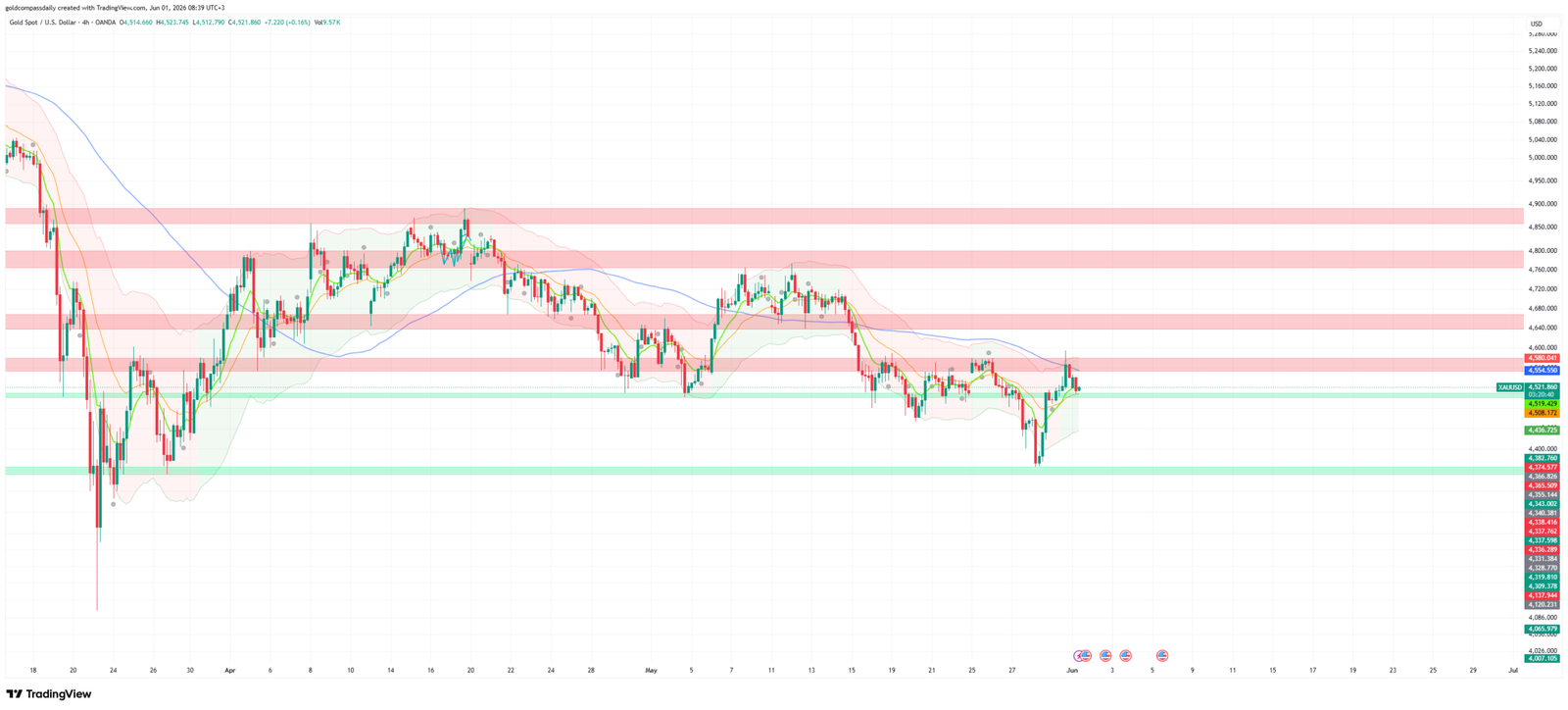
The 4-hour chart captures this tension precisely. Price tested the $4,860 resistance area in mid-April, failed to break it, and corrected all the way to $4,368 — a $492 decline over six weeks. That $4,368 low held on an intraday basis and the recovery has been sharp: $153 in three sessions. The structure of the recovery — fast, on above-average volume, from a level that has structural significance as the foundation of the April recovery — suggests buyers were waiting at $4,368 rather than absent from it. That is a technically healthy reversal.
The 4-hour chart shows price now sitting between the green demand zone at $4,436–$4,554 and the first meaningful resistance at $4,554.550 (the upper boundary of the zone). Above that: pink resistance bands at $4,580–$4,640, $4,680–$4,720, and $4,760–$4,800. The staircase of resistance levels reflects the damage done by May’s correction — each former support level from the April rally is now overhead resistance that must be reclaimed. The speed of reclamation depends entirely on this week’s data.
The Structural Case for Gold in June
Before walking through the week’s event schedule, the macro backdrop requires framing. Three forces converge in June to create a potentially powerful environment for gold:
Global central bank easing wave. The ECB is expected to cut in June — almost certainly. The BOE is moving toward cuts, with one dissenting vote already on record and UK services PMI at 47.9. The RBA cut is near-certain after the employment shock and CPI miss. The RBNZ held but signalled flexibility. The PBoC has maintained Loan Prime Rates while deploying targeted stimulus. The BOJ is the only major central bank moving in the opposite direction — toward tightening — but even its pace of normalisation is cautious. When six of the world’s seven major central banks are cutting or approaching cuts, global real rates are falling. Falling real rates are gold’s most powerful medium-term driver. The correlation is not perfect but it is persistent: gold performs best in environments of declining real interest rates, which is exactly what the second half of 2026 is likely to deliver.
Tariff inflation in the pipeline. The sequence is now established in data: China PPI jumped from 0.5% to 2.8%. German Import Prices are running at 1.2–3.6% monthly. UK PPI Input accelerated to 2.4%. US Import Prices are at 2.3%. These are the upstream price pressures that become consumer inflation with a 3–6 month lag. The Eurozone CPI Flash for June — due Tuesday — is forecast at 3.3% y/y, up from 3.0% in May. UK CPI missed at 2.8% in May but with PPI Input at 2.4%, the June reading may reverse. US Core PCE held at 0.3% in April but the pipeline suggests acceleration in May and June data. The inflation that gold hedges against is not the inflation that has already happened — it is the inflation that the upstream data tells us is coming. That upstream data is unambiguous.
The NFP deceleration trend. April’s NFP at 178K surprised to the upside and drove gold’s correction. The forecast for this Friday’s May NFP is 95K — a significant deceleration. If confirmed at or below 95K, it would represent the weakest back-to-back monthly hiring pace since the Liberation Day announcement and would provide the most direct evidence yet that US employment is feeling the tariff shock. A May NFP below 50K — which is within the range of plausible outcomes given the ADP trajectory and claims data — would force an immediate repricing of the Fed’s rate path and could be the catalyst for gold’s most significant single-session advance of the quarter.
Monday, June 1 — ISM Manufacturing, ISM Prices, Powell Speaks
The week opens with two significant US data points and a Powell speech. Japan’s Capital Spending q/q at 0.0% (forecast 4.1%, prior 6.5%) — a dramatic miss on Japanese business investment, decelerating from 6.5% to zero in a single quarter. This is the most significant Japanese data miss of the week and adds to the BOJ’s growth concern alongside last month’s Tokyo CPI miss. The Final Manufacturing PMI held at 54.5 — Japan’s manufacturing sector remaining in solid expansion despite the capital spending collapse.
China’s RatingDog Manufacturing PMI at 51.8 (forecast 51.4, prior 52.2) — a slight beat against the forecast, confirming China’s manufacturing expansion continues despite the prior week’s weak activity data. Australian ANZ Job Advertisements m/m at 1.8% (prior -0.6%) — a significant improvement in Australian job ad volumes after last month’s contraction. If sustained, this would challenge the June RBA cut narrative — employers listing more jobs suggests hiring intentions have not collapsed as dramatically as the employment print suggested. The MI Inflation Gauge m/m at -0.3% (prior 0.6%) — a sharp reversal in Australian consumer prices, consistent with the CPI miss and adding to the June RBA cut case.
The European manufacturing PMI sequence runs from 10:15am through 11:30am. The key readings: German Final Manufacturing PMI at 49.9 (confirmed in contraction), Eurozone Final Manufacturing PMI at 51.4 (marginally in expansion), UK Final Manufacturing PMI at 53.7 (solidly in expansion). The divergence within Europe — UK manufacturing strong, German manufacturing contracting — is a persistent theme that has been building for months and will shape the relative BOE versus ECB policy trajectory.
At 5:00pm: ISM Manufacturing PMI (forecast 53.3, prior 52.7) — an expected improvement in US manufacturing activity, which would extend the US outperformance narrative against contracting European manufacturing. ISM Manufacturing Prices (forecast 85.3, prior 84.6) — the single most inflation-significant number on today’s calendar. ISM Prices at 85.3 would be the highest reading since the post-COVID inflation surge and would directly validate the tariff inflation thesis: US manufacturers are paying the most for inputs in years, and that cost will reach consumers. For gold, ISM Prices above 85 is the most gold-positive data point available today — it confirms the inflation hedge case without the growth concern that accompanies services sector weakness.
FOMC Member Powell speaks at 3:30am (overnight) — the Fed Chair’s first public communication after Thursday’s Core PCE data. His characterisation of 0.3% Core PCE alongside 2.0% GDP will set the week’s initial USD tone. Any acknowledgement that the data is consistent with approaching cut conditions would be the most significant dovish signal available this week before Friday’s NFP. A reaffirmation of higher-for-longer despite the global growth deterioration would extend May’s dollar strength into June.
Tuesday, June 2 — Eurozone CPI Flash: The Week’s Inflation Verdict
Tuesday’s defining event is the Eurozone CPI Flash Estimate y/y at 12:00pm (forecast 3.3%, prior 3.0%) and Core CPI Flash Estimate y/y (forecast 2.4%, prior 2.2%). A Eurozone CPI at 3.3% — if confirmed — would represent the highest European inflation reading since the post-Liberation Day price increases began feeding through, and would be a paradoxically EUR-positive release: it reduces the pace of ECB easing and supports the euro against the dollar. For gold, the mechanism is more nuanced: hotter Eurozone CPI validates the global tariff inflation narrative (gold-positive through inflation hedge demand) but simultaneously supports the dollar through reduced ECB cut urgency (gold-negative through USD strength). The net effect depends on which channel dominates — historically, when inflation beats coincide with deteriorating growth (as Eurozone PMIs confirm), the inflation hedge channel for gold dominates over the 48-hour window following the release.
The JOLTS Job Openings at 5:00pm (forecast 6.87M, prior 6.87M) — expected unchanged, which would signal the US labour market is in equilibrium rather than deteriorating. A JOLTS reading below 6.5M would be a significant pre-NFP deterioration signal. BOE Governor Bailey speaks at 5:00pm — his comments after last week’s UK services PMI at 47.9 will directly set the market’s June BOE cut probability. UK Manufacturing PMI held at 53.7 — a mixed picture for Bailey: manufacturing strong, services contracting. FOMC Member Hammack speaks at 3:30pm.
Wednesday, June 3 — ADP, ISM Services, Beige Book: The Pre-NFP Setup
Wednesday is the most event-dense single day of the week. The session opens with Australian GDP q/q at 4:30am (forecast 0.5%, prior 0.8%) — a deceleration in Australian quarterly growth that would confirm the domestic slowdown visible in consumer spending and employment data. A GDP reading below 0.3% would make a June RBA cut an absolute certainty and would be the most significant Australian economic signal of the week.
The European services PMI confirmations run from 10:15am through 11:30am. These are final readings — French Services at 42.9, German at 47.8, Eurozone at 46.4, UK at 47.9. No revisions expected. The data confirms what last week’s flash readings showed: European services are in broad contraction, with France leading the deterioration at levels not seen outside of COVID lockdowns.
At 3:15pm: ADP Non-Farm Employment Change (forecast 116K, prior 109K). The ADP trajectory has been declining all year — from 180K+ in January to 109K in April. A third consecutive sub-120K reading would be a significant pre-NFP signal that private sector hiring has shifted into a new, lower gear. A reading below 80K would be the most alarming pre-NFP print available and would almost certainly force downward revisions to Friday’s consensus forecast of 95K.
At 5:00pm: ISM Services PMI (forecast 53.8, prior 53.6) — a slight expected improvement in US services. This is the most important US economic release before Friday. Given that European services are at 42.9–47.9, a US services reading at 53.8 would be exceptional outperformance — and would maintain the US versus Europe divergence that has been the dollar’s primary support. A US services miss below 52 — particularly on the same day European services confirmations at 46.4 are published — would be the most powerful global services contraction signal available this week and would drive a significant gold rally ahead of Friday’s NFP.
At 9:00pm: Fed Beige Book — the first Beige Book since Liberation Day’s full impact was felt. This will be the most comprehensive account of how American businesses across all 12 Federal Reserve districts are actually responding to the tariff environment: price increases, hiring freezes, capital expenditure delays, supply chain disruptions. A Beige Book that describes widespread tariff-driven cost increases combined with slowing activity is the stagflation signal that gold’s bull case requires in explicit, Fed-authored language.
Thursday, June 4 — Claims, Lagarde, BOE Bailey, Unit Labor Costs
Thursday delivers the week’s final pre-NFP labour market signal alongside significant central bank communication. At 3:30pm: Unemployment Claims (forecast 211K, prior 215K) — a slight expected improvement. The claims trajectory has been the most contested data series of the post-Liberation Day period: running at 189K in April (anomalously low), rising to 209–215K in May (normalising), and now expected at 211K. A reading above 230K would be the first genuine signal of accelerating layoffs. Below 200K would validate the labour market resilience narrative heading into Friday’s NFP.
Revised Nonfarm Productivity q/q (forecast 0.7%, prior 0.8%) and Revised Unit Labor Costs q/q (forecast 2.4%, prior 2.3%) — the revised labour cost data. Unit labor costs at 2.4% — above the March reading of 2.3% but dramatically below the December 2025 reading of 4.4% — would confirm that the wage-price spiral is decelerating. A revision lower to below 2.0% would be the most dovish labour market signal available Thursday. A revision above 3.0% would reignite Fed hawkishness concerns heading into NFP.
ECB President Lagarde speaks at 11:00am — six days before the June ECB meeting where a rate cut is almost fully priced. Her language will either confirm the cut is coming or introduce doubt. Given the Eurozone CPI Flash at 3.3% (Tuesday) and the services PMI collapse, Lagarde must navigate between acknowledging tariff-driven inflation (hawkish) and growth concerns (dovish). Any explicit confirmation of June cut plans would be EUR-negative but globally gold-supportive. BOE Governor Bailey speaks at 6:40pm — his second appearance of the week, this time with the full context of Wednesday’s ISM Services and ADP data.
Friday, June 5 — Non-Farm Payrolls: The Week’s and Month’s Defining Moment
Every data point this week is context for this release. The Non-Farm Employment Change is forecast at 95K (prior 115K) — a significant deceleration that would be the weakest official payrolls print since before the Liberation Day announcement. Average Hourly Earnings m/m (forecast 0.3%, prior 0.2%) — an expected slight acceleration in wage growth. Unemployment Rate (forecast 4.3%, prior 4.3%) — expected unchanged.
The NFP forecast of 95K is itself already a pessimistic consensus. The ADP trajectory, the JOLTS decline, and the rising claims readings all point in the same direction: US private sector hiring is slowing. The question is how much. Three scenarios:
NFP above 150K (beat): The labour market is absorbing the tariff shock without significant employment impact. Dollar strengthens, rate cut expectations push into Q4, gold faces resistance at $4,554 and potentially retests the $4,436 support. The structural bull case is maintained but the timeline extends — gold’s next major move higher is delayed into July or later.
NFP 70K–110K (in line): Deceleration confirmed as expected. Dollar mildly weaker, rate cut timeline moves slightly forward, gold breaks above $4,554 toward $4,580–$4,640 in the hours after the release. The technical picture shifts from neutral to bullish and the $4,760–$4,800 range becomes June’s primary target.
NFP below 50K (miss): The most significant US employment deterioration since the 2020 shutdown. Dollar weakens sharply. Fed cut timeline moves forward aggressively — July meeting becomes a live possibility. Gold surges through $4,554, $4,580, $4,640 in sequence, potentially reaching $4,680–$4,720 by the session close. This is the scenario that confirms the correction is over and June’s bull run has definitively begun. Canadian employment data arrives simultaneously — Employment Change (forecast 10.2K, prior -17.7K) and Unemployment Rate (forecast 6.9%, prior 6.9%) — a Canadian employment recovery would be CAD-positive and risk-on.
Key Levels for the Week
- Current price: $4,521
- Green demand zone: $4,436.725 – $4,554.550 — hold above $4,436 to maintain recovery structure
- Key resistance sequence: $4,554.550 → $4,580–$4,600 → $4,640 → $4,680–$4,720 → $4,760–$4,800
- Weekly bull case trigger: ADP below 80K (Wed) + ISM Services miss (Wed) + Claims above 230K (Thu) + NFP below 95K (Fri) = break above $4,640 → $4,720 target
- Weekly bear case risk: ISM Prices above 85 + ISM Services beat + NFP above 150K = break below $4,436 → $4,374–$4,382 retest
- Month-open close to watch: Above $4,554 by Friday close = June opens bullish · Below $4,436 = correction not yet complete
- The floor: $4,368 (May 28 low) — this is the level that defines the correction’s extent. A break below it would mean May’s selloff was not corrective but the beginning of a more significant reversal.
The Week’s Verdict Before It Begins
Gold at $4,521 is precisely where it should be at the start of an NFP week: above structural support, below meaningful resistance, waiting for the data that will determine the month’s direction. The structural case — tariff inflation, global easing wave, safe-haven demand, US growth deceleration — has not changed. What changes this week is whether the data confirms or delays the resolution of the tension between that structural case and the dollar’s resilience.
ISM Manufacturing Prices at 5:00pm today will be the first signal. The Eurozone CPI Flash Tuesday will be the inflation confirmation. ADP and ISM Services Wednesday will set the pre-NFP employment expectation. And Friday at 3:30pm, the Non-Farm Payrolls will write June’s first chapter. Each day’s analysis will be linked here as the week progresses.
Analysis based on the XAU/USD 4-hour chart as of June 1, 2026, 08:39 UTC+3. Economic data sourced from the weekly macro calendar. This article is for informational and educational purposes only and does not constitute financial advice.