

Some books age. Reminiscences of a Stock Operator does not. Published in 1923 as a thinly fictionalised account of Jesse Livermore’s trading career, it remains — more than a century later — the most psychologically accurate description of what it actually feels like to trade for a living that has ever been written. The markets have changed beyond recognition since Livermore operated in the bucket shops of the 1890s and on the floors of the major exchanges in the 1900s and 1910s. The technology, the instruments, the regulatory environment, the information flow — all of it is unrecognisable. And yet every experienced trader who reads this book recognises every emotion, every mistake, and every insight as their own. That is the definition of a timeless work.
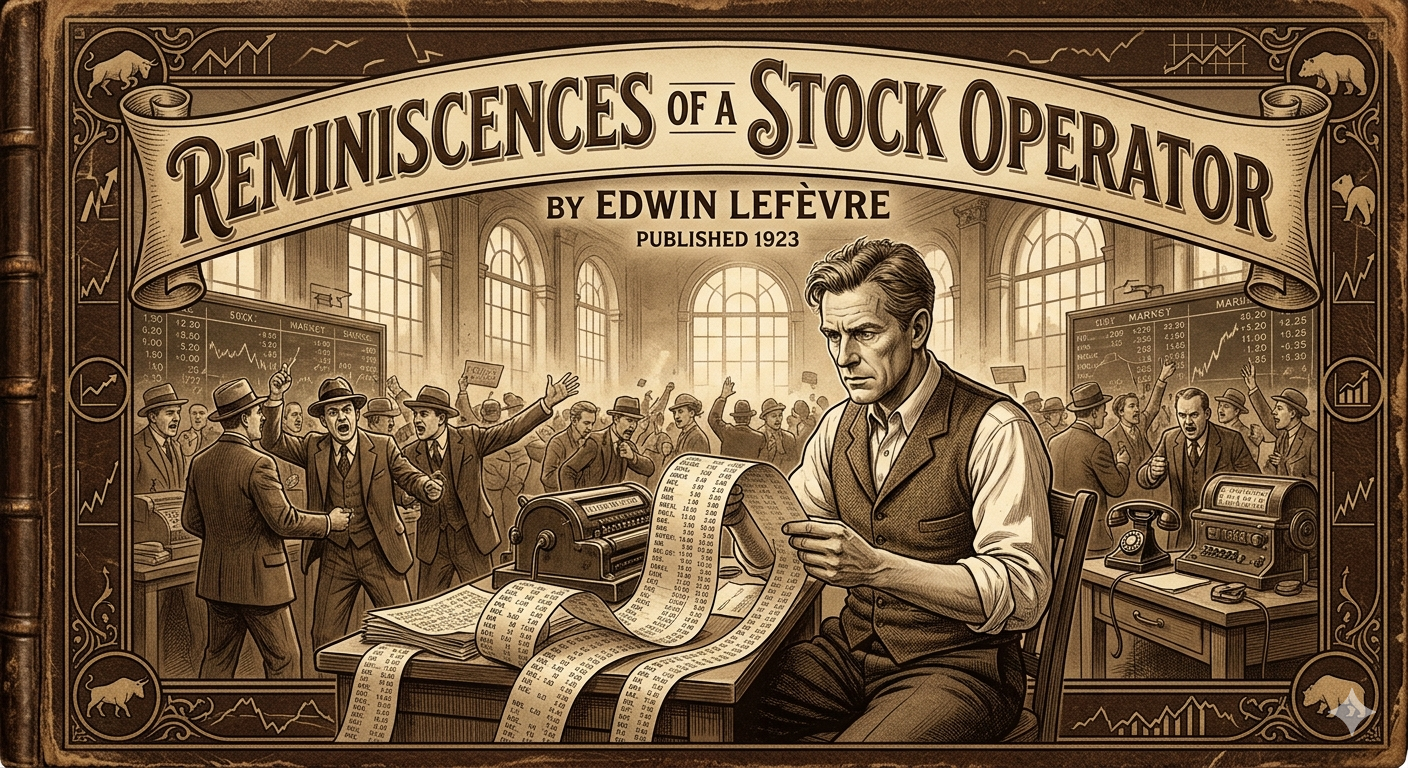
It belongs among the essential reads on every serious trader’s shelf — not as a historical curiosity but as a live document about the permanent psychology of speculation. What Lefèvre captured through his interviews with Livermore was not a story about a particular era of markets. It was a story about the human relationship with uncertainty, money, and ego — a relationship that has not changed in the century since the book was written and will not change in the century ahead.
Who Jesse Livermore Was
Jesse Livermore was the most celebrated speculator of his era — a man who made and lost several fortunes across a career that spanned four decades. He began as a teenager in the bucket shops of Boston, where he discovered that he had an unusual ability to read price tape — to sense the direction of price movement before it became obvious — and turned small stakes into consistent profits at an age when most of his contemporaries had barely left school.
By the early 1900s he had moved to the major exchanges and was trading stocks and commodities at a scale that made him a genuine market force. In 1907 he made approximately $3 million — a sum equivalent to many tens of millions today — by shorting the market ahead of the Panic of 1907. In 1929 he reportedly made $100 million shorting the market ahead of the great crash. Between those landmarks he also went bankrupt twice — losing everything through a combination of overtrading, poor position sizing, abandonment of his own principles, and the specific vulnerabilities of a man whose greatest strength (absolute conviction in his own analysis) was also his greatest weakness (absolute conviction in his own analysis).
Livermore’s life ended in tragedy — he died by suicide in 1940, having lost his fortune for the fourth and final time. Lefèvre’s book, written when Livermore was at or near his peak in the early 1920s, captures the arc of his career through the character of Larry Livingston — a name thin enough that no reader was ever confused about who it referred to.
The Bucket Shop Years: Learning to Read Tape
The book opens in the bucket shops — establishments where customers could bet on stock price movements without actually buying or selling shares. The bets were settled based on tape prices, and the bucket shops were not legitimate brokerages but effectively gambling dens that traded against their customers. They had significant structural advantages: they could manipulate their own execution prices, refuse to honour winning bets above certain thresholds, and simply close their doors if a single customer became too consistently profitable.
Livingston became consistently profitable almost immediately. The key to his early success was a specific skill: he noticed patterns in how prices moved on the tape before significant directional moves. Not chart patterns in the modern technical analysis sense — tape reading in the Livermore era was about the sequence and velocity of price changes, the way stocks behaved at certain price levels, and the relationship between price movement and time. Livermore’s ability to read these patterns was, by his account and the account of everyone who observed him, essentially intuitive — he could not always explain why he was confident about a particular direction, but he was right with a frequency that was not explicable by chance.
The bucket shop years are instructive beyond their narrative function because they establish the foundation of Livermore’s methodology: price is the only truth. Not tips, not stories, not what a company is supposed to be worth — price. The tape tells you what is actually happening in the market, not what anyone thinks should be happening. This principle — that price action is the primary source of trading intelligence — runs through every page of the book and every chapter of Livermore’s career.
The First Major Lesson: Sitting Tight
One of the most quoted passages in the entire book describes the difference between knowing what to do and doing it — and the specific failure mode of the experienced trader who knows the direction of a move but exits too early. Livingston describes a situation where his analysis tells him a stock is going significantly higher. He buys. The stock goes up. He takes his profit. The stock continues up — far past the point where he sold — and he misses the majority of the move he correctly predicted.
The lesson he draws is one of the most important in trading: it is not enough to be right about direction. You must also be right about duration — about how long to hold the position once it is working. Livingston’s formulation is precise: “It was never my thinking that made the big money for me. It was always my sitting. Got that? My sitting tight.” The traders who make the most money are not the ones who are most frequently right. They are the ones who, when they are right, hold through the normal volatility and noise until the move completes rather than exiting at the first sign of turbulence.
This lesson has a technical component and a psychological component. Technically, it requires a methodology for distinguishing between “noise” and “the move is over” — for knowing when a pullback within a trend is a normal consolidation versus a reversal signal. Livermore’s methodology for this was price-based: he defined specific levels at which his thesis would be invalidated, and as long as price stayed above those levels, he held regardless of short-term volatility. Psychologically, it requires the ability to tolerate the discomfort of watching a profitable position fluctuate without acting on that discomfort — a skill that is far harder to develop than any technical knowledge.
The Second Major Lesson: Cutting Losses
The flip side of sitting tight with winning positions is the equal and opposite discipline of cutting losing positions quickly. Livingston describes repeatedly — with increasing self-knowledge as the book progresses — how his worst losses came not from bad analysis but from his failure to act on what his analysis told him when a trade began moving against him.
The pattern is consistent across every major loss in the book. Livingston enters a trade with a clear thesis. The market moves against him. His thesis says this is wrong — the position should be closed. But he does not close it. He holds, hoping the market will reverse. Sometimes it does — and the experience of being saved by hope reinforces the behaviour. More often it does not — and the loss that would have been small becomes catastrophic because the exit that should have happened at $10 down happens instead at $100 down.
Livermore’s explanation for this universal trading failure is precise and honest: it is not stupidity that prevents traders from cutting losses. It is hope — the specific, powerful, human psychological tendency to believe that the current adverse price movement is temporary and the original thesis will eventually be vindicated. Hope is the most dangerous emotion in trading precisely because it is not irrational in normal life. In most human endeavours, persistence in the face of temporary setbacks is a virtue. In trading, when the market is telling you that your thesis is wrong, persistence is not a virtue — it is a path to ruin.
The Third Major Lesson: The Danger of Tips
Several chapters of the book are devoted to a theme that is simultaneously dated and universal: the danger of acting on tips. In Livermore’s era, tips — information allegedly from insiders or well-connected sources about an imminent move in a specific stock — were a constant feature of market culture. Everyone had tips. Most tips were wrong. Some tips were deliberately false, planted by operators who wanted to move public opinion in a specific direction for their own positioning purposes.
Livermore describes in detail the specific cognitive dynamic that makes tips dangerous even for experienced traders: the social and emotional pressure to act on information from a source you trust, even when your own analysis suggests the opposite. A friend — successful, intelligent, apparently in possession of privileged information — tells you that a specific stock is about to move significantly higher. Your own reading of the tape suggests the contrary. Do you follow the tip or your own analysis?
Every time Livermore followed a tip against his own analysis, he lost money. Every time. The pattern is so consistent throughout the book that it becomes, by the later chapters, almost darkly comic. Livermore knows this pattern exists. He has lost money through it repeatedly. He knows the right answer. And yet the social and psychological pressure of a confident tip from a trusted source repeatedly overrides his own judgment.
The lesson is not simply “don’t follow tips.” It is more fundamental than that: any time you trade on information that is external to your own methodology and analysis, you are operating without the edge that your methodology provides. The advantage of a systematic approach is not that it is always right — it is that over time its successes outweigh its failures by a consistent margin. The moment you override that system based on external information, you lose the edge entirely. You are no longer operating a system with a positive expected value. You are guessing.
The Fourth Major Lesson: The Market Always Wins the Argument
Perhaps the most philosophically sophisticated insight in the book concerns the relationship between a trader’s view and the market’s behaviour. Livermore observes that the market does not care about his opinion. The market does not care about anyone’s opinion. Price moves for reasons that are collectively determined by every participant simultaneously, and no single participant — regardless of how correct their analysis, how deep their research, or how strong their conviction — can force the market to validate their view.
This sounds obvious. It is not. Most traders — including Livermore himself, repeatedly — behave as if a sufficiently correct analysis must eventually produce a correct trade. The logic seems sound: if my analysis is right, the market must eventually recognise this and price accordingly. But markets can remain wrong by a trader’s analysis for longer than a trader can remain solvent, as Keynes observed in a different context. And the specific dynamics of leveraged trading mean that a position that is correct in analysis can be fatal in practice if the adverse price movement between entry and eventual vindication exceeds the trader’s available capital.
Livermore’s resolution to this problem is the principle that is central to every successful systematic trading methodology: trade with the market, not against it. Do not take positions that require the market to be wrong for you to make money. Take positions in the direction the market is already moving, and hold them until the market tells you the move is over. This is trend following in its original, most organic formulation — not as a mechanical system but as the practical wisdom of a man who had been destroyed by fighting trends and rebuilt his fortune by following them.
The Psychology of Big Losses
The most honest passages in the book deal with the psychological aftermath of major losses — the specific emotional states that follow a significant drawdown and the way those states interfere with subsequent decision-making. Livermore describes going broke with a specificity that is unusual for a man of his era, when financial failure was more socially stigmatised than it is today. He describes the disorientation of losing confidence in his own judgment — the state where he can no longer trust his own analysis because the analysis that led to the loss was, at the time, equally confident.
The recovery from a major loss, as Livermore describes it, requires more than capital — it requires a specific psychological rebuilding process. The trader who has just lost everything cannot simply be given back the money and expected to trade profitably. The psychological distortions introduced by the loss — the fear that overrides legitimate trading signals, the overcaution that prevents taking necessary risks, or alternatively the recklessness of trying to recover too quickly — must be addressed before the capital can be deployed effectively.
Livermore’s accounts of rebuilding after his two bankruptcies are instructive precisely because they show that the rebuilding was methodological rather than capital-driven. He did not start from a large stake and trade his way back. He started from almost nothing, traded small with absolute discipline, rebuilt his confidence through a sequence of correct trades, and only then increased his size as his conviction in his own judgment was restored. The capital followed the psychology, not the other way around.
What Makes This Book Irreplaceable
The specific value of Reminiscences of a Stock Operator — the reason it appears on every serious trader’s reading list and why its presence on that list has been consistent for a century — is not the specific information it contains. None of the technical information about bucket shops, tape reading, or early 20th-century market mechanics is directly applicable to modern markets. What is irreplaceable is the psychological portrait it provides.
No other book has captured with the same fidelity the specific emotional experiences of trading at a high level: the confidence that comes from a sequence of correct calls, the complacency that follows that confidence, the losses that the complacency enables, the psychological damage those losses inflict, and the disciplined rebuilding process that separates the traders who eventually find consistency from those who do not. Livermore went through this cycle four times in his career. The book was written after the second cycle. The pattern continued after publication. The lesson, apparently, is not one that can be learned once.
That is perhaps the most important thing the book communicates, and the most uncomfortable: the psychological challenges of trading do not go away with experience. They change character — a trader with twenty years of experience faces different psychological distortions than a beginner — but they do not disappear. Every serious trader who has read this book after years in the market will recognise the emotions Livermore describes not as historical curiosities but as live conditions they encounter regularly. The book is not about Jesse Livermore. It is about you.
Read it as the sixth title in the complete list of 10 trading books every serious trader must read. Read it first if you are new to trading. Read it again if you have been trading for years and think you have already absorbed it. The book pays differently at different stages of a trading career — and the readers who find the most in it are almost always those who have already made the mistakes Livermore describes.
This article is part of an ongoing series of full summaries of the most important books in trading. Each title on the list receives its own dedicated review covering the key ideas, the trader profiles, and the practical lessons applicable to active market participants.