

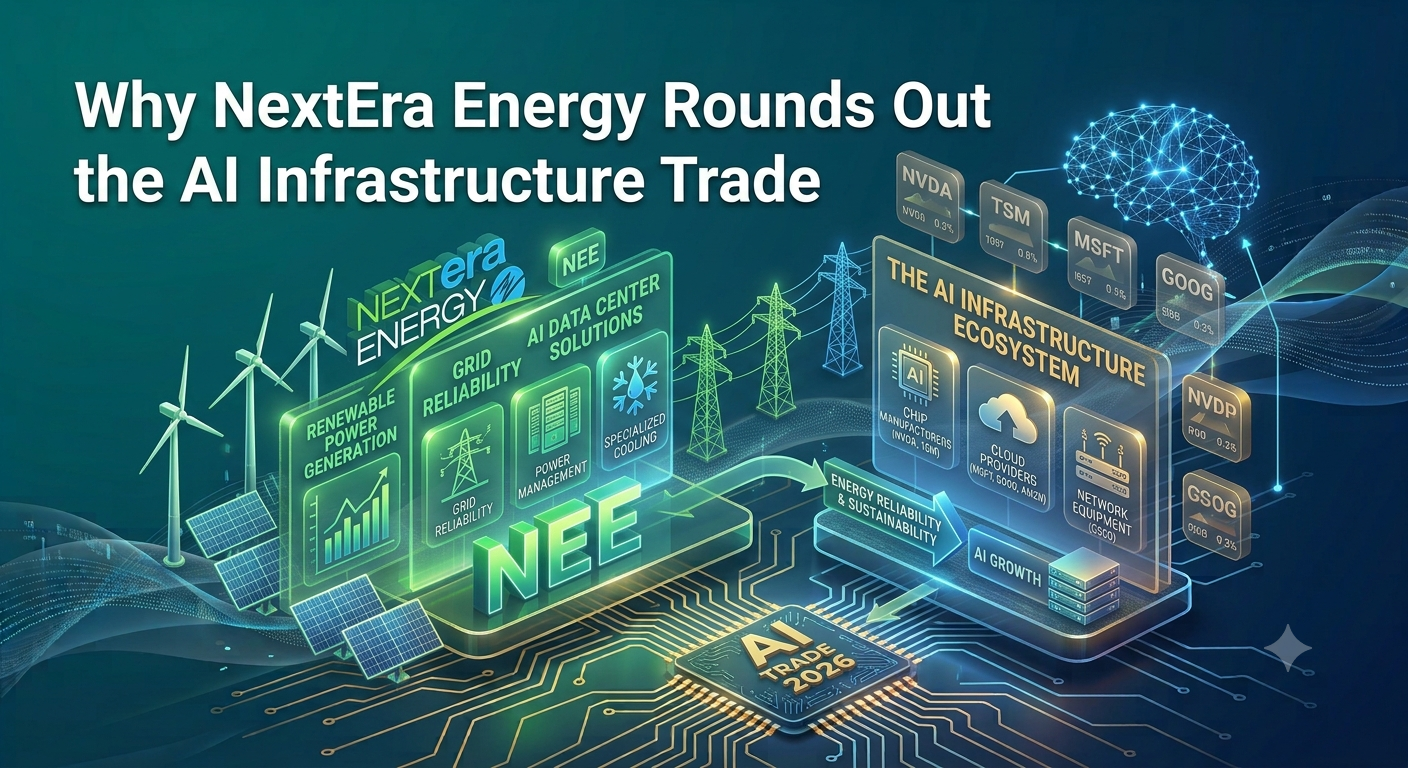
NextEra Energy (NYSE: NEE) was named the third selection in Gold Compass Daily’s Top 5 Stocks to Buy for July 2026 roundup, chosen for its position at the power generation layer of the artificial intelligence build-out. Where Micron supplies memory and Vertiv supplies data center cooling and power distribution hardware, NextEra supplies the electricity itself, through a combination of regulated utility operations at Florida Power & Light and one of the largest renewable energy generation and storage portfolios in North America. As data center construction accelerates nationally, the single most binding constraint on how quickly new AI compute capacity can be energized is increasingly the availability of electricity supply and grid infrastructure, a dynamic that places NextEra in a structurally advantaged position regardless of which chipmaker or cloud provider ultimately leads any given generation of the AI race.
NextEra’s growth profile looks different from the AI infrastructure names covered elsewhere in this series. Its expected earnings growth is measured in high single digits rather than in the triple-digit percentages seen in memory or foundry supply, reflecting its status as a large, regulated utility rather than a pure-play growth stock. That difference is precisely the point: NextEra offers a more moderate, dividend-supported way to gain exposure to the AI power demand theme, serving as a stabilizing complement to the higher-beta names elsewhere in the portfolio. This article walks through the available analyst data in full, alongside the qualitative catalysts and risks shaping the investment case, including a pending mega-merger that is currently dividing analyst opinion.
Current Trading Context
NextEra shares were recently trading near $87.80, down 0.18% on the session. The stock has been volatile over the past several months: one recent snapshot showed shares returning 4.1% over the trailing month, comfortably ahead of the broader utility sector’s 2.7% gain, while an earlier snapshot from several weeks prior showed the stock down 10.3% over a trailing month period, a decline attributed to investor disappointment following a company Investor Day that failed to meet heightened expectations around power demand growth. That volatility reflects a stock currently being repriced in real time around two distinct storylines, the AI-driven electricity demand opportunity and a large pending acquisition, discussed in detail below.
Analyst price targets currently show a wide dispersion depending on data provider and timing. According to data compiled by S&P Global Market Intelligence, the consensus 12-month price target sits near $99.25, implying upside of roughly 12.84% from recent levels, with individual targets ranging from a low of $55 to a high of $117. TipRanks separately shows an average price target of $102.15 based on 13 analysts polled over the trailing three months, with a high forecast of $112 and a low forecast of $90. Recent individual analyst actions illustrate the current split in sentiment: Morgan Stanley raised its price target to $117 from $111 in late June while maintaining an Overweight rating, whereas Barclays raised its target more modestly, to $91 from $90, while assigning an Equal Weight, or Hold-equivalent, rating in early July. Erste Group downgraded the stock to Hold from Buy in late June. The overall consensus rating remains Buy, with roughly three-quarters of covering analysts rating the stock Buy and the remainder Hold, but the divergence between Morgan Stanley’s bullish $117 target and Barclays’ more cautious $91 target is worth keeping in mind, since it reflects genuine disagreement among well-regarded analysts about how much of the AI power demand opportunity is already priced into the stock.
Revenue Estimates: Steady, Utility-Scale Growth
The revenue estimate data available shows a business expected to grow at a pace consistent with a large regulated utility layering incremental data center-driven demand on top of its existing base, a meaningfully more moderate trajectory than the AI supply chain names covered elsewhere in this series, but one still running ahead of typical utility sector growth rates.
- Next quarter (September 2026): 8 analysts covering, average estimate of $9.14 billion, with a low estimate of $8.38 billion and a high estimate of $9.93 billion. That average implies year-over-year growth of 14.72% versus the $7.97 billion reported in the same quarter a year ago.
- Current year (2026): 18 analysts covering, average estimate of $31.54 billion, with a low of $28.78 billion and a high of $34.05 billion, representing growth of 15.06% over the $27.41 billion reported for the prior year.
- Next year (2027): 18 analysts covering, average estimate of $34.55 billion, with a low estimate of $29.93 billion and a high estimate of $39.32 billion, implying growth of 9.55% over the current year’s projected base.
Data for the current quarter, the three months ending June 30, 2026, was not clearly captured in the sourced material, so it is disclosed here as a gap rather than estimated. Separately compiled analyst commentary points to a revenue consensus for that quarter in the range of $7.97 billion to $8.17 billion depending on data provider, with the divergence reflecting differences in how individual research desks model NextEra’s regulated versus competitive segments; readers should treat that range as approximate rather than as a precise consensus figure.
The pattern across the periods that are clearly sourced is a deceleration from 15.06% current-year growth to 9.55% next-year growth, consistent with the mathematics of growing off a larger base rather than any indication of a slowing underlying opportunity. Notably, NextEra’s own 2025 fiscal year revenue of $27.41 billion represented growth of 10.74% over 2024’s $24.75 billion, meaning the current-year estimate of 15.06% growth actually represents an acceleration relative to the prior year’s pace, a detail that supports the broader thesis that AI-driven electricity demand is beginning to show up more visibly in NextEra’s top line.
Earnings Estimates: High-Single-Digit Growth With a Clear Long-Term Target
The earnings estimate table shows a more measured trajectory than the revenue figures above, reflecting the capital-intensive nature of utility and renewable energy infrastructure investment, where near-term earnings growth is constrained by the pace of regulatory rate case approvals and project completions even as the underlying demand opportunity expands.
- Next quarter (September 2026): 12 analysts, average EPS estimate of $1.22, with a low of $1.04 and a high of $1.42, compared with $1.13 in the same quarter a year ago.
- Current year (2026): 19 analysts, average estimate of $4.04, with a low of $3.97 and a high of $4.30, compared with $3.71 in the prior year, implying growth of approximately 8.9%.
- Next year (2027): 23 analysts, average estimate of $4.40, with a low estimate of $4.23, compared with the current year’s $4.04 base, implying growth of approximately 8.9%. The corresponding high estimate for this period was not clearly legible in the sourced data and is omitted here rather than estimated.
For the current quarter, the three months ending June 30, 2026, separately compiled analyst commentary points to an EPS consensus clustering in the $1.07 to $1.13 range depending on data provider, again reflecting differences across research desks rather than a single precise figure; management has guided toward full-year 2026 adjusted EPS in a range of $3.92 to $4.02, targeting the high end of that range, broadly consistent with the $4.04 current-year consensus shown above.
The consistency of the roughly 8.9% growth rate across both the current and next fiscal years is notable, and it aligns closely with management’s own publicly stated long-term target of adjusted EPS compound annual growth of 8% or better through 2032, measured off a 2025 base of $3.71. That alignment between analyst consensus and management guidance suggests the current earnings estimates are not pricing in either significant upside surprise or downside disappointment relative to the company’s own stated ambitions, a materially different dynamic than the AI supply chain names elsewhere in this series, where analyst estimates have been revised sharply higher well beyond initial company guidance.
Earnings History: A Mostly Consistent Beat Pattern With One Notable Miss
NextEra’s trailing earnings history over the last four reported quarters shows a company that has generally outperformed analyst expectations, with one clear exception that is worth examining honestly rather than glossing over.
- Second quarter 2025: EPS estimate of approximately $0.98 versus actual of $1.05, a beat of $0.07, or a 7.14% positive surprise.
- Third quarter 2025: EPS estimate of $0.98 versus actual of $1.13, a beat of $0.15, or a 15.31% positive surprise.
- Fourth quarter 2025: EPS estimate of $0.56 versus actual of $0.54, a miss of $0.02, or a negative surprise of approximately 3.57%.
- First quarter 2026: EPS estimate of approximately $0.97 to $0.98 versus actual of $1.09, a beat of roughly $0.11 to $0.12, or a positive surprise in the range of 11.2% to 12.4% depending on the specific consensus figure used by different data providers.
The fourth quarter 2025 miss stands out as the one blemish in an otherwise consistent beat pattern, and it is worth noting directly rather than omitting, consistent with the principle that chart-accurate and factually sourced data should take precedence over a cleaner but less honest narrative. A single modest miss of two cents per share is not, in isolation, a significant concern for a company of NextEra’s scale and regulatory complexity, where quarterly results can be affected by weather-related demand swings, the timing of asset sales, and regulatory decision timing that do not necessarily reflect the underlying earnings trajectory. The subsequent rebound to a double-digit percentage beat in the first quarter of 2026 suggests the fourth-quarter miss did not represent a break in the company’s broader execution track record, but investors should note that NextEra’s beat pattern has been somewhat less uniformly positive than some of the more explosively growing AI supply chain names covered elsewhere in this series.
Segment-Level Growth Drivers
Beneath the consolidated estimates, NextEra’s two primary operating segments are each showing distinct growth dynamics worth understanding individually. Florida Power & Light, the company’s regulated utility segment serving approximately 12 million people across roughly 6 million customer accounts, has been the more predictable growth engine, with regulatory capital and associated earnings growth running at approximately 8.8% and a reported regulatory return on equity of approximately 11.7% for the twelve months ending March 2026. The segment placed approximately 600 megawatts of new owned solar capacity into service in the most recent quarter, bringing its owned solar portfolio above 8.5 gigawatts.
NextEra Energy Resources, the company’s competitive renewables and storage segment, has been more directly tied to the AI infrastructure buildout. The segment originated 1.3 gigawatts of battery storage in the most recent quarter and has a standalone and co-located battery pipeline exceeding 10 gigawatts, excluding potential expansion opportunities. In a development directly linked to the AI theme, the U.S. Department of Commerce selected Energy Resources to build 9.5 gigawatts of new gas-fired generation to serve large electricity loads tied to a Japanese investment commitment, and the segment now operates over 30 dedicated data center hubs, with a year-end target of approximately 40. Management has set a base-case target of securing 15 gigawatts of new generation capacity for large data center loads by 2035, with disclosed upside potential of 30 or more gigawatts should demand continue to accelerate.
NextEra Energy Transmission, a smaller but growing segment, has secured more than $5 billion in new transmission projects since 2023 and now holds regulated and secured capital of approximately $8 billion, providing an additional, more moderate growth vector layered on top of the two primary segments.
The AI Power Demand Catalyst and Supply Chain Security
The central qualitative catalyst supporting NextEra’s inclusion in this list is the surge in electricity demand tied to AI data center construction nationally, a dynamic that has been widely described across the utility sector as one of the defining structural stories of the current period. NextEra’s scale, spanning regulated utility operations, renewable generation, natural gas transmission, and battery storage, positions it to capture this demand across multiple channels simultaneously rather than depending on a single business line.
A meaningful part of the investment case rests on NextEra’s disclosed supply chain security, an increasingly important differentiator given the tariff and trade policy uncertainty that has weighed on some renewable energy peers. Management has stated that the company has proactively secured solar panel and battery supply through 2029, key wind components through 2027, and sufficient transformer capacity through the end of the decade. That transformer commitment is particularly significant in the current environment, given that skyrocketing demand from AI data centers has been widely reported to be exacerbating shortages of critical grid equipment like transformers across the United States broadly, driving up costs and stretching wait times for utilities that have not secured capacity in advance. NextEra has also mitigated interest rate exposure through an interest rate hedging program exceeding $43 billion, a relevant consideration given the company’s capital-intensive growth model and sensitivity to financing costs.
On the technology side, NextEra has launched a company-wide initiative called Rewire in partnership with Google Cloud, applying artificial intelligence tools to grid optimization, equipment monitoring, and generation and dispatch efficiency. Early products under this initiative, including tools referred to as Conduit, Generation Entitlement, and Grid Composer, were brought to market in the first quarter of 2026 with the stated aim of improving field efficiency, detecting abnormal equipment conditions, and optimizing dispatch decisions. This represents a notable example of the utility sector applying the same technology it is increasingly being called upon to power, and management has framed it as a source of ongoing cost savings and operational improvement rather than a speculative side project.
Recontracting activity provides additional visibility into forward growth. Management has identified up to 6 gigawatts of renewables and 1.5 gigawatts of nuclear recontracting opportunities through 2032, and in the first quarter of 2026 alone the company recontracted more than 600 megawatts of existing projects with average contract terms exceeding 18 years, at new contract pricing that management described as running roughly $20 per megawatt-hour above prior realized pricing, a detail that speaks directly to the pricing power renewable generators are beginning to command as electricity demand tightens.
The Pending Dominion Energy Acquisition: Opportunity and Overhang
The single largest source of both opportunity and uncertainty in NextEra’s current story is its proposed acquisition of Dominion Energy in an all-stock deal valued at nearly $67 billion, announced as a combination of two leading utilities positioned to meet growing electricity demand from AI-driven data centers. The strategic logic is straightforward: Dominion brings substantial data-center-adjacent regulated utility exposure, particularly in Virginia, one of the most concentrated data center markets in the country, and the combined company would represent a meaningfially larger regulated asset base than NextEra operates alone today.
Reaction to the deal among sell-side analysts has been mixed and evolving. On the more constructive side, at least one analyst has initiated coverage with a Buy rating explicitly citing Dominion merger synergies and data-center-driven growth upside as the basis for a positive view, and Barclays reaffirmed a Buy rating with an unchanged $112 price target in early July, citing the acquisition’s advancement as strategically and regulatorily well-positioned. On the Dominion side of the transaction, Jefferies upgraded Dominion to Buy from Hold with a price target increase to $76 from $65 following the announcement, while Mizuho raised its Dominion price target to $72 from $66 while maintaining a Neutral rating, reflecting a similarly constructive but not unanimous reception.
At the same time, the deal is currently facing scrutiny over potential anticompetitive concerns, and its ultimate regulatory outcome remains a genuine source of event risk rather than a foregone conclusion. A combination of this scale, uniting two of the largest utilities on the U.S. East Coast, will require approval across multiple state regulatory jurisdictions in addition to federal antitrust review, a process that could extend over an extended timeline and introduces the possibility of required divestitures, modified deal terms, or in a tail-risk scenario, an outright block. Investors should treat the Dominion transaction as a multi-quarter overhang that will likely generate periodic headline volatility in NextEra shares as the regulatory process unfolds, independent of the company’s underlying operating performance.
Dividend Profile
NextEra carries a dividend yield that has made it a recurring name on income-focused screens, with a dividend that management has targeted to grow at approximately 10% annually through 2026 off a 2024 base, moderating to approximately 6% per year from year-end 2026 through 2028. The company’s board declared a regular quarterly common stock dividend of $0.6232 per share in late May, consistent with that stated growth trajectory. NextEra has also been named alongside Walmart and Abbott Laboratories as one of a small group of dividend aristocrat stocks carrying a Strong Buy rating on Wall Street with a payout ratio above 50%, a combination that speaks to the company’s standing among income-oriented investors even as its growth profile has become increasingly tied to AI-era electricity demand.
Risks Investors Should Weigh
Several distinct risks are worth weighing directly rather than glossing over, given how they show up concretely in the data and analyst commentary reviewed above.
The Investor Day disappointment referenced earlier in this article is the first and most immediate. NextEra’s stock underperformed the broader utility sector by more than 450 basis points following an Investor Day that failed to meet heightened investor expectations around power demand growth, and disclosed metrics showed a reduction in wind assets within the development backlog, falling from 36% to 25% of the 2024-2027 pipeline. That shift raises legitimate questions about the durability of NextEra’s renewable growth pipeline in an environment of decreasing government support for renewable energy, management changes, and elevated costs of capital, all of which have been cited as factors pressuring the company’s credit metrics and overall financial outlook.
The pending Dominion Energy acquisition, discussed in detail above, represents the second major risk, given the genuine uncertainty around its regulatory approval timeline and the possibility of modified terms or an extended review process. The wide dispersion in analyst price targets, from Morgan Stanley’s bullish $117 to lower estimates well below $90, reflects in significant part differing views on how this transaction ultimately resolves.
A third risk relates to valuation. Independent valuation grading has assigned NextEra a D grade on valuation-based metrics relative to sector peers, indicating the stock trades at a premium that is not obviously supported by traditional valuation multiples alone, a premium that reflects the market’s willingness to pay up for AI-era growth optionality embedded in a historically slower-growing utility business. Should sentiment around AI-driven electricity demand cool, whether due to a moderation in data center construction activity or a broader reassessment of AI capital expenditure plans, NextEra’s premium multiple could compress independent of the company’s own operating performance.
Finally, the broader industry-wide shortage of critical grid equipment, particularly transformers, represents a sector-level risk that could affect the pace at which NextEra and peers are able to execute on their stated growth pipelines, even though management has stated that the company’s own transformer capacity is secured through the end of the decade. Persistent supply chain tightness across the utility sector more broadly could still introduce cost pressure or execution delays at the margin.
Putting the Case Together
NextEra’s inclusion in Gold Compass Daily’s July 2026 list rests on a fundamentally different risk-and-reward profile than the AI supply chain names covered elsewhere in this series. Rather than offering explosive, multiple-hundred-percent earnings growth, NextEra offers a steadier, high-single-digit growth trajectory that is closely aligned with management’s own long-term guidance, layered on top of a well-covered dividend that has grown consistently for over a decade. Its exposure to the AI theme comes through the increasingly binding constraint of electricity supply itself, a dynamic evidenced concretely by the Department of Commerce’s selection of NextEra’s Energy Resources segment to build 9.5 gigawatts of new generation and the company’s growing footprint of dedicated data center hubs.
At the same time, the risks here are real and multidimensional in a way that is somewhat different from the more narrowly defined competitive and valuation risks facing pure-play AI supply chain names. The Investor Day disappointment, the ongoing Dominion Energy regulatory process, and a valuation that already prices in continued AI-driven demand all argue for viewing NextEra as a moderate-growth, income-supported complement to the higher-beta names in this series rather than as a high-conviction growth trade in its own right. For investors seeking diversified exposure to the AI infrastructure buildout without the volatility profile of a Micron or a Vertiv, NextEra’s combination of regulated earnings visibility, a growing dividend, and direct exposure to the electricity constraint underlying the entire AI buildout makes a reasoned case for inclusion, provided position sizing reflects the genuine, multi-quarter uncertainty introduced by the pending Dominion transaction.
For the full context on how NextEra fits alongside the other four names selected for July, including Micron Technology, Vertiv Holdings, Taiwan Semiconductor, and AbbVie, see the complete roundup: Top 5 Stocks to Buy for July 2026: AI, Power, Pharma.
Disclaimer
This article is provided for informational purposes only and does not constitute investment advice, a recommendation, or a solicitation to buy or sell any security. Prices, analyst estimates, and revision data referenced above reflect figures available as of early July 2026 and are subject to change without notice, particularly given the ongoing regulatory process surrounding the proposed Dominion Energy acquisition. Past performance is not indicative of future results. Readers should conduct their own due diligence and consult a licensed financial advisor before making investment decisions.
Gold Compass Daily | Published July 12, 2026, 09:00 UTC+3