

Ethereum Price Recovery: Navigating the Aftermath of the February Crash
The first week of February 2026 has been a trial by fire for crypto investors. Ethereum (ETH), the world’s second-largest cryptocurrency, suffered a violent rejection at the $2,800 psychological barrier, leading to a massive Ethereum Price Recovery attempt currently unfolding on the 4-hour charts. For the casual observer, the recent drop to $1,730 felt like the end of the bull market; for institutional players, it was a necessary “flushing” of over-leveraged retail positions.
As of today, February 8, Ethereum is trading near $2,125. The market is caught in a tug-of-war between shell-shocked sellers and opportunistic dip-buyers. Understanding the technical structure of this rebound is crucial for anyone looking to navigate the high-stakes environment of the 2026 crypto cycle.
Technical Analysis: The 4-Hour “Dead Cat” or Double Bottom?
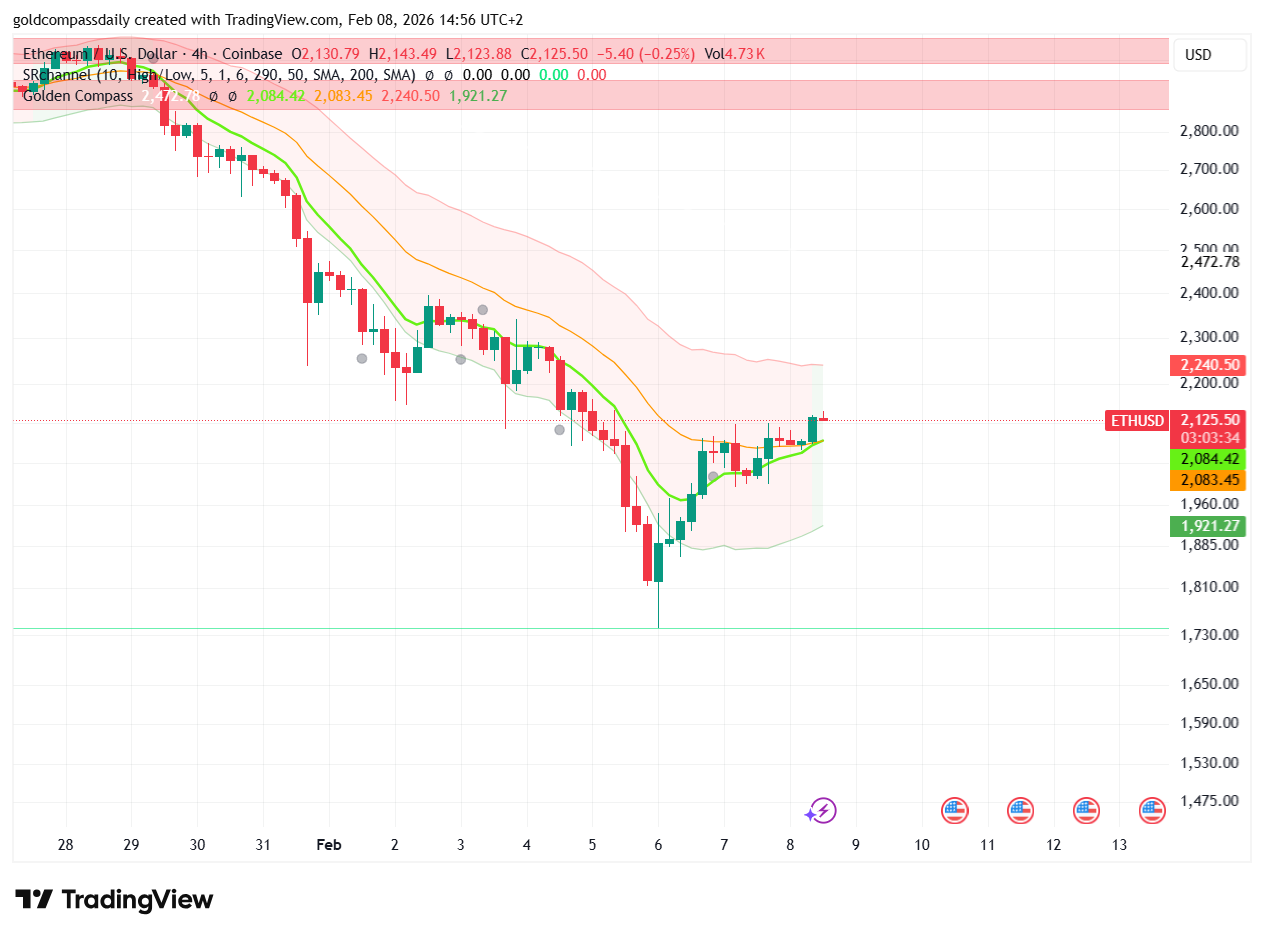
The 4-hour chart highlights a textbook liquidation event. After a sustained downtrend that began in late January, ETH sliced through its moving averages like butter, eventually hitting an “air pocket” that sent prices to a multi-month low near $1,730. This level has now become the “line in the sand” for the current Ethereum Price Recovery thesis.
- The Resistance Ceiling ($2,240): Currently, ETH is struggling against the $2,240 zone. This was a previous support level that has now flipped into a formidable resistance. A clean 4-hour close above this level is required to shift the short-term bias from bearish to neutral.
- Volume Profile: The bounce from $1,730 was accompanied by high volume, suggesting that institutional “whales” stepped in to provide a floor. However, the subsequent climb toward $2,125 has seen declining volume, a classic warning sign of an exhausted rally.
- The “Golden Compass” Indicator: Our proprietary channel shows ETH trading at the lower boundary. While this indicates “value” for long-term holders, short-term traders are waiting for a reclaim of the $2,084 level to confirm momentum.
Why the Liquidation Happened: The Macro Trigger
The Ethereum Price Recovery is not happening in a vacuum. The broader market was rattled by a strengthening U.S. Dollar Index (DXY) and a sudden hawkish shift from global central banks. Furthermore, Ethereum-specific sell pressure mounted as large-scale liquidations in the DeFi (Decentralized Finance) sector forced automated selling protocols to dump thousands of ETH onto the open market.
Interestingly, despite the price crash, network activity remains robust. Layer-2 adoption and institutional staking through ETH ETFs continue to grow, providing a fundamental “safety net” that prevents a total collapse to sub-$1,500 levels.
The Road Ahead: Targets and Traps
For a sustained Ethereum Price Recovery to take hold, the market needs to see a period of “boring” consolidation. Volatility needs to contract, allowing the Relative Strength Index (RSI) to reset from its extreme oversold conditions. If ETH can hold the $1,920 support on a weekly basis, the path toward $2,472 becomes the primary target for March 2026.
Critical Levels to Watch:
1. **The Bull Target ($2,472):** This represents the 50% Fibonacci retracement of the entire February dump. Reaching this would confirm the “crash” was just a deep correction in a broader uptrend.
2. **The Bear Trap ($1,730):** A breach of this low would likely trigger a secondary wave of panic, potentially targeting the $1,475 support zone.
Conclusion: Strategic Patience is Key
Today’s Ethereum Price Recovery attempt is a high-risk, high-reward moment. For long-term investors, these prices represent a significant discount relative to the January highs. For day traders, the market remains a “minefield” until the $2,240 resistance is decisively conquered. In the world of 2026 crypto, the fastest way to lose capital is to chase the bounce without structural confirmation.