

Gold Price Forecast 2026: Decoding the $5,000 Recovery Milestone
The global gold market has entered a critical phase this February. After a heart-stopping drop from its $5,600 peak down to the mid-$4,000s, the “yellow metal” is fighting to turn the tides. This Gold Price Forecast 2026 analyzes the current 1-hour chart structure to determine if the $5,022 level is a sustainable launchpad or a temporary pause in a larger correction.
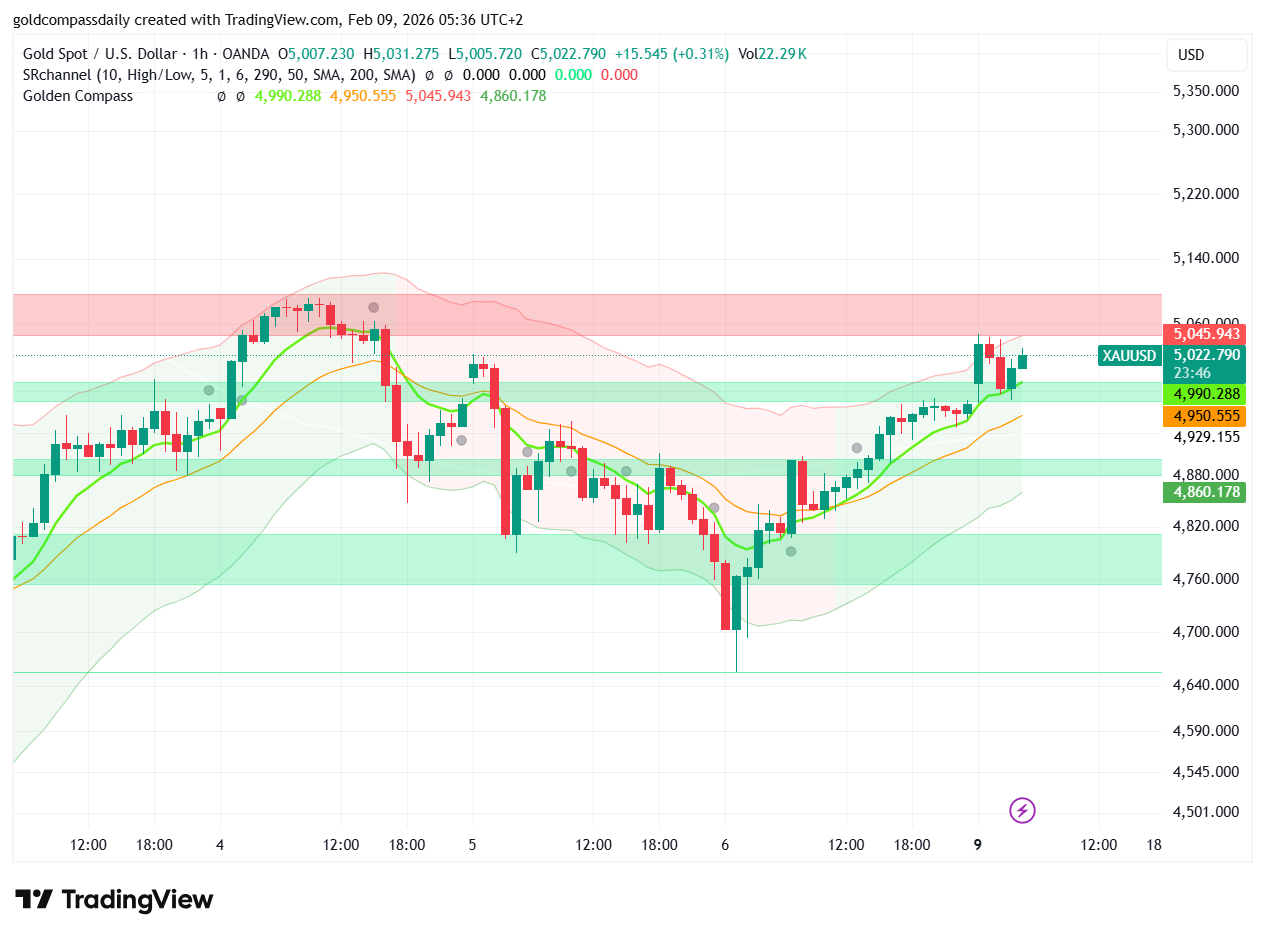
Technical Analysis: The 1-Hour Chart “U-Turn”
On the 1-hour timeframe, gold (XAU/USD) has recently shown remarkable resilience. Following a period of intense selling pressure, the price has successfully reclaimed the $5,000 psychological barrier, currently sitting at $5,022.79. This move is significant as it marks a shift from a “lower-low” pattern to a cautious uptrend.
- Immediate Support ($4,990): The market has established a firm base just below the $5,000 mark. As long as gold trades above $4,990, the short-term bullish bias remains intact.
- The Resistance Ceiling ($5,045): To confirm a full-scale Gold Price Forecast 2026 rally, the price must decisively break through the $5,045 resistance zone. This area has previously acted as a “rejection point” where sellers typically re-enter the market.
- Moving Averages: The price is currently oscillating around its 50 and 200-period simple moving averages (SMAs). A “Golden Cross” on this timeframe would provide the necessary momentum for a move toward $5,150.
Fundamental Drivers: Why Gold is Bouncing Now
The current Gold Price Forecast 2026 is not just about lines on a chart; it is driven by massive shifts in global economic policy. The recent nomination of Kevin Warsh as Fed Chair initially sent gold into a “flash crash” due to fears of a more hawkish (higher interest rate) environment. However, the market is now repricing this news as a signal of potential economic turbulence, driving investors back to safety.
Furthermore, central bank demand remains at historic highs. With countries like China and Poland continuing to diversify their reserves away from the US dollar, a permanent “price floor” seems to have been established near $4,700, making every deep correction a massive buying opportunity for institutional players.
The “Safe Haven” Psychology: Traders vs. Holders
For the average reader, the movement of gold is the ultimate “fear gauge.” When gold rises alongside a record-breaking stock market (like the Dow hitting 50,000), it suggests that professional investors are “hedging their bets” against a potential bubble burst.
In our Gold Price Forecast 2026, we observe that the 1-hour chart “V-shape” recovery suggests that the “fear of missing out” (FOMO) is currently stronger than the fear of a crash. Retail traders are looking at the $5,022 price tag as a “discount” compared to the $5,600 highs seen just weeks ago.
Strategic Outlook: What to Expect This Week
This week is defined by “The Battle of the Levels.” Investors should watch for the reaction at $5,000. If the price slips back to $4,860, the bullish thesis is delayed. However, a sustained hold above $5,025 targets the $5,241 region by mid-February.
Critical Checkpoints:
1. **The Bull Target ($5,045):** A 1-hour close above this level clears the path for $5,150.
2. **The Bear Signal ($4,950):** A drop below this zone suggests the $5,000 reclaim was a “fakeout.”
3. **Economic Catalyst:** Watch the US inflation data (CPI) on Friday; any sign of cooling inflation will be “rocket fuel” for the Gold Price Forecast 2026.
Conclusion: Is the Bottom Finally In?
While the path to $6,000 is fraught with volatility, the current 1-hour chart suggests that the worst of the January “flash crash” is behind us. The Gold Price Forecast 2026 remains cautiously optimistic. For those looking to enter the market, the $5,000 level represents the “line in the sand.” As long as the bulls defend this ground, gold’s status as the ultimate store of value in 2026 remains undisputed.