

While technical strategies address the “where” and “when” of gold trading, the macro-driven approach addresses the “why” — and for many experienced gold traders, it forms the foundation upon which technical entries are built. Gold is, at its core, a macro asset, and understanding the primary drivers behind its price behavior is essential to trading it with conviction rather than reacting to price movement alone.
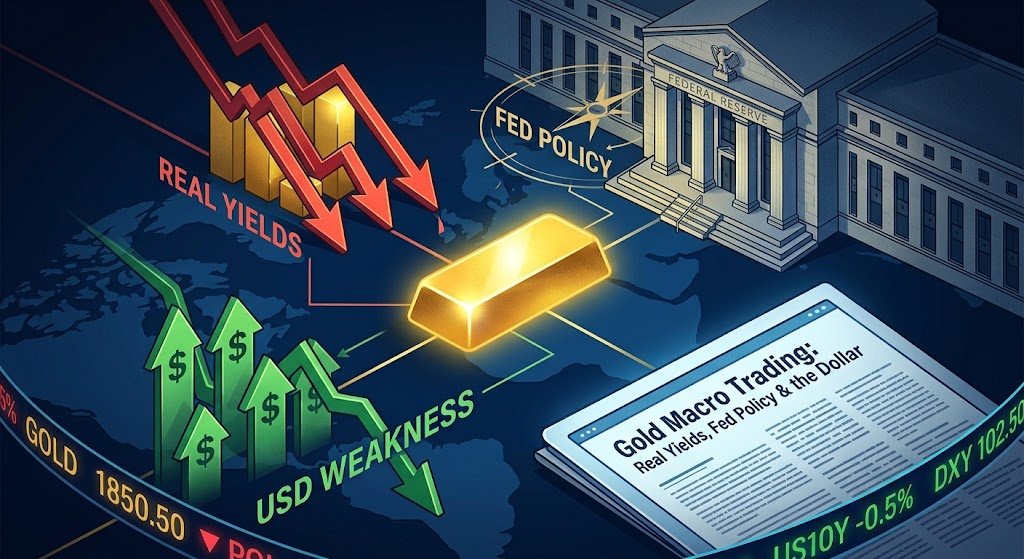
This guide walks through the real yield framework that anchors most professional gold analysis, the dollar’s role as a leading indicator, how central bank policy cycles shape gold’s larger trends, when inflation data actually moves gold and when it doesn’t, and how to combine these fundamental inputs into a coherent, tradeable macro thesis.
The Real Yield Framework
The single most important macro framework for gold is the real yield relationship. Real yields — calculated as nominal Treasury yields minus inflation expectations, commonly proxied by 10-year Treasury Inflation-Protected Securities (TIPS) yields — represent the opportunity cost of holding a non-yielding asset like gold. When real yields fall, the opportunity cost of holding gold decreases, typically supporting higher gold prices. When real yields rise, gold becomes comparatively less attractive relative to yield-bearing assets, typically pressuring prices lower.
This inverse relationship has historically been one of the most reliable macro correlations in the gold market, and many professional gold desks track real yields as their primary directional input. The relationship holds because gold generates no yield or dividend of its own — its opportunity cost relative to yield-bearing assets like Treasuries rises and falls directly with the real return those alternatives offer. A trader monitoring the 10-year real yield alongside a gold chart will often notice that meaningful directional shifts in gold coincide closely with turning points in the real yield trend, even when the correlation to nominal yields alone is far less consistent.
The Dollar Index as a Leading Indicator
The US Dollar Index provides a second, closely related lens. Since gold is priced in dollars, dollar strength mechanically raises the cost of gold for holders of other currencies, generally suppressing demand, while dollar weakness has the opposite effect. Because DXY often moves ahead of or alongside shifts in Fed policy expectations, traders frequently use it as a leading or confirming indicator alongside the real yield framework, watching for divergences between the two that might signal an approaching shift in gold’s directional bias.
In practice, real yields and the dollar tend to move together most of the time, since both are heavily influenced by the same underlying Fed policy expectations. When they diverge — for example, real yields falling while the dollar remains firm — it often signals that one market is pricing in a shift the other has not yet caught up to, and gold traders frequently watch for this kind of divergence as an early signal of a coming move rather than waiting for both indicators to align before acting.
Central Bank Policy Cycles
Central bank policy cycles sit upstream of both of these relationships. Rate hike cycles generally suppress gold by pushing real yields higher and supporting the dollar, while rate cut cycles tend to support gold through the opposite mechanism. The anticipation of policy shifts — reflected in interest rate futures markets and forward guidance — often moves gold before the actual policy change takes effect, meaning gold traders need to track policy expectations, not just realized decisions.
This forward-looking nature of markets is one of the more counterintuitive aspects of trading gold on macro fundamentals. Gold has, at various points, begun a sustained rally well before an actual rate cut cycle started, simply because market pricing shifted decisively toward expecting one. Conversely, gold has continued rallying even after a cutting cycle formally began if the market judged the pace of cuts to be faster than previously priced, and stalled once expectations were judged to be fully priced in. This is why professional traders emphasize tracking the changing expectations embedded in rate futures pricing rather than only reacting to the policy decisions themselves once announced.
Inflation Hedge Demand: When It Matters and When It Doesn’t
Gold is frequently described as an inflation hedge, but this relationship is conditional rather than constant. CPI data tends to drive meaningful gold price action primarily when it surprises relative to expectations and when it shifts the market’s view of future Fed policy — a CPI print that is in line with expectations often produces limited gold price reaction, even if the absolute inflation figure is elevated, because it does not change the prevailing rate outlook.
This distinction trips up many newer gold traders, who assume any high inflation reading should automatically be bullish for gold. In reality, an in-line but elevated CPI print that confirms the market’s existing rate path often produces a muted gold reaction, while a smaller-than-expected deviation that meaningfully shifts rate cut or hike expectations can produce an outsized move. The relevant question is rarely “is inflation high?” but rather “does this data change what the market expects the Fed to do next?”
A Structural Example
Consider a simplified, structural illustration of how these pieces interact. The Federal Reserve has been holding rates steady for an extended period following a tightening cycle, with the market broadly split on the timing of the first cut. A run of softer-than-expected labor market data begins shifting interest rate futures pricing meaningfully toward an earlier and deeper cutting cycle than previously assumed.
As this repricing occurs, 10-year real yields begin trending lower, reflecting the market’s adjusted rate expectations, and the dollar index weakens in tandem as yield differentials versus other major currencies narrow. Gold, tracking this combination of falling real yields and dollar weakness, begins a sustained uptrend well before the Fed actually delivers its first cut — illustrating how the macro thesis and the eventual policy action can be separated by a considerable lag, with the market move often front-running the formal decision.
Building a Macro Thesis for Gold
Building a coherent macro thesis for gold involves synthesizing all of these components: the direction of Fed policy expectations, the trajectory of the dollar, the behavior of real yields, and any prevailing geopolitical risk premium. A trader who identifies a Fed cutting cycle developing alongside falling real yields and dollar weakness has a strong, multi-factor case for a bullish gold bias — considerably stronger conviction than relying on any single input in isolation.
Geopolitical risk premium deserves a brief note of its own within this synthesis. Unlike the other three factors, which tend to move in relatively identifiable, data-driven cycles, geopolitical risk can appear or dissolve abruptly and is inherently harder to forecast. Traders generally treat a rising geopolitical premium as a factor that can add to an existing macro-driven move, or temporarily override it in the short term, rather than as a primary standalone thesis to trade on its own.
Practical Implementation: Which Calendar Events to Watch
Practically, this means monitoring a specific set of recurring economic calendar events: FOMC meetings and the accompanying statements and press conferences, monthly Non-Farm Payrolls data, CPI releases, and Core PCE — the Fed’s preferred inflation gauge. Each of these has the potential to shift the real yield and dollar dynamics that drive gold.
Of these, FOMC meetings typically carry the most direct weight, since they combine the actual policy decision with forward guidance that can shift rate expectations across the entire future curve in a single event. NFP and CPI releases are generally the two most reliable monthly catalysts for shifting near-term rate expectations, and Core PCE — while receiving less mainstream attention — is closely tracked by professional desks specifically because of its status as the Fed’s preferred inflation measure.
Combining Macro Thesis with Technical Entry Points
Rather than trading the macro thesis in isolation, experienced traders combine it with the technical strategies described elsewhere in this guide — using the macro thesis to establish directional bias, and technical structure to time entries with tighter risk parameters. A macro thesis alone rarely provides a precise entry price or a defined risk level; it answers the directional question, while technical structure — trend alignment, key levels, and precise entry timing — answers the “where” and “when.”
In practice, this means a trader convinced of a bullish macro backdrop for gold does not necessarily buy immediately upon forming that view. Instead, the macro thesis raises the trader’s willingness to buy dips toward key technical levels or trend-based retests, rather than fading them, giving the fundamental view a disciplined technical execution framework.
Common Mistakes Traders Make
Several recurring errors undermine an otherwise sound macro approach to gold. The first is reacting to the headline inflation or jobs number in isolation, without considering whether the data actually shifted the market’s rate expectations relative to what was already priced in.
A second common mistake is treating macro conviction as a reason to ignore technical risk management entirely, on the assumption that a strong fundamental thesis makes precise entry timing unnecessary. Even a correct macro thesis can be poorly timed, and traders who size positions aggressively based on conviction alone are more exposed to short-term drawdowns than those who still respect technical structure and risk parameters.
A third mistake is following nominal Treasury yields rather than real yields when assessing gold’s macro backdrop. Nominal yields alone can be misleading, since a rise in nominal yields driven primarily by higher inflation expectations, rather than tighter policy, does not necessarily translate into a higher real yield — and can, in some cases, coincide with a supportive rather than bearish gold environment.
Frequently Asked Questions
What is the most important macro driver of gold prices?
Real yields — nominal Treasury yields minus inflation expectations — are generally considered the most reliable macro driver of gold, since they represent the direct opportunity cost of holding a non-yielding asset. Falling real yields tend to support gold, while rising real yields tend to pressure it.
Does gold always rise when inflation is high?
Not necessarily. Gold tends to react most strongly to inflation data that surprises relative to expectations and shifts the market’s view of future Fed policy, rather than to the absolute level of inflation itself. An in-line CPI print, even at an elevated level, often produces a limited gold reaction if it confirms the existing rate outlook.
How does the Fed’s rate cycle affect gold?
Rate hike cycles generally pressure gold lower by raising real yields and supporting the dollar, while rate cut cycles tend to support gold through the opposite mechanism. Markets often begin pricing these effects into gold well before the Fed formally changes policy.
Should gold be traded on macro fundamentals alone?
Most experienced traders combine a macro thesis with technical analysis rather than trading fundamentals in isolation. The macro view establishes directional bias, while technical structure helps define precise entry points, stop placement, and targets.
Conclusion
The macro-driven fundamental approach explains the underlying forces that move gold over weeks and months, giving traders a framework for understanding why gold trends develop rather than simply reacting to price after the fact. Real yields, the dollar, Fed policy expectations, and conditional inflation hedge demand together form the core inputs to a coherent macro thesis, with scheduled events like FOMC meetings, NFP, and CPI serving as the primary catalysts that shift these dynamics. As with the other strategies in this series, the macro approach performs best not as a standalone timing tool, but when paired with technical structure to translate a directional thesis into disciplined, well-timed trade execution.
This article is for informational and educational purposes only and does not constitute financial advice. Gold trading involves significant risk of loss.