

Weekly Thesis
Gold enters the week of July 6–10, 2026 at $4,175 — recovering sharply from the prior week’s low near $3,942 after a June Nonfarm Payrolls miss of historic proportions stripped the Federal Reserve’s rate-hike narrative of its most important pillar. The defining question for the week is whether the metal can sustain its momentum through a dense event corridor anchored by the June 17 FOMC meeting minutes on Wednesday and FOMC member commentary on Monday and Thursday, or whether residual rate-hike pricing and unresolved US-Iran geopolitics cap the advance below the critical $4,180–$4,200 resistance band. Gold Compass Daily maintains a Cautiously Bullish weekly bias above $4,100, with the recovery structure intact and the macroeconomic backdrop increasingly tilted against the rate-hike scenario that drove gold lower through June.
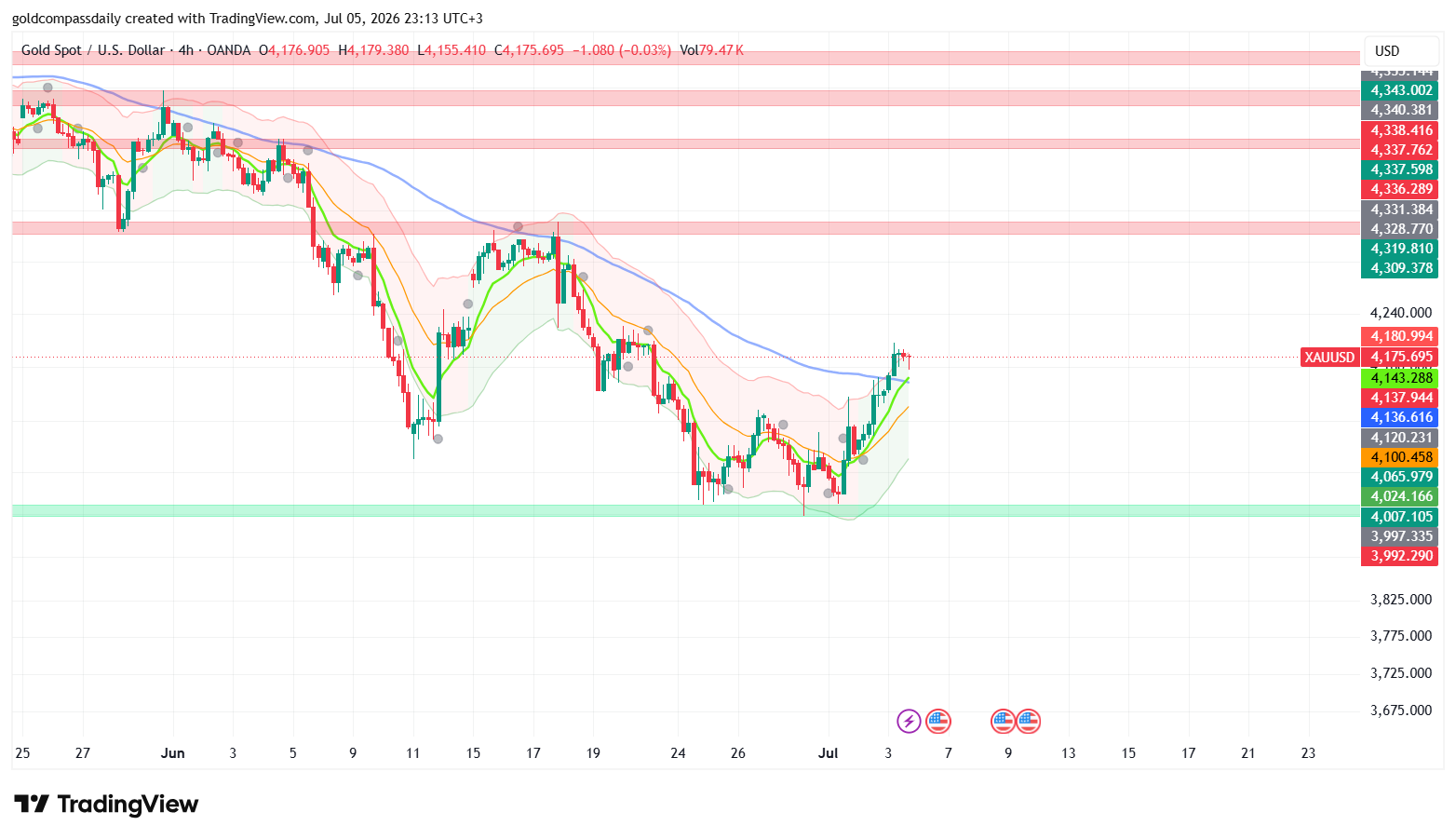
Key Levels for the Week
- Weekly bias: Cautiously Bullish above $4,100
- Key support: $4,136–$4,143 (short-term MA cluster and prior breakout zone) → $4,100–$4,065 (structural base) → $4,024 (demand floor)
- Key resistance: $4,180–$4,181 (horizontal resistance, immediate ceiling) → $4,240 (gap zone) → $4,309–$4,319 (descending long-term MA and prior structure)
- Weekly bull target: $4,240–$4,280 (conditional on a clear daily close above $4,180 and dovish FOMC minutes)
- Weekly bear risk: $4,065–$4,024 (conditional on hawkish FOMC tone or surprise US-Iran ceasefire progress removing safe-haven premium)
- The floor: $4,007 — a sustained break below this level signals the recovery from $3,942 has failed and opens a retest of the prior cycle lows
The Week’s Defining Event
The single most important release of the week is the FOMC Meeting Minutes from the June 16–17 session, due Wednesday, July 8 at 9:00 PM UTC+3. Markets already received the headline: the Fed held rates steady at 3.50%–3.75% and Chair Kevin Warsh’s debut meeting produced a dot plot leaning toward at least one hike before year-end 2026. What the minutes will reveal — and what gold traders will trade immediately — is the internal temperature of the Committee. The June NFP miss of just 57,000 jobs (against a 110,000 consensus, with an additional 74,000 in downward revisions to April and May) landed after the June meeting, meaning the minutes predate that shock. The asymmetry is what makes them dangerous: if the June minutes read as confidently hawkish given the data available at that time, gold faces a narrative tension with a labor market that has since deteriorated sharply. A hawkish tone validates the dollar and presses gold back toward $4,100. A more balanced or nuanced tone — one that already acknowledged downside risks to growth — hands bulls the confirmation they need to push through $4,180 and target $4,240. There is no other event this week that carries equivalent binary potential for the XAU/USD directional trade.
Macro Context
Gold enters the week in a structurally stronger position than at any point in the prior month, and the reason is the June labor market report. The US economy added just 57,000 jobs in June against a consensus forecast near 110,000–115,000 — the weakest single print since February — while prior months saw a combined 74,000 in downward revisions. The immediate effect was a repricing across rates markets: Fed funds futures moved sharply to reduce the probability of a September rate hike, the dollar slipped to a two-week low, and gold surged from a session low near $4,032 to close the shortened Independence Day week near $4,175. The NFP miss matters for gold not merely because it weakens the Fed’s case for tightening but because it arrives against a backdrop of inflation that remains elevated at the headline level — a paradox of soft growth and sticky prices that historically benefits non-yielding hard assets. With Fed Chair Kevin Warsh having abandoned conventional forward guidance and reduced policy communication to reactive data-dependence, every week’s economic releases now carry outsized weight for rates pricing, and by extension for gold.
The Federal Reserve policy backdrop entering the week remains the dominant structural driver. The June dot plot shifted the median 2026 rate projection higher, with nine FOMC members penciling in at least one hike against eight for steady and one for a cut. Core PCE was revised up to a 3.3% year-end forecast, and GDP was revised down to 2.2%. This is a stagflationary configuration — the precise environment in which gold historically outperforms. The Fed’s own projections acknowledge that inflation will remain above target throughout 2026, while growth is slowing and the labor market is cracking faster than expected. FOMC member Waller speaks Monday and FOMC member Williams speaks Thursday: both appearances carry weight as potential signals of how the Committee is processing the NFP shock. Any indication that the Fed is moving closer to a policy pause — as opposed to actively considering a hike — would remove the single most significant ceiling on gold’s near-term trajectory.
Geopolitical risk remains embedded in the gold price but is evolving in a direction that creates asymmetric risk for bulls. The US-Iran conflict resulted in a 60-day Memorandum of Understanding that partially reopened the Strait of Hormuz, and WTI crude has retreated to approximately $67 per barrel from a peak of $113 — a significant energy price deflation that in theory reduces one source of inflationary pressure and softens the argument for rate hikes. Indirect talks in Doha produced what Qatari mediators called “positive progress” but no breakthrough. The risk for gold is that a meaningful ceasefire deal removes the safe-haven bid that has been a persistent floor under prices. The risk to the upside is renewed escalation — Iranian officials have continued to assert sovereignty over the Strait of Hormuz, and any deterioration in the MoU framework would generate immediate safe-haven demand. Central bank purchasing remains a structural support: according to IMF data, global central bank gold accumulation continued through Q2 2026 at multi-year elevated rates, providing an institutional buying floor that absorbs short-term selling pressure during pullbacks.
Daily Event Calendar
Monday, July 6
- 12:00 PM UTC+3 — EUR Retail Sales m/m (forecast: +0.2%, prior: -0.4%): A beat supports risk appetite, which can rotate mild pressure onto gold; a miss reinforces slowdown narrative and provides mild support.
- 4:45 PM UTC+3 — USD Final Services PMI (forecast: 51.4, prior: 51.3): Confirms or adjusts the services sector picture; weak reading would extend NFP-driven bearish dollar momentum.
- 5:00 PM UTC+3 — USD ISM Services PMI (forecast: 54.2, prior: 54.5): The more closely watched of the two PMI releases; the Employment Index sub-component will be scrutinized specifically for confirmation of the NFP labor market deterioration. A reading below 50 on employment would be highly supportive for gold.
- 6:00 PM UTC+3 — USD FOMC Member Waller Speaks: Waller has been one of the more hawkish Fed voices in 2026; any softening in his rate-hike language in light of the NFP miss would be a significant bullish catalyst for gold. Watch closely.
Tuesday, July 7
- 12:30 PM UTC+3 — GBP Bank of England Financial Stability Report and Governor Bailey Speaks: BOE commentary on growth risks and financial conditions can influence risk appetite; a cautious tone supports safe-haven demand including gold.
- 3:15 PM UTC+3 — USD ADP Weekly Employment Change: The weekly ADP figure provides a secondary read on US labor conditions. Following last week’s NFP shock, traders will look for confirmation of structural weakness; a continued softening extends the dollar negative / gold positive environment.
- 3:30 PM UTC+3 — USD Trade Balance (forecast: -$78.5B, prior: -$55.9B): A widening trade deficit can add to dollar pressure and provide indirect support for gold.
Wednesday, July 8
- 5:00 AM UTC+3 — NZD Official Cash Rate (forecast: 2.50%, prior: 2.25%) + RBNZ Rate Statement: A 25bp cut would continue the global easing trend and validate the “lower for longer” macro narrative that supports gold. Rate decision plus press conference at 6:00 AM UTC+3 could set risk tone early in the session.
- 9:00 PM UTC+3 — USD FOMC Meeting Minutes (June 16–17): The week’s primary event. The minutes reveal internal Fed debate about the pace of potential tightening and members’ assessment of growth and inflation risks. A hawkish tone hits gold toward $4,100; a balanced or cautious tone clears the path toward $4,240. Gold traders should be positioned ahead of this release.
Thursday, July 9
- 4:30 AM UTC+3 — CNY CPI y/y (forecast: +1.1%, prior: +1.2%) and PPI y/y (forecast: +4.2%, prior: +3.9%): Chinese PPI acceleration would reinforce global cost pressures and support the inflation hedge case for gold.
- 2:30 PM UTC+3 — EUR ECB Monetary Policy Meeting Accounts: ECB internal discussion provides context on European rate trajectory; a dovish tilt supports gold by weakening the euro interest rate differential versus the US dollar.
- 3:30 PM UTC+3 — USD Unemployment Claims (forecast: 218K, prior: 215K): The first post-NFP weekly claims print; any deterioration confirms the labor market cracking thesis and extends the NFP-driven gold bid.
- 4:00 PM UTC+3 — USD FOMC Member Williams Speaks: New York Fed President Williams is a permanent voter and centrist voice; his characterization of the labor market following the NFP miss will be parsed for any shift in the Fed’s rate-hike calculus.
- 5:00 PM UTC+3 — USD Existing Home Sales (forecast: 4.20M, prior: 4.17M): Secondary data point; adds to the composite picture of US economic momentum.
Friday, July 10
- 3:30 PM UTC+3 — CAD Employment Change (forecast: +10.0K, prior: +87.8K) and Unemployment Rate (forecast: 6.6%): A sharp Canadian jobs slowdown would compound the North American labor market weakness narrative and reinforce the bearish dollar environment.
- Tentative — USD Fed Monetary Policy Report: Published semi-annually, this document provides the Fed’s comprehensive view on the economy and monetary policy. Given the NFP miss, any forward-looking language on the labor market carries potential market impact. Release timing is tentative and may not coincide with active trading hours.
Weekly Bull / Bear Scenarios
Bull Scenario — Target: $4,240–$4,280
The bull case requires three aligned conditions. First, Monday’s ISM Services Employment component prints below the neutral 50 level, extending the NFP miss narrative into the services sector and keeping rate-hike pricing depressed. Second, Wednesday’s FOMC minutes reveal a Committee that was already cautious on growth risks in June — before the NFP shock — which would invalidate the hawkish dot plot as a near-term guide and deliver a significant dovish surprise given current market positioning. Third, FOMC members Waller and Williams offer language that conditions any future hike on sustained inflation above current levels rather than signaling imminent action. Under this scenario, gold breaks decisively through the $4,180–$4,181 resistance ceiling, consolidates above $4,200, and extends toward the $4,240 gap zone by Thursday. The weekly close target is $4,260–$4,280, with the descending long-term moving average near $4,309 becoming the next test in the following week. Geopolitical flare-up from the US-Iran framework would add a safe-haven premium that accelerates this path.
Bear Scenario — Risk: $4,065–$4,024
The bear case activates if the June FOMC minutes read hawkishly — projecting confidence in the economy and emphasizing inflation over growth risks — or if FOMC member commentary on Monday and Thursday signals the Fed intends to look through the NFP miss as a one-time anomaly. A strong ADP employment figure on Tuesday would amplify the hawkish interpretation, suggesting the NFP miss may have been distorted. Additionally, any breakthrough in US-Iran direct talks — particularly progress toward a permanent reopening of the Strait of Hormuz — would reduce the geopolitical risk premium embedded in gold prices, pushing them toward the $4,100–$4,065 support band. Under this scenario, gold fails at $4,180 on Monday, retreats to test the $4,136–$4,143 MA cluster, and a sustained break below $4,100 would put the $4,024–$4,007 support zone directly in play. The weekly close below $4,100 would neutralize the recovery structure and signal a retest of the prior low is possible.
This Week’s Daily Analysis
- Monday, July 6 — Gold opens the week at $4,175, holding just below the critical $4,180 resistance as markets return from a shortened US holiday week. ISM Services PMI and FOMC Member Waller’s speech are the primary intraday catalysts. The bullish recovery structure from $3,942 remains intact above $4,136.
- Tuesday, July 7 — ADP weekly employment data and the US Trade Balance report provide the session’s directional inputs. Gold traders watch for confirmation that the NFP-driven dollar weakness is sustained rather than a short-covering rebound ahead of Wednesday’s FOMC minutes.
- Wednesday, July 8 — FOMC Meeting Minutes Day. The June 16–17 minutes release at 9:00 PM UTC+3 is the week’s binary event. Positioning ahead of the release and the immediate post-release reaction will define the week’s directional bias. RBNZ rate decision early in the session sets the global central bank tone.
- Thursday, July 9 — Post-minutes follow-through session. Weekly US unemployment claims and FOMC member Williams’s remarks test whether the market’s post-minutes interpretation holds. Chinese CPI and PPI data in the Asian session provide early commodity inflation context.
- Friday, July 10 — Canadian employment data and the tentative release of the Fed Monetary Policy Report round out the week. End-of-week positioning flows determine whether gold closes above or below the $4,180 pivot — the technical confirmation level that defines the coming week’s bias.
Chart Structure — 4-Hour Analysis
The 4-hour XAU/USD chart as of July 5, 2026 tells a recovery story with unresolved overhead risk. Price made a significant low near $3,942 during the prior week — a level that has now been established as a higher low relative to the broader structure — and staged a sharp rally that recaptured $4,100, $4,136, and $4,150 in sequence. The short-term green moving average has crossed above the medium-term orange moving average, and both are now curling upward within an expanding Bollinger Band — a configuration that confirms momentum has shifted to the upside following the NFP-driven rally.
However, price is currently stalling directly at the $4,180–$4,181 horizontal resistance level, which is marked clearly on the chart as the first significant ceiling in the recovery path. The long-term blue moving average continues to descend from the upper left of the chart and is now positioned near $4,309, representing a significant structural headwind for any continuation rally. The cluster of resistance levels between $4,309 and $4,343 — encompassing multiple prior support-turned-resistance zones — defines the ceiling of any bullish extension this week.
On the downside, the $4,136–$4,143 zone represents the first line of structural defense, formed by the convergence of the short-term and medium-term moving averages. Below that, $4,100–$4,065 is the key demand zone that held during the prior week’s consolidation before the NFP spike higher. The critical floor level is $4,007–$4,024: a break and sustained close below this zone would invalidate the recovery structure and expose the $3,942 prior low to a retest. Gold Compass Daily notes that the Bollinger Band lower band has risen to approximately $4,024, providing dynamic confirmation of this floor.
Analysis based on the XAU/USD 4-hour chart as of July 5, 2026 at 23:13 UTC+3. This article is for informational and educational purposes only and does not constitute financial advice.
For the prior week’s analysis and structural context, see Gold Compass Daily’s Gold Week Ahead: June 29–July 3 — NFP Week Tests Bounce From $4,007 Low.