

Gold enters the week of September 21–26, 2026 at $4,378 — staging a recovery from the $4,230 lows printed mid-last week, but trading directly into a layered resistance zone that will define whether the bounce has structural legs or simply represents a short-cover rally in a still-damaged technical picture. The single most important theme for the week is validation: can gold hold above its short-term moving averages, absorb a wall of Fed commentary, and clear $4,426 — or does the recovery stall and roll back toward the consolidation lows? A packed global PMI calendar on Wednesday, combined with six scheduled FOMC member appearances across the week, makes this a high-information environment that will force a directional resolution before Friday’s close.
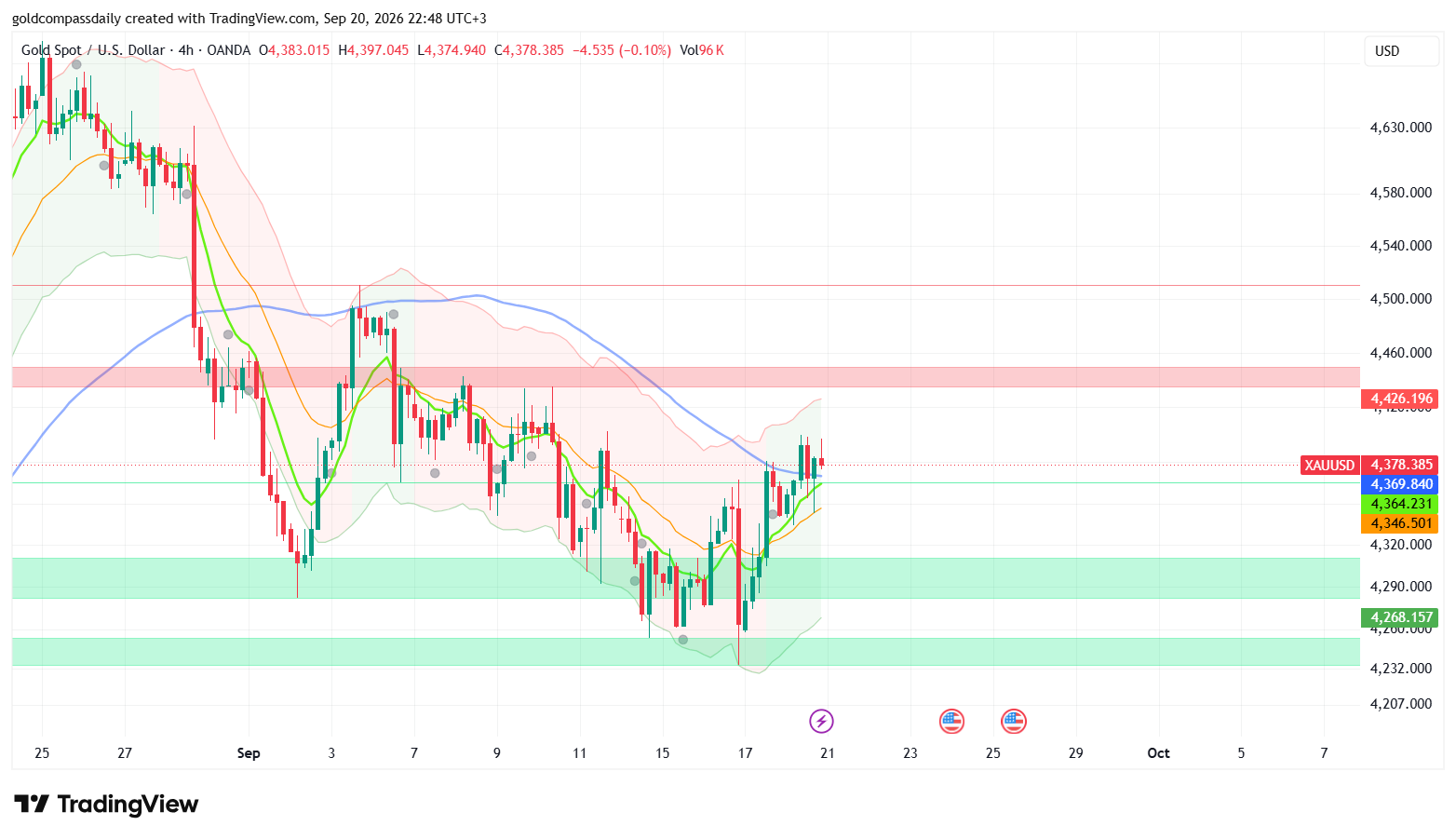
Key Levels for the Week
- Weekly bias: Cautiously Bullish above $4,346 — the orange medium-term MA must hold on any pullback to sustain the recovery thesis
- Key support: $4,346 (orange MA / prior consolidation) → $4,290–$4,320 (green demand zone, last week’s base)
- Key resistance: $4,378–$4,380 (current price / blue MA convergence) → $4,426 (upper pink resistance band) → $4,460 (structural ceiling from early September)
- Weekly bull target: $4,460–$4,480 (conditional on a clean break and close above $4,426 on strong volume)
- Weekly bear risk: $4,268 (labeled chart support) and then $4,230–$4,240 retest (conditional on loss of $4,320 on a closing basis)
- The floor: $4,230–$4,240 — a break below this level on weekly close terms would signal a structural trend reversal and open the $4,100–$4,150 zone
The Week’s Defining Event
Wednesday’s global Flash PMI sweep is the single data point that will do the most to define gold’s direction for the week of September 21–26. The PMI releases — covering Australia, France, Germany, the Eurozone, the United Kingdom, and the United States in a compressed six-hour window — deliver the most up-to-date read on global economic momentum available this week. For gold, the transmission mechanism is direct: if U.S. Manufacturing and Services PMIs print above consensus (53.4 and 56.0 respectively), it reinforces the narrative that the Federal Reserve has little urgency to accelerate rate cuts, putting upward pressure on real yields and downward pressure on gold. Conversely, any miss in U.S. data — particularly a Services PMI slide that signals consumer and corporate softening — would revive the rate-cut impulse and provide the macro fuel gold needs to push through $4,426. The European PMI readings matter secondarily: a deteriorating German manufacturing print (prior 54.3, forecast 54.0) confirms global industrial weakness and tends to support safe-haven demand, adding a second potential tailwind for gold even as U.S. data dominates the dollar response.
Macro Context
Gold’s technical condition entering the week is one of recovery within a damaged structure. The 4H chart shows clearly that price peaked above $4,580 in late August before executing a sustained decline of more than $350 over three weeks, printing a multi-week low near $4,230 around September 15–16. The subsequent bounce to current levels of $4,378 has been sharp and covers roughly $150 of that decline — but the recovery has returned price directly to where the short-term and long-term moving averages converge. The green short-term MA ($4,364), orange medium-term MA ($4,346), and blue long-term MA (~$4,370) are all clustered within a $25 band around current price. This MA compression is a coiling structure: it precedes directional expansion, and the direction of that expansion — not the coil itself — is what this week’s calendar will determine. The weekly structure still shows a sequence of lower highs from the August peak, meaning the burden of proof lies with bulls to establish a new higher high above $4,460 before the trend can be called recovered rather than merely bouncing.
The macro backdrop is split in a way that creates genuine directional uncertainty, which explains gold’s consolidation behavior. On the supportive side, the Federal Reserve’s rate-cut cycle — initiated in 2025 and continuing into 2026 — has been the primary structural driver of gold’s multi-month bull trend. Real yields, while elevated, have been on a declining trajectory as markets price an extended easing cycle, and any data that reinforces that path supports gold’s fundamental valuation floor. Fed Chair Kevin Warsh’s institutional framework has consistently emphasized data dependence rather than a preset pace of cuts, which means each week’s data releases have outsized significance for near-term gold pricing. Additionally, central bank gold demand — documented as a consistent and largely price-insensitive buyer base throughout 2025 and into 2026 — provides a structural bid that limits downside even during technical corrections of the magnitude seen over the past three weeks.
On the pressuring side, the dollar has retained relative strength during gold’s correction phase, as U.S. economic data has generally outperformed European equivalents — a dynamic clearly visible in the PMI differentials expected this Wednesday, where U.S. Services is forecast at 56.5 versus the Eurozone’s 51.6. A dollar that refuses to weaken meaningfully creates a ceiling for gold’s recovery pace even when the directional bias is upward. Separately, the Swiss National Bank’s Thursday rate decision — with the policy rate expected to hold at 0.00% — is a reminder that the global rate cycle is not uniformly accommodative. SNB policy stability reduces safe-haven urgency in European markets and limits cross-currency flows that might otherwise amplify gold demand. The aggregate macro picture supports a cautiously bullish stance: the structural tailwinds are intact, but the near-term technical damage requires confirmation before new capital is justified at current prices.
Daily Event Calendar
Monday, September 21
- All Day — JPY — Bank Holiday (Japan): Reduced Asian session liquidity; gold may gap or drift during early hours without Tokyo’s participation — watch for thin-market volatility in the Asian open.
- 13:00 UTC — EUR — German Buba Monthly Report: The Bundesbank’s monthly assessment will be parsed for any revision in the ECB’s inflation or growth outlook; a dovish tone supports gold via EUR weakness relative to USD.
- 13:30 UTC — USD — FOMC Member Goolsbee Speaks: Goolsbee is among the more dovish voices on the FOMC; any language reinforcing rate-cut expectations or expressing concern about labor market cooling would provide immediate support to gold at the $4,378 level.
- 18:00 UTC — EUR — ECB President Lagarde Speaks: Lagarde’s remarks will be monitored for any shift in the ECB’s rate path — a more dovish lean weakens the EUR/USD relationship in a way that can amplify dollar strength and cap gold’s early-week advance.
- 18:05 UTC — CAD — BOC Governor Macklem Speaks: Secondary for gold, but Canadian rate signals affect commodity-linked flows; relevant context for the broader risk sentiment backdrop.
Tuesday, September 22
- All Day — JPY — Bank Holiday (Japan): Second consecutive session of reduced Asian liquidity; early price action will be driven primarily by European and U.S. participants.
- 06:10 UTC — AUD — RBA Governor Bullock Speaks: Any shift in RBA tone affects AUD/USD, which in turn influences commodity sentiment; hawkish RBA language could modestly support gold via commodity-currency risk appetite.
- 14:00 UTC — EUR — ECB President Lagarde Speaks (again): Lagarde’s second appearance in two days signals the ECB is in active communication mode; consistency or deviation from Monday’s remarks will be closely watched for EUR and gold implications.
- 15:15 UTC — USD — ADP Weekly Employment Change (forecast 16.3K prior): This non-standard weekly ADP print provides a real-time read on U.S. labor conditions; a significant miss would amplify dovish Fed expectations and provide a lift to gold ahead of Wednesday’s PMI data.
- 17:05 UTC — USD — FOMC Member Williams Speaks: Williams, as New York Fed President, carries significant weight; his framing of the rate outlook will set expectations heading into Wednesday’s PMI releases and could move gold by $10–$20 per ounce depending on tone.
- 17:20 UTC — USD — FOMC Member Jefferson Speaks: As Fed Vice Chair, Jefferson’s remarks on the pace of cuts and the balance of risks are high-significance; two senior Fed officials speaking the same day creates potential for directional clarity or conflicting signals.
- 20:00 UTC — USD — FOMC Member Barkin Speaks: Barkin’s regional Fed perspective adds texture to the labor market and inflation assessment; third Fed voice in a single day amplifies the week’s communication signal.
Wednesday, September 23
- 10:15 UTC — EUR — French Flash Manufacturing PMI (forecast 50.9 / prior 51.1): French manufacturing holding at expansion threshold — a miss would confirm European industrial softness and add to safe-haven demand for gold.
- 10:15 UTC — EUR — French Flash Services PMI (forecast 48.4 / prior 48.0): Services contraction territory for France is already consensus; depth of the miss matters more than the direction for gold’s reaction.
- 10:30 UTC — EUR — German Flash Manufacturing PMI (forecast 54.0 / prior 54.3): Germany’s manufacturing has been the bright spot in European data; any deterioration would weigh on EUR/USD and create mixed signals for gold — safe-haven demand vs. dollar strength.
- 10:30 UTC — EUR — German Flash Services PMI (forecast 49.9 / prior 49.7): German services flirting with contraction reinforces ECB dovish pressure and supports the case for gold’s safe-haven premium.
- 11:00 UTC — EUR — Eurozone Flash PMIs (Mfg 52.6 / Services 51.4): Aggregate Eurozone reading — the headline number that EUR/USD traders react to first; a composite below expectations would weaken EUR and potentially support USD, creating a ceiling effect for gold in the short term.
- 11:30 UTC — GBP — Flash Manufacturing PMI (forecast 51.4 / prior 51.7) and Services PMI (forecast 52.0 / prior 52.5): UK PMI data feeds into BOE rate expectations; a miss would weigh on sterling but has secondary gold implications via cross-currency safe-haven flows.
- 16:45 UTC — USD — Flash Manufacturing PMI (forecast 53.4 / prior 53.9) and Flash Services PMI (forecast 56.0 / prior 56.5): The most important data release of the week for gold. U.S. PMI data above consensus reinforces Fed patience and dollar strength — a direct headwind for gold’s push through $4,426. A miss in Services below 55.0 would trigger immediate repricing of rate-cut expectations and provide the catalyst for a genuine breakout attempt.
- 17:05 UTC — USD — FOMC Member Barr Speaks: Immediately following PMI data, Barr’s comments will either reinforce or soften the market’s initial reaction — watch for real-time gold volatility in the 17:00–18:00 UTC window.
- 17:30 UTC — USD — Crude Oil Inventories: Oil inventory data affects energy sector risk sentiment and can amplify or dampen broader commodity moves including gold.
Thursday, September 24
- 10:30 UTC — CHF — SNB Policy Rate Decision (forecast hold at 0.00%): The SNB is expected to hold rates at zero; any surprise cut into negative territory — however unlikely — would be immediately bullish for gold as a non-yielding asset and would signal global deflationary pressures. A hold as expected has minimal gold impact.
- 11:00 UTC — EUR — German ifo Business Climate (forecast 89.0 / prior 88.8): Germany’s premier business sentiment indicator; a beat would partially offset any European PMI weakness from Wednesday and reduce safe-haven demand pressure on gold.
- 11:10 UTC — USD — FOMC Member Williams Speaks (again): Williams’ second appearance of the week — if his Thursday remarks align with Tuesday’s, the consistency reinforces the rate outlook signal; divergence would create uncertainty that historically supports gold.
- 15:30 UTC — USD — Unemployment Claims (forecast 201K / prior 196K): Weekly claims data provides the most current read on U.S. labor market conditions; a print above 210K would reignite growth concerns and support gold; a print below 190K would reinforce Fed patience and cap gold’s rally.
- 15:30 UTC — USD — Current Account (forecast -$259B / prior -$227B): A widening current account deficit is structurally bearish for the dollar over the medium term and supports gold as a dollar alternative; the magnitude of this widening will be parsed by institutional traders.
- 17:00 UTC — USD — New Home Sales (forecast 619K / prior 607K): Housing data speaks to the rate-sensitive sector’s health; a beat would suggest the economy is absorbing current rates, reducing urgency for cuts — mildly negative for gold.
- 15:30 UTC — CAD — Retail Sales m/m (forecast -0.8% / prior +0.6%): Canadian consumer spending contraction would weigh on CAD and commodity-linked assets broadly; secondary gold signal.
Friday, September 25
- 12:15 UTC — GBP — BOE Governor Bailey Speaks: Bailey’s remarks will be assessed for any shift in the Bank of England’s rate trajectory following the week’s PMI data; a more dovish tone supports GBP-denominated gold demand and broader safe-haven flows.
- 12:15 UTC — USD — FOMC Member Williams Speaks (third appearance): Williams speaking three times in one week is a deliberate Fed communication strategy; by Friday, the cumulative message will be clear — watch for the market to have fully priced his view heading into the weekend.
- 15:30 UTC — USD — Core Durable Goods Orders m/m (forecast 0.5% / prior 0.4%): Business investment proxy — a beat reinforces U.S. economic resilience and supports the case for a patient Fed; a miss revives growth concerns. Gold’s Friday reaction will depend heavily on how the week’s prior data has already shifted positioning.
- 15:30 UTC — USD — Durable Goods Orders m/m (forecast -0.3% / prior +1.1%): The headline is expected to contract due to volatile transportation orders; the core reading matters more, but a larger-than-expected headline contraction could amplify any existing risk-off tone.
- 17:00 UTC — USD — Revised UoM Consumer Sentiment (forecast 47.5 / prior 47.8) and Inflation Expectations (prior 4.6%): Consumer confidence near historic lows (forecast 47.5) reflects ongoing household financial stress; elevated inflation expectations at 4.6% create a stagflationary narrative that is structurally bullish for gold. Any deterioration in the headline sentiment or uptick in expectations would close the week on a gold-supportive note.
- 21:00 UTC — USD — FOMC Member Hammack Speaks: Late Friday Fed commentary; will summarize the week’s communication and set the narrative for weekend positioning.
Weekly Bull / Bear Scenarios
Bull Case
Trigger combination: U.S. Services PMI on Wednesday misses consensus (print below 55.0) + FOMC members Williams and Jefferson deliver dovish remarks Tuesday + Unemployment Claims rise above 205K Thursday → Gold breaks above $4,426 resistance zone with conviction, accelerates through $4,440 and tests the $4,460–$4,480 structural ceiling by Friday’s close. In this scenario, the bounce from $4,230 is validated as a genuine trend resumption, the sequence of lower highs is broken, and the weekly candle closes above the pink resistance band — establishing a new higher high. The bull scenario also requires that Durable Goods data on Friday does not significantly outperform, preventing a late-week dollar surge that could cap the advance. Weekly bull target: $4,460–$4,480.
Bear Case
Trigger combination: U.S. PMI data (Wednesday) prints at or above consensus across both Manufacturing and Services + Williams and Jefferson adopt a patient, non-committal tone on cuts + Unemployment Claims come in at or below 196K Thursday → Gold fails to clear $4,426, rolls over from current $4,378 level, and returns to test the $4,320–$4,290 green support zone. In this scenario, the recovery from last week’s lows is exposed as a technical bounce within a still-bearish structure, the cluster of moving averages at current price acts as resistance rather than support, and the weekly candle prints a bearish engulfing or shooting star pattern that signals the next leg lower. If $4,290 fails to hold on a closing basis, the $4,268 labeled support is the next test, and $4,230 becomes the weekly low retest target. Weekly bear risk: $4,268 → $4,230 retest.
This Week’s Daily Analysis
- Monday, September 21 — Gold opens the week at $4,378 in a thin Asian session with Japanese markets closed for a bank holiday. FOMC Member Goolsbee and ECB President Lagarde both speak during the U.S. session, making afternoon commentary the primary price catalyst for the day. The technical setup is a test of moving average convergence — three MAs within a $25 band — and the direction of resolution from this coil sets the tone for the week.
- Tuesday, September 22 — A second consecutive Japanese holiday keeps Asian liquidity thin. The session is dominated by three FOMC speakers: Williams (17:05 UTC), Jefferson (17:20 UTC), and Barkin (20:00 UTC), alongside ADP weekly employment data. The cumulative tone from Fed speakers will establish the market’s rate-cut expectations heading into Wednesday’s pivotal PMI data.
- Wednesday, September 23 — The week’s defining session. Global Flash PMI data from Australia through the U.S. delivers the most comprehensive economic update of the week in a single day. U.S. Flash Manufacturing (forecast 53.4) and Services PMI (forecast 56.0) at 16:45 UTC are the headline events — expect elevated volatility in gold between 16:30 and 18:00 UTC as the data and FOMC Member Barr’s subsequent commentary interact with existing positioning.
- Thursday, September 24 — SNB rate decision (hold expected at 0.00%) anchors early European session tone. U.S. Unemployment Claims (forecast 201K) and Current Account data at 15:30 UTC are the key afternoon releases. A third Williams appearance (11:10 UTC) makes Thursday a high-Fed-communication day. German ifo data (11:00 UTC) provides a final cross-check on European growth conditions.
- Friday, September 25 — China’s bank holiday limits Asian participation. BOE Governor Bailey speaks at 12:15 UTC alongside Williams’ third weekly appearance. Core Durable Goods Orders and the headline Durable Goods print at 15:30 UTC provide the manufacturing investment read. The session closes with Revised UoM Consumer Sentiment (forecast 47.5) and Inflation Expectations (prior 4.6%) at 17:00 UTC — a stagflationary combination that could set the directional bias for early next week.
Analysis based on the XAU/USD 4H chart as of September 20, 2026, 22:48 UTC+3. This article is for informational and educational purposes only and does not constitute financial advice.