

U.S. equity markets enter August 2026 on firm footing, but the terrain demands discipline. The S&P 500 has gained roughly 8% year-to-date through mid-year, a performance anchored by one overriding force: earnings. According to FactSet data, S&P 500 companies have beaten consensus estimates by an average of 9.2% over the past four quarters — a beat rate that has kept institutional conviction intact even as macroeconomic signals have grown more complex.
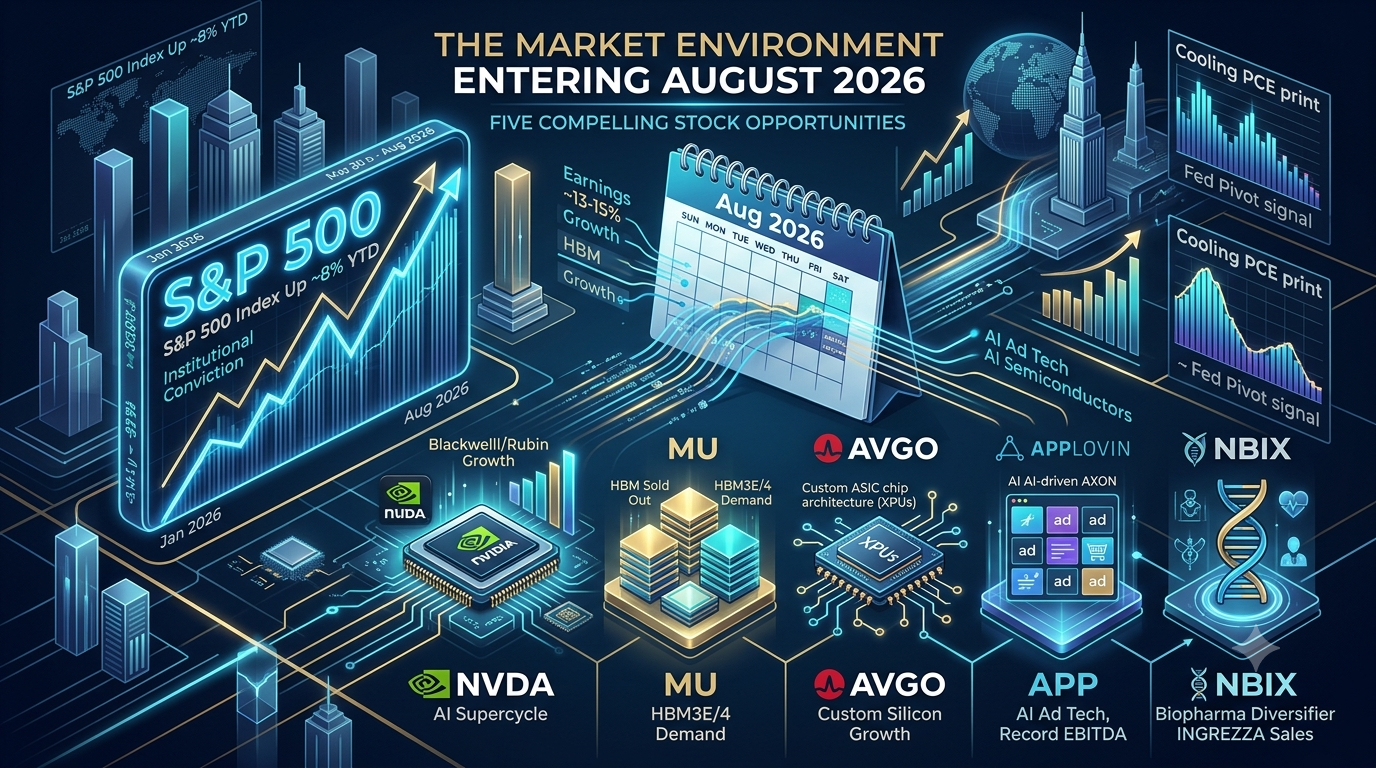
The Federal Reserve, now under Chair Kevin Warsh, held the federal funds rate steady at 3.50%–3.75% through its July 29–30 meeting. The accompanying rhetoric hinted at a potential pivot ahead, and a cooling PCE print on July 31 reinforced market expectations that the tightening cycle has concluded. That shift in Fed tone drove a mid-week reversal in the final days of July, with technology and communication services leading gains as the 10-year Treasury yield softened. Volatility fell, inflows rose, and sentiment rotated decisively toward a soft-landing scenario.
Against that backdrop, J.P. Morgan Global Research projects that the AI supercycle will drive above-trend S&P 500 earnings growth of 13–15% over at least the next two years. Goldman Sachs and Morgan Stanley have each noted that the strong earnings trend is likely to persist through year-end, pushing the index higher. The consensus S&P 500 year-end target implies an additional 5% gain from current levels — modest by recent standards, but anchored in a macro environment where elevated capital expenditure on artificial intelligence infrastructure is still accelerating.
For stock-pickers, this environment rewards selectivity. The five names below represent what the research supports as the most compelling risk-adjusted opportunities entering August 2026, spanning semiconductors, AI infrastructure, ad technology, and biopharma. Each has been evaluated on earnings growth trajectory, revenue momentum, free cash flow quality, analyst consensus, and specific catalysts that are live in the current month.
1. Nvidia Corporation (NVDA)
The Case in Brief
Nvidia remains the dominant infrastructure layer of the artificial intelligence supercycle, and August 2026 brings a pivotal near-term catalyst: the company’s fiscal Q2 2027 earnings report, scheduled for August 26 or 27. Analysts expect revenue of approximately $91 billion for the quarter — guidance the company itself set in May — representing sequential growth from the record $81.6 billion posted in Q1. That Q1 report, released on May 20, included an additional $80 billion share repurchase authorization and a 25-fold increase in the quarterly dividend to $0.25 per share.
The investment thesis for NVDA in August is not purely about one earnings print. It is about the durability of a structural position. Nvidia controls an estimated 80% of the AI GPU market by revenue, and that share is defended by more than hardware. The CUDA software ecosystem — which took over a decade to build and is deeply integrated into the workflows of every major AI laboratory and hyperscaler — creates switching costs that competitors have struggled to replicate at scale. AMD’s MI300 series has made inroads in specific workloads, and custom silicon from Google, Amazon, and Meta is gaining relevance, but none of these alternatives displaces Nvidia across the breadth of AI training and inference applications.
The Blackwell and Rubin Product Cycle
The Blackwell GPU architecture has driven the current revenue cycle. Data center revenue hit $62.3 billion in Q4 fiscal 2026 alone, up 75% year-over-year, with Blackwell systems in such demand that the company described supply as the binding constraint rather than customer interest. The next architecture, Vera Rubin, features HBM4 memory and a 3nm process node, and first samples began shipping to customers during the quarter. Manufacturing partners including Foxconn, Quanta Cloud Technology, and Supermicro are developing STX-based systems expected to be broadly available in the second half of 2026. Analysts at Simply Wall St have lifted their NVDA fair value estimate to $296.81 and raised price targets to a range of approximately $470–$500, with the Rubin ramp timeline and data center order visibility through 2027 as the primary justifications.
Key Metrics
- Stock price (late July 2026): approximately $200
- Expected FY2027 EPS growth: approximately 88% year-over-year
- Expected revenue growth (FY2027): approximately 82%
- Forward P/E: approximately 20x
- Analyst consensus: Strong Buy; price targets $470–$500+
Key Risk
The earnings report on August 26 is as much a risk as it is a catalyst. Nvidia’s history includes post-earnings declines even on strong beats, because market expectations are set high and any shortfall in data center revenue guidance — however marginal — can trigger profit-taking. Geopolitical exposure to China chip export policy adds ongoing headline risk. Investors with near-term sensitivity should consider whether they prefer to enter ahead of earnings or on any post-report weakness.
2. Micron Technology (MU)
The Case in Brief
Micron Technology is the most compelling value-growth combination in the semiconductor memory space, and its August 2026 setup is unusually clear. The company’s entire 2026 high-bandwidth memory (HBM) supply is sold out under fixed-price contracts. That statement, which would have seemed implausible for a company historically at the mercy of commodity DRAM cycles, reflects how fundamentally AI infrastructure demand has restructured memory economics.
Micron is one of only three vertically integrated memory producers globally, alongside Samsung and SK Hynix. Within that group, it has staked out a differentiated position in HBM — the specialized memory architecture that sits closest to GPU compute die and is essential for large-scale AI training. Micron’s 12-high HBM3E stacks consume approximately 30% less power than competing products, and the company holds roughly 21% market share in HBM as of early 2026. HBM4 volume production is scheduled for later this year, timed to coincide with next-generation GPU releases from Nvidia and AMD.
The Earnings Picture
Forbes, citing StockAnalysis.com data, projects that Micron will report approximately 785% EPS growth for fiscal year 2026, which closes August 31. That follows 538% EPS growth in the prior year. While the headline EPS growth figures reflect the depth of the prior downcycle as much as the magnitude of the current upturn, the underlying quality of the earnings is improving structurally: gross margins reached 74.9% in Q2 FY2026, and Q2 revenue surged 196% year-over-year. Seeking Alpha analysis notes that HBM products command premium pricing versus commodity DRAM, improving Micron’s overall profitability and providing greater earnings visibility than in prior cycles.
DA Davidson analyst Gil Luria has a $1,000 price target on MU, arguing that the market continues to price Micron as though the current cycle will mean-revert like prior downturns — a premise he views as increasingly untenable given the structural shift in demand from AI infrastructure.
Key Metrics
- Stock price (late July 2026): approximately $849
- Expected FY2026 EPS growth: approximately 785%
- Expected three-year EPS growth: approximately 171%
- Free cash flow growth: approximately 1,291%
- Forward P/E: approximately 5.9x
- Analyst consensus: Strong Buy; average price target $489–$536 near term, with high-conviction outliers above $1,000
Key Risk
Memory remains a cyclical industry. Any slowdown in hyperscaler AI capex spending, which is projected at over $600 billion in 2026 from the four major cloud providers, would compress HBM demand faster than fixed-price contracts can insulate. Technology transition risk is also real: HBM4 yield rates and bonding quality will determine whether Micron can hold or grow its market share as the next generation ramps. Samsung and SK Hynix will not cede ground without a response.
3. Broadcom Inc. (AVGO)
The Case in Brief
Broadcom occupies a strategically distinct position in the AI hardware stack from Nvidia: rather than competing head-to-head in general-purpose GPU accelerators, it partners with hyperscalers to design custom AI chips — application-specific integrated circuits (ASICs) and XPUs — optimized for specific workloads. That model has made Broadcom the preferred design partner for some of the largest technology companies in the world, and the revenue pipeline reflects it.
In its fiscal Q2 2026 earnings report, Broadcom posted record total revenue of $22.2 billion, including approximately $10.8 billion from AI semiconductors — growth of more than 100% year-over-year in that segment. CEO Hock Tan confirmed that the company has six core custom chip customers, including Anthropic, Google, Meta, and OpenAI. For fiscal Q3 2026 (ending August 2), management guided total revenue to $29.4 billion — an 84% year-over-year increase — with AI semiconductor revenue expected to reach approximately $16 billion, triple the Q2 figure.
The Custom Silicon Opportunity
The investment thesis for AVGO in 2026 is that custom silicon is not a niche alternative to GPU clusters — it is the next phase of AI infrastructure as hyperscalers optimize for inference efficiency and cost at scale. General-purpose training clusters dominated the first phase of the AI buildout; the second phase increasingly involves inference at massive scale, where workload-specific chips offer meaningful cost and power advantages. Broadcom’s partnerships position it directly in that transition. The company reiterated its guidance for AI semiconductor revenue in excess of $100 billion in fiscal year 2027. Analyst price targets cluster in the $470–$582 range, reflecting expectations for stronger AI networking, XPU momentum, and continued Google TPU-related business.
Key Metrics
- Stock price (late July 2026): approximately $371
- Expected FY2026 EPS growth: approximately 70%
- Expected three-year EPS growth: approximately 56%
- Expected revenue growth: approximately 66%
- Forward P/E: approximately 23.6x
- Analyst consensus: Buy; 88% of analysts rate Buy or Strong Buy; price targets $470–$582
Key Risk
AVGO shares fell more than 12% after the Q2 earnings report despite record results, because the AI revenue guidance for fiscal 2027 did not exceed what the most optimistic analysts had modeled. That price action is a clear signal that expectations management is difficult at these valuations. Margin pressure is also a watch item as Broadcom’s product mix shifts toward more complex custom designs. The stock rewards investors who are comfortable holding through post-earnings volatility on the expectation that the structural AI custom chip story remains intact.
4. AppLovin Corporation (APP)
The Case in Brief
AppLovin is the most compelling AI-native ad technology play in the current market cycle, and August 2026 is a high-conviction month for the stock with its Q2 2026 earnings report confirmed for August 5, after the market close. Analysts expect AppLovin to report diluted EPS of $3.72, representing 64.6% year-over-year growth from $2.26 in the prior-year quarter. Revenue guidance for Q2 was set at $1.915–$1.945 billion, implying approximately 52–55% growth year-over-year. The company has beaten Wall Street’s EPS estimates in each of the last four consecutive quarters.
AppLovin operates the AXON platform, an AI-driven advertising engine that analyzes user data at scale to identify individuals most likely to install an app, make a purchase, or engage with specific content. The company divested its mobile gaming studios in 2025, transforming itself into a pure-play advertising technology company. The consequence is extraordinary margin profile: free cash flow margins are above 70%, and adjusted EBITDA margin for Q1 2026 came in at a record 85%, producing $1.56 billion in EBITDA on $1.84 billion in revenue.
The E-Commerce Expansion Catalyst
The key strategic development in 2026 is AppLovin’s expansion beyond mobile game advertising into the much larger e-commerce advertising market. On June 29, Raymond James initiated coverage with a Strong Buy rating, explicitly citing the e-commerce expansion as a significant long-term growth opportunity beyond the company’s legacy mobile app advertising base. The launch of the Axon Ads Manager as a self-serve platform for a broader pool of e-commerce advertisers is the mechanism. The e-commerce advertising market is orders of magnitude larger than mobile gaming, and even modest penetration would represent a material revenue expansion. For fiscal year 2026, analysts project full-year EPS of $15.93, up 58.7% from $10.04 in fiscal 2025. FY2027 EPS is projected at $20.89, a further 31% increase.
The stock sold off sharply in mid-July on mixed industry data points around e-commerce advertising momentum, creating what Piper Sandler described as a buying opportunity — the firm reiterated an Overweight rating with a $665 price target, noting that core gaming market momentum remained solid through Q2 and that AppLovin could increase sales and marketing investment in H2 without damaging core margins.
Key Metrics
- Stock price (late July 2026): approximately $424
- Expected FY2026 EPS growth: approximately 59%
- Expected three-year EPS growth: approximately 36%
- Expected revenue growth: approximately 50%
- Adjusted EBITDA margin: approximately 84–85%
- Analyst consensus: Strong Buy; Jefferies target $700, Piper Sandler $665
Key Risk
The August 5 earnings report is the primary near-term binary event. Any deceleration in the e-commerce advertising ramp — or a narrowing in EBITDA margin from the record 85% level — could trigger selling. The July selloff demonstrated how quickly sentiment can shift on APP when industry channel checks disappoint. The company’s free cash flow generation is exceptional, but much of its valuation depends on the assumption that e-commerce becomes a durable, scalable revenue driver rather than an incremental one.
5. Neurocrine Biosciences (NBIX)
The Case in Brief
Among the five names in this list, Neurocrine Biosciences offers the most differentiated sector exposure and serves as a portfolio diversifier against the AI semiconductor concentration that defines the other four picks. NBIX is a commercial-stage biopharmaceutical company specializing in neurological, neuroendocrine, and neuropsychiatric disorders. It is not a speculative biotech; it is a profitable, cash-generative business with multiple marketed products, an expanding pipeline, and a recent earnings print that prompted price target increases from TD Cowen, Guggenheim, Cantor Fitzgerald, Piper Sandler, Needham, Stifel, Morgan Stanley, Wells Fargo, and JPMorgan — collectively a remarkably broad wave of analyst support.
Neurocrine’s flagship product, INGREZZA (valbenazine), treats tardive dyskinesia — an involuntary movement disorder caused by long-term use of certain psychiatric medications. The market is large, underpenetrated, and growing. In Q2 2026, INGREZZA generated $716 million in sales, up 15% year-over-year, and management raised full-year INGREZZA guidance to $2.825–$2.875 billion. That guidance raise, alongside the strong Q2 print, triggered the broad wave of analyst price target revisions noted above.
Portfolio Expansion and Pipeline
The commercial story extends beyond INGREZZA. CRENESSITY (crinecerfont), a treatment for congenital adrenal hyperplasia, generated $184 million in Q2 2026 as patient enrollment and reimbursement coverage continued to scale. The Soleno Therapeutics acquisition added VYKAT XR, a hyperphagia treatment with patent protections extending into the mid-2040s, which contributed $54 million in its first quarters of commercial contribution. Citi raised its NBIX price target to $249 following the Q2 results. Wells Fargo set a $200 target with an Overweight rating. The average 12-month consensus target from 28 analysts is approximately $200, implying roughly 11% upside from current trading levels, with the high-conviction outliers in the $220–$250 range reflecting the peak sales potential of the expanded portfolio.
Analyst consensus reflects this strength: of 28 analysts tracked by Investing.com, 25 rate NBIX a Buy, with a Strong Buy consensus designation. The forecast annual earnings growth rate of 24.4% exceeds the U.S. specialty pharma industry average of 17.4%, and projected EPS rises from approximately $7.62 in 2026 to $10.15 in 2027.
Key Metrics
- Stock price (late July 2026): approximately $185
- Expected FY2026 EPS growth: approximately 60%
- Expected three-year EPS growth: approximately 34%
- Expected revenue growth: approximately 32%
- Free cash flow growth: approximately 69%
- Forward P/E: approximately 16.9x
- Analyst consensus: Strong Buy; average 12-month target approximately $200–$204; high-end $249
Key Risk
Despite the strong execution, the market’s initial response to the Q2 earnings call was a high-volume selloff, as traders appeared to have expected a broader revenue beat or a more substantial guidance increase beyond INGREZZA. That reaction suggests that the stock’s recent strength has elevated buy-side expectations, and future guidance revisions will need to keep pace. INGREZZA also faces the standard commercial risks of a maturing flagship product: net pricing pressure from formulary access negotiations, and the eventual need for the newer products to carry a larger share of total revenue growth. Insider selling from a company director under a pre-arranged Rule 10b5-1 plan was noted following the Q2 report — a neutral signal in isolation, but worth monitoring for pattern.
Portfolio Considerations and Final Thoughts
The five names above span the AI hardware supply chain (NVDA, MU, AVGO), AI-native software and advertising (APP), and differentiated biopharma (NBIX). That construction reflects the current market reality: earnings leadership in 2026 is concentrated in AI infrastructure exposure, but a portfolio that is exclusively concentrated in that theme carries substantial correlated risk if hyperscaler capex growth decelerates or if the Federal Reserve’s projected pivot is delayed.
August 2026 contains several near-term catalysts that directly affect these names. AppLovin reports on August 5. NVDA reports on August 26. Micron’s fiscal year closes on August 31, with a report likely in late September. Broadcom’s Q3 period closes August 2, with a report expected in early September. These earnings events are the primary price-moving catalysts in the near term and should be incorporated into position sizing decisions — particularly for investors who are sensitive to earnings-day volatility.
The macro backdrop is supportive: the Fed has signaled that the tightening cycle has concluded, the PCE print has been cooling, and the August NFP report (released on August 1) will provide the first read on labor market conditions after the July FOMC. A soft labor market reading — without crossing into genuine deterioration — would reinforce soft-landing expectations and provide a constructive backdrop for risk assets through the remainder of the month.
This article is for informational purposes only and does not constitute investment advice. Past performance is not indicative of future results. All investors should conduct their own due diligence and consider their individual risk tolerance before making any investment decisions.