

Gold trades cautiously at $4,079 heading into Monday’s close, consolidating above near-term support as markets position ahead of the week’s defining macro event: the Federal Reserve’s July 28–29 meeting. With a rate hold broadly expected but by no means certain, the pre-FOMC positioning phase is keeping volatility compressed — and the next directional break dependent on what Chair Kevin Warsh signals about September.
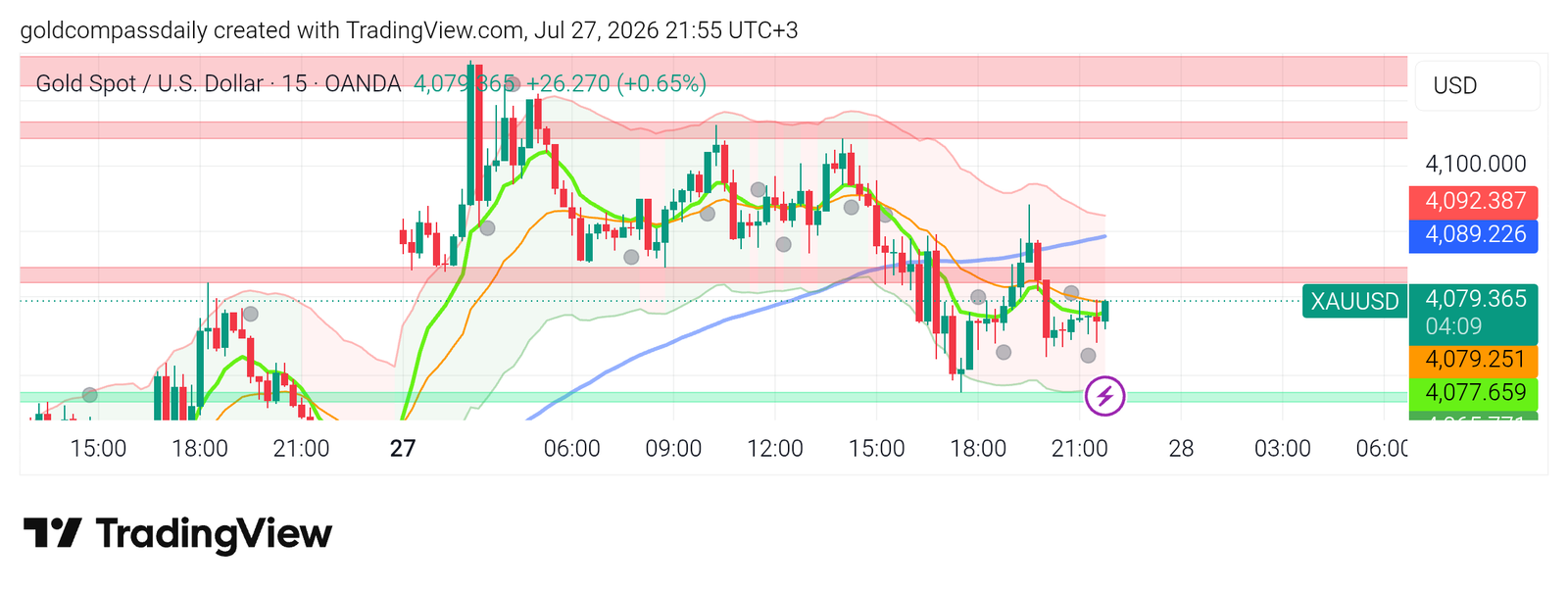
Key Levels
- Bias: Cautiously Bullish above $4,077 | Neutral-to-Bearish below $4,065
- Support: $4,077–$4,078 (green band / rising blue MA) → $4,065 → $4,050
- Resistance: $4,089–$4,092 (session high cluster) → $4,100 (psychological) → $4,137–$4,150 (weekly bull target)
- Session target: $4,092 (on sustained hold above $4,079 into the close)
- Invalidation: Break and close below $4,065 = bearish retest of $4,050 likely before Tuesday’s FOMC open
Catalyst of the Day
The dominant force governing gold’s behaviour this week is the FOMC meeting beginning Tuesday, July 28, with the rate decision and Chair Warsh’s press conference due Wednesday, July 29 at 14:00 ET (21:00 UTC+3). Markets are not pricing the decision itself as a surprise — Gold Compass Daily’s weekly hub outlines the full catalyst sequence — but the policy statement language and any shift in Warsh’s tone toward September will drive the real volatility. A hold accompanied by hawkish language strengthens the dollar and pressures gold; a hold with a dovish tilt — acknowledging softening in employment or energy disinflation — gives gold the fuel to clear $4,092–$4,100. With CME FedWatch pricing a 61.3% hold probability, the residual 38.7% uncertainty is keeping the pre-FOMC range tight. Watch for any intraday repricing of September rate expectations as the trigger for the next $30–$40 move in either direction.
Fundamental Context
The macro backdrop for gold entering FOMC week is structurally supportive but tactically complicated. The current federal funds target range sits at 3.50%–3.75% after the June 17 decision held rates unchanged — a unanimous vote that reflected still-elevated inflation above the Fed’s 2% target alongside a cooling labour market. The June jobs report showed just 57,000 nonfarm payrolls added, well below consensus, which removed the immediate pressure for a hike. However, nearly half of FOMC members indicated at the June meeting that they would support a rate increase before year-end, meaning Warsh’s press conference Wednesday carries forward-guidance weight that markets will parse carefully. For gold, the arithmetic is straightforward: a prolonged hold environment at 3.50%–3.75% reduces the opportunity cost of holding non-yielding bullion and provides a price floor, while any hawkish signal that raises the probability of a September hike would revive dollar strength and weigh on XAU/USD.
The secondary driver is the US–Iran geopolitical backdrop. Brent crude’s spike above $100 per barrel last week complicated the inflation narrative by introducing an energy-driven upside risk to CPI — a factor that makes the Fed’s path more restrictive, not less. When crude retreated on peace-talk hopes, some of gold’s safe-haven premium unwound with it, explaining the mid-session drift from the day’s high toward $4,065 before recovering. Central bank structural demand remains the floor under price: Q1 2026 net official purchases reached 244 tonnes, up 17% quarter-on-quarter, with China adding to reserves for the twentieth consecutive month. This structural bid does not react to individual FOMC meetings but provides the base beneath which institutional sellers find limited follow-through.
Thursday’s Q2 GDP print and Friday’s PCE inflation data — the Fed’s preferred inflation gauge — are the data points most likely to reprice gold beyond Wednesday’s reaction. If PCE arrives above 2.5% and GDP remains resilient, the September hike narrative gains credibility and gold faces renewed pressure toward $4,050. If PCE softens and GDP disappoints, the rate-cut timeline is pulled forward and $4,137–$4,150 comes back into scope.
Chart Analysis
The 15-minute XAU/USD chart as of 21:55 UTC+3 shows price at $4,079.37, holding within a tight $4,077–$4,092 range after a volatile session. The early session printed a sharp advance to the $4,079–$4,080 cluster near the upper resistance band, followed by a mid-session decline that tested the $4,065 area and recovered. The rising blue moving average — the slowest and most structurally significant on this timeframe — is approaching from below at approximately $4,077, converging with the green support band to form a layered floor. The green and orange moving averages have rolled sideways-to-slightly-lower after the mid-day retreat, reflecting the consolidation character of the close rather than any renewed momentum. Price is currently resting on the intersection of the rising blue MA and the green support band, which is the critical hold-or-fail level into the close. The upper resistance band in red is capping at $4,092–$4,100, a zone that has contained multiple intraday highs this session. With no new momentum catalyst before Wednesday’s FOMC, the chart structure favours continued compression between $4,077 and $4,092 through Tuesday.
Bull / Bear Scenarios
Bull Scenario
Trigger: Price holds above $4,077 into Monday’s close and opens Tuesday above $4,080 → Target: $4,092 test, with extension to $4,100 psychological level if FOMC statement Wednesday is read as hold-with-dovish-lean. Weekly bull target remains $4,137–$4,150 on a confirmed break above $4,100.
Bear Scenario
Trigger: Loss of $4,065 on a 15-minute close basis → Target: $4,050 retest, with risk to $4,030–$4,020 if FOMC statement Wednesday signals elevated probability of a September rate hike. A drop below $4,020 before the Fed decision would represent a structural deterioration.
Events Ahead
- Tuesday, July 28 — FOMC Meeting Begins (all-day): No decision today, but any pre-positioning flows or leaked commentary can move gold 15–25 points intraday.
- Tuesday, July 28 — 16:00 ET (23:00 UTC+3) — US Consumer Confidence (July): A sharp miss relative to consensus signals weaker demand and adds to the hold/cut case, supportive for gold.
- Wednesday, July 29 — 14:00 ET (21:00 UTC+3) — FOMC Rate Decision + Warsh Press Conference: The primary volatility event of the week. Watch the policy statement for “persistent inflation” language and Warsh’s comments on September. This is the week’s defining moment for XAU/USD direction.
- Thursday, July 30 — 08:30 ET (15:30 UTC+3) — US Q2 GDP (Advance Estimate): A below-consensus GDP print softens the case for additional tightening and supports gold; a strong beat revives hike expectations.
- Thursday, July 30 — 08:30 ET (15:30 UTC+3) — PCE Inflation (June): The Fed’s preferred inflation measure, releasing the morning after the decision. A hot PCE print above 2.5% is the clearest post-FOMC bearish trigger for gold.
- Friday, August 1 — 08:30 ET (15:30 UTC+3) — US Nonfarm Payrolls (July): Labour market confirmation. A second consecutive weak jobs print strengthens the dovish case and would support a move toward $4,137–$4,150.
Gold enters FOMC week holding its ground at $4,079, with the structure favouring patience over aggression. The technical setup is compressed and the fundamental catalyst is 48 hours away. The position that pays is the one that waits for Wednesday’s Warsh press conference to define the next 300-point range.
Analysis based on the XAU/USD 15-minute chart as of July 27, 2026, 21:55 UTC+3. This article is for informational and educational purposes only and does not constitute financial advice.