

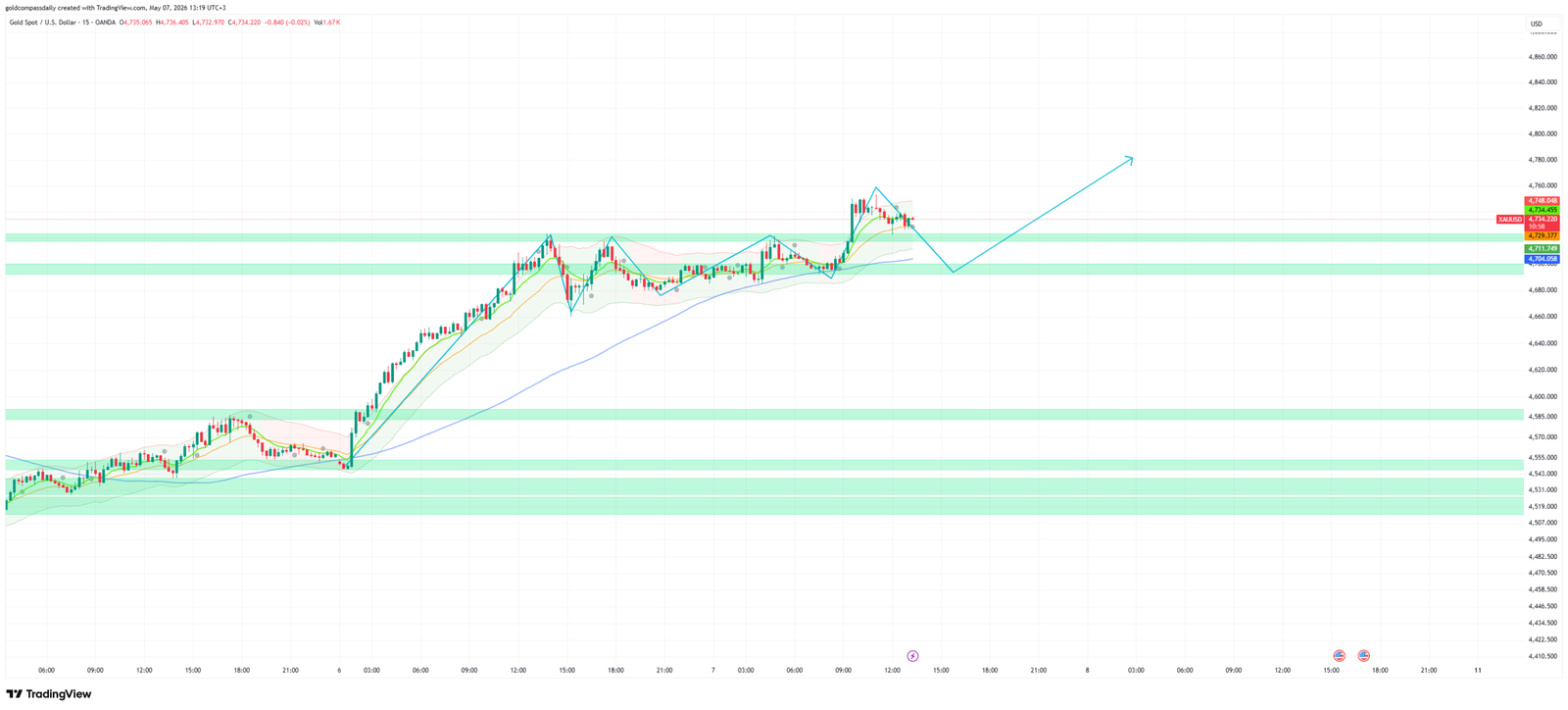
Gold is back on the march. After finding a floor at $4,504 on Monday — the post-NFP low that held the green demand zone — XAU/USD has staged a $230 recovery over three sessions, reaching $4,748 in early Thursday trading before consolidating at $4,734. The 15-minute chart projects a minor dip to the $4,704–$4,711 support zone before the continuation toward $4,780+. Today’s primary catalyst is US Unemployment Claims at 3:30pm — the pre-NFP labour market signal that will determine whether gold breaks above $4,748 and targets the April highs, or consolidates for one more session before the final push. Three FOMC members speak in the evening, adding a second round of Fed communication to an already consequential day.
The Chart: Three-Day Rally, Healthy Pullback in Progress
The 15-minute chart tells the story of a recovery that has been building methodically since Monday’s $4,504 low. The move from $4,504 to $4,748 — a $244 rally in three sessions — has been orderly: each day’s high is higher than the last, each pullback has been shallow, and the green demand zones visible throughout the chart have been left well below current price. The multiple green horizontal bands at $4,555, $4,585, $4,543, and $4,519 now represent the structural floor that buyers have defended at every test this week.
The projected path on the chart shows a dip into the $4,704.058–$4,711.749 zone before the next leg higher toward $4,780+. That dip zone aligns with the green demand band visible at the top of the chart’s support structure and represents a natural retracement of approximately 38% of the three-day rally — a healthy corrective move that would strengthen the recovery structure before the continuation.
The immediate resistance is $4,748.048 — today’s session high. A clean close above that level opens the path toward $4,780 and then the April high area near $4,860–$4,900. The floor is $4,704.058. A close below that breaks the higher-low sequence that has defined this week’s recovery and would bring the $4,660 area back into focus.
Already Published: European Morning Mixed
Japan’s Monetary Policy Meeting Minutes at 2:50am revealed that BOJ members discussed the pace of rate normalisation in the context of wage growth and tariff uncertainty. The minutes showed more internal debate about the timing of further hikes than previous communications suggested — a nuanced dovish signal for the yen that has been largely absorbed without major market impact. Japan’s Monetary Base y/y at -10.5% (prior -11.6%) — the pace of balance sheet reduction is slowing, consistent with the BOJ’s gradual normalisation approach.
Australia’s Goods Trade Balance at $4.38B — below the prior of $5.69B but still a healthy surplus. Australia’s trade position remains strong despite the global demand headwinds from Liberation Day. The surplus narrowing from $5.69B to $4.38B reflects both lower commodity prices (ANZ Commodity Prices at -0.8% yesterday) and a modest pickup in import demand. Net: AUD-neutral to mildly negative.
German Factory Orders m/m at 1.0% (forecast 1.0%, prior 0.9%) — in line with expectations. German factory orders growing for the second consecutive month at 1.0% confirms that the manufacturing recovery visible in the PMI data is translating into actual order books. This is a genuine positive for German industrials and EUR/USD — it adds to the picture of a Eurozone economy that entered Q2 with unexpected momentum before the full tariff impact arrives in Q2 data.
French Trade Balance at -5.6B (prior -5.8B) — a marginal improvement in France’s trade deficit. The French external position remains deeply in deficit — consistent with weak export competitiveness and resilient import demand. No material market impact.
Eurozone Retail Sales m/m at -0.3% (forecast -0.3%, prior -0.2%) — in line. European consumers continue to pull back — spending declined for the third consecutive month. This persistent retail weakness is the most important argument for continued ECB easing: the Eurozone economy’s growth is being driven by external demand (manufacturing exports) rather than domestic consumption.
UK Construction PMI at 46.0 (forecast 46.0, prior 45.6) — in contraction but slightly improved. UK construction remains in contraction for the seventh consecutive month — the persistent weakness in this sector reflects the combination of elevated mortgage rates and planning uncertainty. A slight improvement from 45.6 to 46.0 is a marginal positive signal — the pace of contraction is slowing — but the sector remains well below the 50 expansion threshold.
Swiss Unemployment Rate held at 3.0% (forecast 3.0%, prior 3.0%) — stable, no market impact. Switzerland’s labour market remains one of the tightest in the world.
Challenger Job Cuts at 2:30pm: The Pre-Claims Warning Signal
Challenger Job Cuts y/y is due at 2:30pm with the prior reading at -78.0%. This measures announced corporate layoffs on a year-over-year basis — the deeply negative prior reading signals that companies announced dramatically fewer layoffs year-over-year. A reading that moves toward zero or turns positive would be the first signal of accelerating corporate job cuts — a meaningful early warning ahead of tomorrow’s NFP and today’s claims data at 3:30pm.
In the context of Liberation Day tariff uncertainty, watch for any sector-specific language in the Challenger report about tariff-related restructuring announcements in manufacturing, retail, or import-dependent sectors.
3:30pm — Unemployment Claims: The Pre-NFP Signal
Weekly Unemployment Claims are forecast at 205K (prior 189K) — a meaningful expected increase. The prior reading of 189K was the lowest in several months, signalling exceptional labour market resilience. A return to 205K would be a normalisation — not alarming in isolation, but a second consecutive above-200K reading would begin to establish a trend of rising claims that could be the first concrete evidence of Liberation Day’s impact on US employment.
The claims data is the most important pre-NFP indicator available this week. With next Friday’s official payrolls being the defining economic event of May, today’s claims reading sets the market’s expectation. Three scenarios:
Below 195K (beat): Labour market exceptional resilience confirmed. Dollar strengthens. Gold faces resistance at $4,748. NFP expectations rise. The dip to $4,704 becomes more likely as positioning adjusts for a strong Friday report.
205K–215K (in line): Normal weekly variation. Markets hold current positioning. Gold consolidates between $4,704 and $4,748. The technical dip-then-rally setup plays out as projected.
Above 225K (miss): First meaningful signal of labour market deterioration. Dollar weakens. Gold breaks above $4,748 immediately. NFP expectations fall sharply. The path to $4,780+ accelerates significantly and the recovery toward April highs ($4,860) becomes the dominant narrative.
Prelim Nonfarm Productivity q/q at 1.0% (prior 1.8%) and Prelim Unit Labor Costs q/q at 2.5% (prior 4.4%) — both expected to show significant deceleration. Lower unit labor costs mean less wage-driven inflation pressure — a signal that should be gold-supportive through reduced Fed hawkishness concerns. If unit labor costs come in below 2.0%, it would be the most disinflationary labour market signal since the FOMC meeting and would reinforce the case for eventual Fed cuts.
Three FOMC Members: The Evening’s Direction Setters
Kashkari speaks at 8:00pm, Hammack at 9:05pm, and Williams at 10:30pm. Three Fed communications in the same evening — after a week of balanced messaging from the FOMC — creates the potential for meaningful USD volatility after the US market close.
Kashkari (Minneapolis Fed) has historically been one of the more hawkish FOMC members. His reaction to this week’s softer ISM Services data and the claims reading will be particularly telling — if Kashkari acknowledges that the data is softening, it signals the hawkish wing of the Fed is beginning to shift. Hammack (Cleveland Fed) has been more centrist. Williams (New York Fed) — who spoke Monday in a balanced tone — will provide the committee’s clearest signal when he speaks at 10:30pm, having had the full week of data to assess.
Any of the three acknowledging that tariff uncertainty is weighing on growth in a way that “warrants monitoring both sides of the mandate” would be interpreted as a dovish lean — gold-positive and dollar-negative heading into Friday’s overnight session.
Consumer Credit at 10:00pm: The Spending Reality Check
Consumer Credit m/m at $12.5B (prior $9.5B) — an expected increase in consumer borrowing. Rising consumer credit can be interpreted two ways: consumers are confident and spending (bullish) or consumers are relying on debt because income growth isn’t covering expenses (bearish). In the current environment of deteriorating consumer confidence (CB Confidence missed last week) alongside persistent spending, the credit data is more likely to signal stress than strength.
Key Levels and Full Market Summary
- Gold (XAU/USD): $4,734 · Dip target $4,704–$4,711 · Resistance $4,748 · Target $4,780+ · Floor $4,704 · Claims 3:30pm + three FOMC members 8:00–10:30pm
- EUR/USD: German Factory Orders beat (1.0%) = mild EUR support · Eurozone Retail Sales -0.3% = ECB cut case · Challenger at 2:30pm + Claims at 3:30pm drive USD afternoon · Williams 10:30pm closes the session
- GBP/USD: UK Construction PMI slightly improved at 46.0 · MPC Lombardelli 11:00am + Taylor 3:40pm = two BOE communications · Claims and USD direction drive the close
- USD/JPY: BOJ minutes show more internal debate than expected = mild yen support · Claims below 195K = pair holds elevated · Claims above 225K = sharp decline
- AUD/USD: Trade surplus narrowing · No major AUD catalyst today · Moves with risk sentiment from Claims and FOMC speakers
- S&P 500 / Nasdaq: Three-day gold rally confirms risk appetite improving · Claims below 195K = NFP beat expected = equities hold · Claims above 225K = recession concern but rate cut rally in Nasdaq
- US Treasuries: Unit Labor Costs deceleration to 2.5% = yields fall = gold rallies · Claims above 225K = 2-year yield drops sharply · Williams 10:30pm = the most important Treasury market signal of the evening
- Gold week summary so far: $4,504 low Monday → $4,748 high Thursday = $244 recovery = 5.4% in three sessions · April bull case reasserting · $4,780 is the next target · $4,860–$4,900 is May’s objective if claims disappoint today
Gold has recovered $244 from Monday’s low in three sessions. The structure is bullish, the momentum is building, and today’s claims data at 3:30pm is the gating event for the next leg higher. A claims reading above 225K — the first real evidence that Liberation Day is affecting US employment — would be the most powerful catalyst available this week for a break above $4,748 and a push toward $4,780 and beyond. The dip to $4,704 is the technical entry point. Claims above 225K is the fundamental catalyst. Three FOMC speakers this evening write the overnight script.
Analysis based on the XAU/USD 15-minute chart as of May 7, 2026, 13:19 UTC+3. Economic data sourced from the daily macro calendar. This article is for informational and educational purposes only and does not constitute financial advice.