

Gold is heading into the most important data release of the month in the best technical shape it has been since the post-FOMC collapse began in March. After recovering $221 from Monday’s $4,504 low to Thursday’s $4,765 session high, XAU/USD is consolidating at $4,722 ahead of today’s Non-Farm Payrolls at 3:30pm. The 15-minute chart projects a minor dip to the $4,701–$4,716 support zone before the continuation toward $4,780+ — but the NFP will determine whether that target is reached today or whether gold needs one more session of consolidation before the April highs at $4,860–$4,900 come back into view. The consensus forecast of 65K jobs — against last month’s 178K — would be the weakest payrolls report since the pandemic era if confirmed.
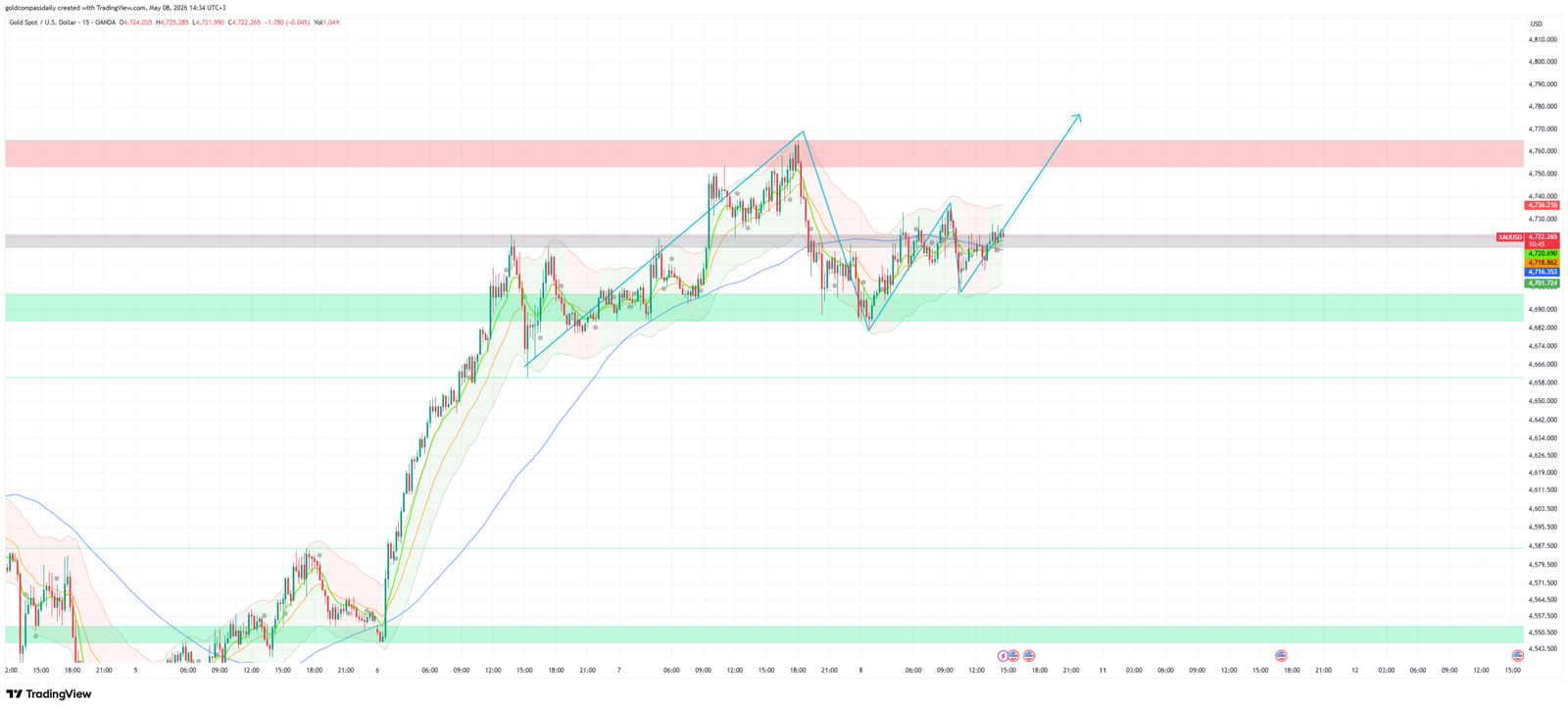
The Chart: Consolidation Near Highs, NFP Is the Catalyst
The weekly recovery from $4,504 to $4,765 has been one of the cleanest technical moves of 2026 — five consecutive days of higher lows, a break above every resistance level in sequence, and a final push to $4,765 that tested the pink resistance band visible at the top of the chart. The current consolidation between $4,701.724 and $4,736.210 is healthy — it represents the market holding its gains ahead of the week’s most significant event rather than giving them back.
The projected path shows a dip into the green demand zone at $4,701–$4,716 — which aligns with the dotted support level and the lower boundary of the current consolidation — before a break above $4,736 and a continuation toward $4,780+. The pink resistance band between $4,750 and $4,760 is the immediate ceiling. A close above that zone after today’s NFP would represent the most significant technical breakout since the April rally began and would put the $4,860 area back on the immediate agenda.
The floor is $4,701.724. A close below that on a strong NFP would signal that the recovery is taking a breather and the $4,660–$4,680 area becomes the next support. The structural bull case — tariff inflation, Fed uncertainty, safe-haven demand — remains intact regardless of today’s number.
Already Published: Japan Wages Miss, German Data Mixed
Japan’s Average Cash Earnings y/y printed at 2.7% — below the forecast of 3.2% and the prior 3.4%. This is a meaningful deceleration in Japanese wage growth — the primary variable the BOJ has been watching to justify further rate normalisation. A miss on wages reduces the urgency for the next BOJ hike and is modestly yen-negative. USD/JPY faces modest upward pressure from this data — dollar-positive at the margin, which adds a small near-term headwind for gold before the NFP dominates everything.
German Industrial Production m/m at -0.7% — below the forecast of 0.4% and the prior -0.5%. German factory output fell for the second consecutive month despite the manufacturing PMI showing expansion. This divergence between survey data (PMI) and hard data (industrial production) is the classic pattern of a turning point — orders are being placed, but output hasn’t yet responded. The miss is EUR-negative at the margin. German Trade Balance at 14.3B — below the forecast of 17.8B and the prior 19.6B. Germany’s trade surplus is narrowing — fewer exports and/or more imports. In the context of Liberation Day tariffs, a shrinking German trade surplus is the first hard-data evidence of tariff impact on German trade flows.
UK Halifax HPI m/m at -0.1% — below the forecast of 0.0% and continuing the prior -0.5% trend. UK house prices are declining for the second consecutive month — the housing market recovery seen in mortgage approvals data is not yet translating into price gains. GBP faces modest downward pressure on this miss.
Swiss SECO Consumer Climate at -40 — better than the forecast of -46 and the prior -43. A significant beat — Swiss consumers are less pessimistic than expected. The improvement from -43 to -40 (versus a forecast of -46) is a meaningful positive surprise. Swiss consumer confidence improving despite Liberation Day uncertainty suggests the tariff shock’s psychological impact is more contained than feared for Switzerland’s domestic economy.
10:00am — ECB President Lagarde Speaks: EUR Direction Pre-NFP
ECB President Lagarde speaks at 10:00am — her second appearance this week after Thursday’s 3:30pm communication. In the pre-NFP window, Lagarde’s comments will either reinforce or soften the EUR/USD direction heading into the afternoon’s defining data release. Given this week’s data — German industrial production miss, narrowing trade surplus, deteriorating retail sales — the most likely tone is one that emphasises the need for continued ECB easing while acknowledging the tariff-driven inflation complication.
Any signal that the ECB is prepared to cut at the June meeting regardless of the tariff inflation (because the growth risk outweighs the inflation concern) would be EUR-negative and dollar-positive — adding a mild headwind for gold before the NFP. A more hawkish Lagarde citing the CPI Flash’s 3.0% headline print as a reason for caution would be EUR-positive and could provide brief EUR/USD support through the European session.
12:45pm — FOMC Member Cook: The Pre-NFP Fed Signal
FOMC Member Cook speaks at 12:45pm — the Fed’s final scheduled communication before the NFP. In the current environment — where the FOMC delivered a balanced hold last Wednesday and three members spoke dovishly on Thursday evening — Cook’s pre-NFP comments will shape how markets interpret whatever the payrolls number delivers. If Cook signals that the Fed is “watching both sides of the mandate carefully,” markets will interpret any NFP weakness as accelerating the cut timeline. If Cook reaffirms the data-dependent stance without acknowledging growth risks, the Fed’s reaction function is less certain and the NFP number needs to be more extreme to force a repricing.
3:20pm — BOE Governor Bailey: Sterling Context
BOE Governor Bailey speaks at 3:20pm — ten minutes before the NFP drops. His timing is either unfortunate or deliberate. Bailey’s comments will be largely overshadowed by the 3:30pm US data, but any significant statement about UK monetary policy — particularly around the May rate cut decision — could move GBP/USD independently of the NFP reaction for the first few minutes.
3:30pm — Non-Farm Payrolls: The Week’s Defining Moment
Everything this week has been preparation for this moment. The Non-Farm Employment Change is forecast at 65K — against a prior reading of 178K. If confirmed, this would represent the largest single-month payrolls deceleration since the immediate post-COVID period and would be the first concrete evidence that Liberation Day’s tariff shock is feeding through into actual US hiring decisions.
The forecast of 65K was set after a week of softening signals: Tuesday’s ISM Services held at 54.0 but JOLTS declined to 6.86M, Wednesday’s ADP came in weak, Thursday’s claims rose to 205K from the prior 189K, and the Challenger Job Cuts data showed a meaningful deterioration in layoff announcements. All of these signals pointed lower for payrolls — but the question is whether 65K is already priced in or whether the actual number diverges significantly from this already-pessimistic consensus.
Three scenarios define the market reaction:
NFP above 130K (beat): The labour market is holding up better than the tariff shock would predict. Dollar strengthens significantly — DXY rallies, gold falls from $4,722 toward $4,680 and potentially $4,660. Rate cut expectations push further into Q4 2026. Equity markets receive a mixed signal (good for earnings but bad for rate cuts). The dip to $4,701 becomes more likely and potentially deeper.
NFP 50K–80K (in line with consensus): Weak but expected. The dollar initially rallies on “relief” that it wasn’t worse, then fades as the reality of sub-100K payrolls sinks in. Gold consolidates between $4,701 and $4,748 before a more directional move on the following week’s data. The technical dip-then-rally pattern plays out exactly as projected.
NFP below 30K or negative (miss): The most gold-bullish outcome available. A payrolls number that approaches zero or turns negative would be a recession signal that forces immediate repricing of the entire Fed rate path. Dollar collapses, gold surges through $4,748 and $4,760 in immediate reaction, potentially testing $4,800 before the session closes. This scenario would confirm that the post-Liberation Day economic damage is real and accelerating — the most powerful catalyst for gold’s April highs to be retested and exceeded.
The Average Hourly Earnings m/m at 0.3% (prior 0.2%) and Unemployment Rate at 4.3% (prior 4.3%) are the companion releases. A rising unemployment rate (above 4.4%) combined with weak payrolls would be the most complete labour market deterioration signal. Stable earnings (0.3%) despite weak hiring maintains the stagflation narrative — inflation not falling, employment not growing.
5:00pm — UoM Consumer Sentiment and Inflation Expectations
After the NFP dust settles, the Preliminary University of Michigan Consumer Sentiment at 49.7 (prior 49.8) and Inflation Expectations at 4.7% provide the consumer psychology context. A sentiment reading below 50 — which the forecast confirms — is already at levels associated with recession in historical data. Combined with CB Confidence’s miss last week, the US consumer confidence picture is deteriorating consistently. Inflation Expectations at 4.7% (prior level) — if confirmed at elevated levels — maintains the stagflation signal that is gold’s structural bull case: consumers expect prices to remain high while confidence collapses.
7:00pm — President Trump Speaks
Trump speaks at 7:00pm — after the NFP and UoM data. In the context of a potentially very weak payrolls report, Trump’s response will be closely watched. A weak NFP could provoke either a doubling down on tariff policy (“the short-term pain is worth the long-term gain”) or an acknowledgement that tariffs need adjustment. Either response moves markets — the former extends the tariff uncertainty premium in gold, the latter reduces it temporarily.
Key Levels and Full Market Summary
- Gold (XAU/USD): $4,722 · Dip target $4,701–$4,716 · Pink resistance $4,750–$4,760 · Target $4,780+ · Floor $4,701 · NFP 3:30pm is everything · UoM 5:00pm confirms the narrative
- EUR/USD: German IP miss + trade surplus narrowing = EUR headwind · Lagarde 10:00am sets morning tone · NFP drives the close · Weak NFP = EUR rallies sharply · Strong NFP = EUR breaks lower
- GBP/USD: Halifax HPI miss = modest GBP pressure · Bailey 3:20pm just before NFP = brief GBP volatility · NFP overwhelms all sterling-specific factors
- USD/JPY: Japan wage miss (2.7%) = mild yen weakness · NFP below 30K = sharp pair decline as yen safe-haven surges · NFP beat = pair holds elevated levels
- AUD/USD: Moves with risk sentiment from NFP · Weak NFP + Australia China trade exposure = AUD benefits from dollar weakness but faces commodity demand concern
- S&P 500 / Nasdaq: NFP below 30K = initial selloff on recession fear, then sharp rally on rate cut repricing — Nasdaq leads · NFP beat = modest equity support but rate cut hopes fade
- US Treasuries: NFP miss = 2-year yields fall sharply = most bullish Treasury signal of Q2 · NFP beat = yields hold = gold headwind
- UoM Inflation Expectations at 4.7%: If confirmed at elevated levels = stagflation signal = gold structural bull case reinforced regardless of NFP outcome
- Gold weekly close: Above $4,748 = bullish weekly close confirming recovery · Above $4,760 = pink resistance cleared = $4,860 retest in sight · Below $4,680 = NFP beat, consolidation week needed
This is the week’s final chapter — and potentially the most important page. Gold has recovered $221 from Monday’s low, the technical structure is the most bullish it has been since March’s highs, and today’s NFP arrives with a forecast of 65K that would be, if confirmed, the weakest hiring since the pandemic. The stagflation narrative — tariff-driven inflation meeting a weakening labour market — is gold’s bull case written in real-time data. Today at 3:30pm, that narrative either gets confirmed or challenged. Hold $4,701. Watch 3:30pm. The path to $4,860 starts here.
Analysis based on the XAU/USD 15-minute chart as of May 8, 2026, 14:34 UTC+3. Economic data sourced from the daily macro calendar. This article is for informational and educational purposes only and does not constitute financial advice.