

Gold slips to $4,513 in thin Memorial Day liquidity before recovering, with Consumer Confidence at 5:00pm as the session’s only meaningful US catalyst.
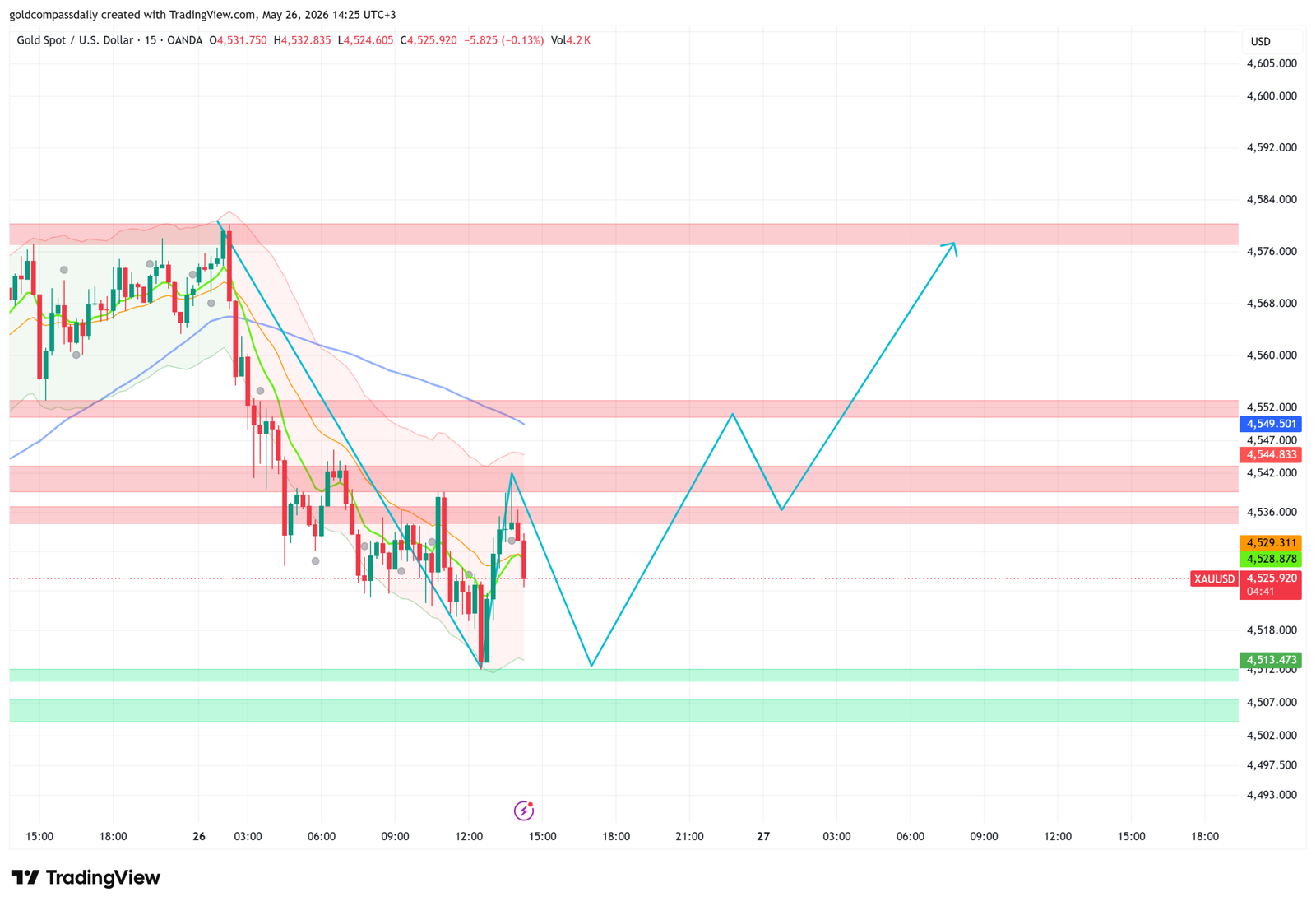
XAU/USD is trading at $4,525 — down from yesterday’s $4,582 session high — after a sharp intraday drop to $4,513 in the early European hours exposed the vulnerability of thin-liquidity price action. US markets remain closed for Memorial Day, eliminating the institutional participation that normally absorbs selling pressure of this magnitude. The 15-minute chart projects one more test of the $4,513.473 green support before a recovery toward $4,576+, with the pink resistance bands at $4,544.833 and $4,552 as the sequential hurdles above. Today is a positioning session rather than a directional one — the week’s defining events begin Wednesday with Australian CPI and the RBNZ, and culminate Thursday with Prelim GDP, Core PCE, and Unemployment Claims. For the full weekly roadmap, see the Gold Week Ahead: May 26–30.
The Fundamental Driver: BOJ CPI Miss Weakens Yen, UK Retail Beats — Mixed Signals in Thin Markets
BOJ Core CPI y/y printed at 1.4% — a miss against the forecast of 1.7% and below the prior 1.7%. The Bank of Japan’s preferred inflation gauge decelerating from 1.7% to 1.4% is a meaningful signal: it reduces the urgency for the next BOJ rate hike and weakens the yen normalisation narrative that has been one of the structural dollar-negative forces supporting gold over the past month. USD/JPY moved higher on the release — dollar-positive, which created the early-session headwind that pushed gold from $4,545 to $4,513. The BOJ CPI miss does not reverse the normalisation trajectory — Japanese wage growth at 4.1% and trade balance at surplus both remain yen-supportive — but it delays the next hike and reduces the near-term yen-driven dollar pressure.
Counterbalancing the BOJ miss, the UK CBI Realized Sales at -46 — better than the forecast of -52 and dramatically better than the prior -68 — signals that UK retail conditions are improving faster than the market expected. After last week’s services PMI collapse to 47.9 and the ongoing UK consumer confidence deterioration, a CBI Realized Sales reading of -46 versus a -52 forecast is a genuine positive surprise. UK retailers are reporting worse-than-neutral conditions — -46 still means contraction — but the direction of change is upward for the third consecutive month. For GBP, the beat is mildly positive. For gold, it reduces one component of the UK stagflation signal that had been building through the week, marginally weakening the safe-haven case from British economic distress.
The BRC Shop Price Index y/y at 1.2% (forecast 1.1%, prior 1.0%) — a slight beat on UK retail shop prices. British store prices are rising modestly and accelerating — consistent with the PPI Input beat at 2.4% from last week and the tariff-driven import price pipeline. For the BOE, rising shop prices alongside improving retail sales and decelerating CPI creates an unusual configuration: the underlying inflation pressure (at the producer and input level) is still building even as the headline consumer measure decelerated to 2.8%. Tomorrow’s Australian CPI will provide the next clean read on whether tariff-driven price acceleration is arriving at the consumer level or still sitting in the pipeline.
The Chart: Thin Liquidity Dip, Support at $4,513
The 15-minute chart reflects a market under artificial selling pressure from the absence of US institutional participation. The drop from $4,582 to $4,513 — a $69 intraday move on below-average volume — is characteristic of Memorial Day price action: a small amount of selling creates a disproportionate move because there are fewer buyers available to absorb it. The same dynamic works in reverse: when US markets reopen Wednesday, the buying support returns and the dip is typically recovered quickly if the fundamental case is intact.
The green demand zone at $4,512–$4,513.473 has held on both intraday tests today. The projected path shows one more touch of that level — completing the Memorial Day dip — before the recovery toward $4,544.833 (first pink resistance) and then $4,552 and $4,576+ as US liquidity returns. A close on the 15-minute chart above $4,529.311 signals the dip is complete and the recovery is underway. A close below $4,512 — a level that has not been tested intraday — would be a genuine support break that opens the $4,478 weekly low visible on the 4-hour chart.
5:00pm — CB Consumer Confidence: The Session’s Only US Input
With US equity and bond markets closed, the CB Consumer Confidence at 5:00pm (forecast 91.9, prior 92.8) is the only US economic release today that carries any meaningful market-moving potential — and even this will trade in reduced liquidity without the full participation of US institutional desks.
A reading of 91.9 would represent a continuation of the steady decline from 105+ in February to the low 90s now. The direction of travel has been consistent and is itself the signal — US consumers have been becoming progressively less confident for four consecutive months, even before April’s Liberation Day tariff impact was fully felt. A reading below 88 — which would represent an acceleration of the trend — would be the most significant single US data point available today and could push gold back toward $4,544 despite the thin liquidity conditions. A beat above 95 would be the most positive US signal of the session and would strengthen the dollar modestly, testing the $4,513 support.
The S&P/CS Composite-20 HPI y/y (prior 0.9%) and HPI m/m (forecast 0.1%, prior 0.0%) at 4:00pm provide the US housing context. A monthly reading of 0.1% would signal that US home prices are barely growing — consistent with the housing construction data (Building Permits and Housing Starts both decelerating) and the mortgage rate pressure that has been depressing transaction volumes for over a year.
What Matters More: Wednesday and Thursday
Today is a day to hold levels rather than make moves. The real week begins Wednesday morning with Australian CPI at 4:30am — where a reading below 4.3% y/y would make a June RBA cut near-certain and signal that Asia-Pacific tariff disinflation is arriving faster than expected. Wednesday afternoon brings the RBNZ decision at 5:00am and ADP Employment at 3:15pm, setting the tone for Thursday’s data barrage.
Thursday at 3:30pm delivers the most concentrated US data release of the month: Prelim GDP q/q (forecast 2.0%), Core PCE m/m (forecast 0.3%), Unemployment Claims (forecast 211K), Personal Income and Personal Spending simultaneously. That 3:30pm release will determine whether gold’s path to $4,755 opens this week or whether the correction needs one more test of $4,478 before the next bull leg begins. Today’s job is to hold $4,513. Thursday’s job is to break $4,635.
Key Levels
- Support: $4,513.473 (green zone, today’s low) → $4,512 (breakdown trigger) → $4,478 (weekly low)
- Resistance: $4,529.311 → $4,544.833 → $4,552 → $4,576 (recovery target)
- Dip target: $4,513 — one more test possible in thin afternoon liquidity
- Recovery trigger: Close above $4,529 = dip complete, $4,544 next
- Bias: Neutral — Memorial Day thin liquidity distorts direction · Hold $4,512, position for Wednesday’s catalysts
- Week ahead: Full event calendar and level analysis at Gold Week Ahead: May 26–30
Analysis based on the XAU/USD 15-minute chart as of May 26, 2026, 14:25 UTC+3. Economic data sourced from the daily macro calendar. This article is for informational and educational purposes only and does not constitute financial advice.