

Opening Verdict
The Disciplined Trader by Mark Douglas is the foundational text on trading psychology — required reading for any trader who executes sound analysis yet consistently fails to translate it into consistent profits. Where most trading books focus on systems and setups, Douglas addresses the variable that ultimately determines long-term performance: the trader’s own mind.
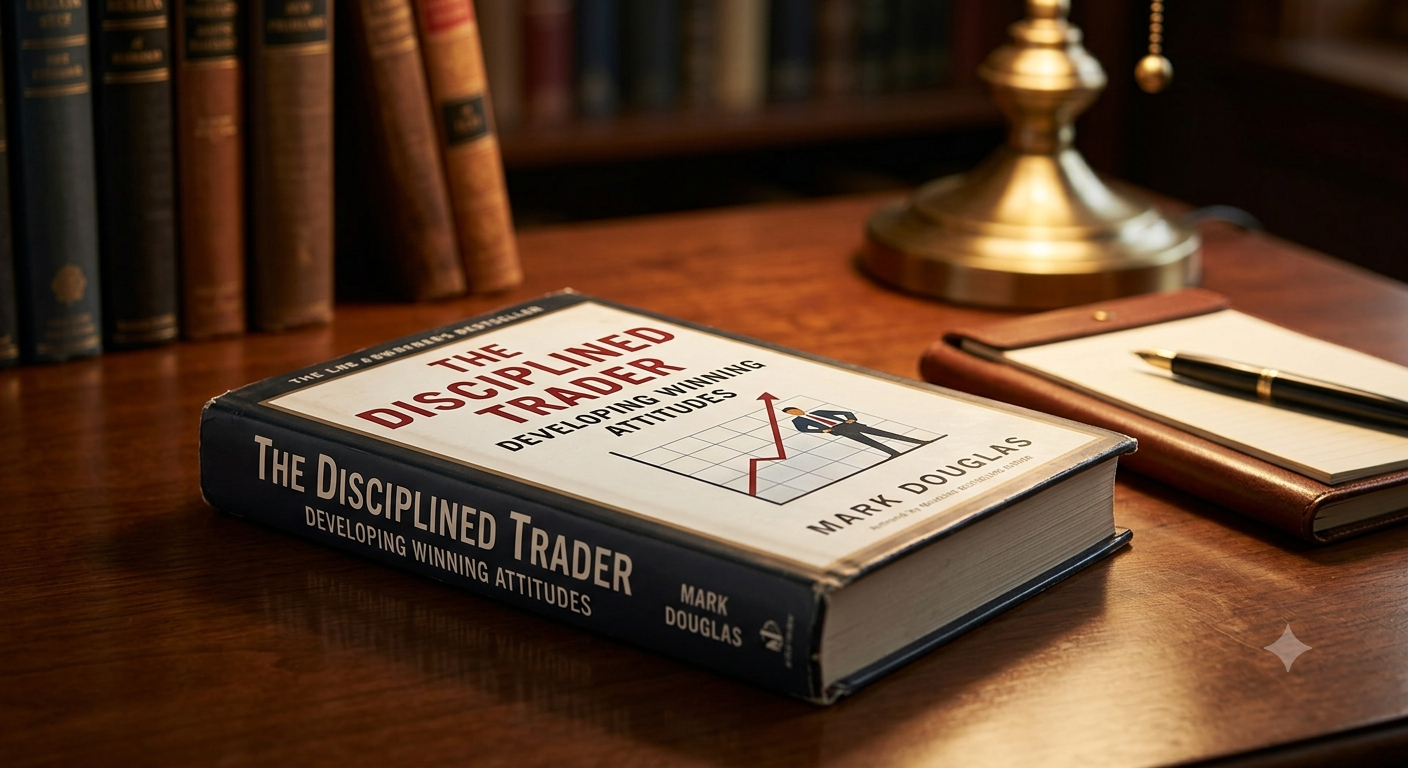
Book Overview
- Author: Mark Douglas — trading coach, seminar leader, and one of the first writers to systematically apply psychological principles to financial market performance
- First published: 1990
- Best for: Intermediate to Advanced traders experiencing consistency problems despite possessing technical competence
- Core focus: Trading Psychology
- Key takeaway: Consistent profitability is a function of mental discipline, not technical knowledge — and that discipline can be deliberately developed
- Rating: 4.5/5
What the Book Covers
Douglas opens with a premise that cuts against the instinct of most developing traders: the primary obstacle to profitability is not a flawed system or insufficient market knowledge — it is the psychological framework the trader brings to the market. The book’s central argument is that markets are a unique environment operating by rules that are fundamentally incompatible with the way human beings are conditioned to think, feel, and respond to uncertainty. The result is a systematic conflict between natural psychological tendencies and what profitable trading actually requires.
Structured in three parts, the book first establishes why trading is psychologically unlike any other professional discipline. It then dissects the specific mental patterns — fear, euphoria, revenge trading, and the compulsive need for certainty — that sabotage execution. The final section offers a framework for rebuilding a trader’s belief system from the ground up, creating what Douglas describes as a “disciplined trading mind.” The book does not teach chart patterns or entry signals; it teaches the mental operating system beneath every trade decision.
Key Lessons for Traders
1. The Market Has No Responsibility to Meet Expectations
Douglas argues that one of the most destructive habits traders carry into the market is the belief that a well-reasoned trade deserves to win. Markets are indifferent to analysis, effort, or conviction. Accepting this structurally — not just intellectually — removes the emotional charge from losses and allows traders to respond to price action rather than fight it.
2. Fear Is the Primary Performance Killer
Fear of loss, fear of missing a move, and fear of being wrong each produce specific and predictable execution failures: premature exits, over-leveraged entries, and hesitation at high-probability setups. Douglas identifies fear as a learned response — one that can be unlearned by consistently executing within a defined rule set until the rules replace emotional reaction as the default decision driver.
3. Consistency Requires a Probabilistic Mindset
Profitable trading does not require predicting the outcome of any individual trade — it requires executing a statistical edge across a large sample of trades. Douglas draws a direct parallel to casino management: the house does not know the outcome of the next hand, but it operates with absolute confidence because the edge plays out over time. Traders who internalize this shift stop treating each trade as a verdict on their competence and start treating it as one data point in a long-run process.
4. Losses Must Be Redefined, Not Avoided
Most traders are conditioned by education and professional culture to treat losses as failures. Douglas argues that this framing is actively harmful in a trading context. A loss that falls within a predefined risk parameter is not a failure — it is a cost of doing business, as routine as a retailer’s wholesale expense. Traders who cannot make this cognitive shift will continuously distort their execution to avoid losses, undermining the very edge they are attempting to exploit.
5. Mechanical Trading Rules Are a Psychological Tool, Not a Limitation
Douglas presents rule-based trading not merely as a technical discipline but as a psychological one. Explicit rules — on entry, exit, position sizing, and maximum daily loss — remove the in-the-moment discretionary decisions that expose traders to emotional interference. Following rules consistently builds the trust in one’s own process that is the foundation of disciplined execution.
What Gold Compass Daily Found Most Valuable
Gold Compass Daily’s analysis finds the book’s most durable contribution to be its treatment of the relationship between belief and execution. Douglas demonstrates, with unusual precision, that a trader’s beliefs about markets, money, and personal capability are not abstract — they manifest directly in how orders are placed, held, and closed. A trader who believes losses are dangerous will exit profitable trades early to lock in a gain and hold losing trades to avoid realizing a loss — the exact inversion of optimal behavior. This insight applies with particular force to markets like XAU/USD, where high volatility and macro sensitivity create constant emotional pressure. Technical analysis provides the directional framework; the psychological framework Douglas describes determines whether a trader can actually execute within it.
Who Should Read This Book
Read this if:
The trader has a defined methodology — technical, macro, or systematic — and understands market structure, but finds that live execution consistently underperforms backtested or demo results. This profile describes a trader whose limiting factor is no longer knowledge but the psychological interference that surfaces when real capital is at risk. The Disciplined Trader directly targets this gap. It also pairs well with the traders profiled across the Market Wizards, The New Market Wizards, Stock Market Wizards, Hedge Fund Market Wizards, and Unknown Market Wizards series, where psychological consistency surfaces repeatedly as the defining trait of long-term outperformers.
Skip this if:
The trader is in the earliest stage of market education and has not yet developed a functional trading method. Without an existing system to apply Douglas’s psychological framework to, the book’s lessons remain theoretical. Beginners are better served first building technical competence — see Reminiscences of a Stock Operator for market intuition grounded in real-world experience — before addressing the execution psychology Douglas covers.
Final Verdict
The Disciplined Trader occupies a category of its own in trading literature because it addresses a problem most trading books do not acknowledge: that the trader, not the system, is typically the weakest link in the performance chain. Douglas wrote this book before trading psychology became a recognized discipline, and it remains the clearest articulation of why technically competent traders fail and what they can do about it. The recommendation from Gold Compass Daily is to read this book after establishing a functional trading approach and encountering the first serious drawdown caused by emotional decision-making — because that is the moment its arguments become concrete rather than conceptual. For a broader reading framework across disciplines, the Gold Compass Daily essential trading book list places The Disciplined Trader within a full curriculum for serious market participants.
This review is for informational and educational purposes only and does not constitute financial advice.