

Gold recovers $145 from Thursday’s low as the Iran ceasefire extension and soft Core PCE combine to close May on a constructive note.
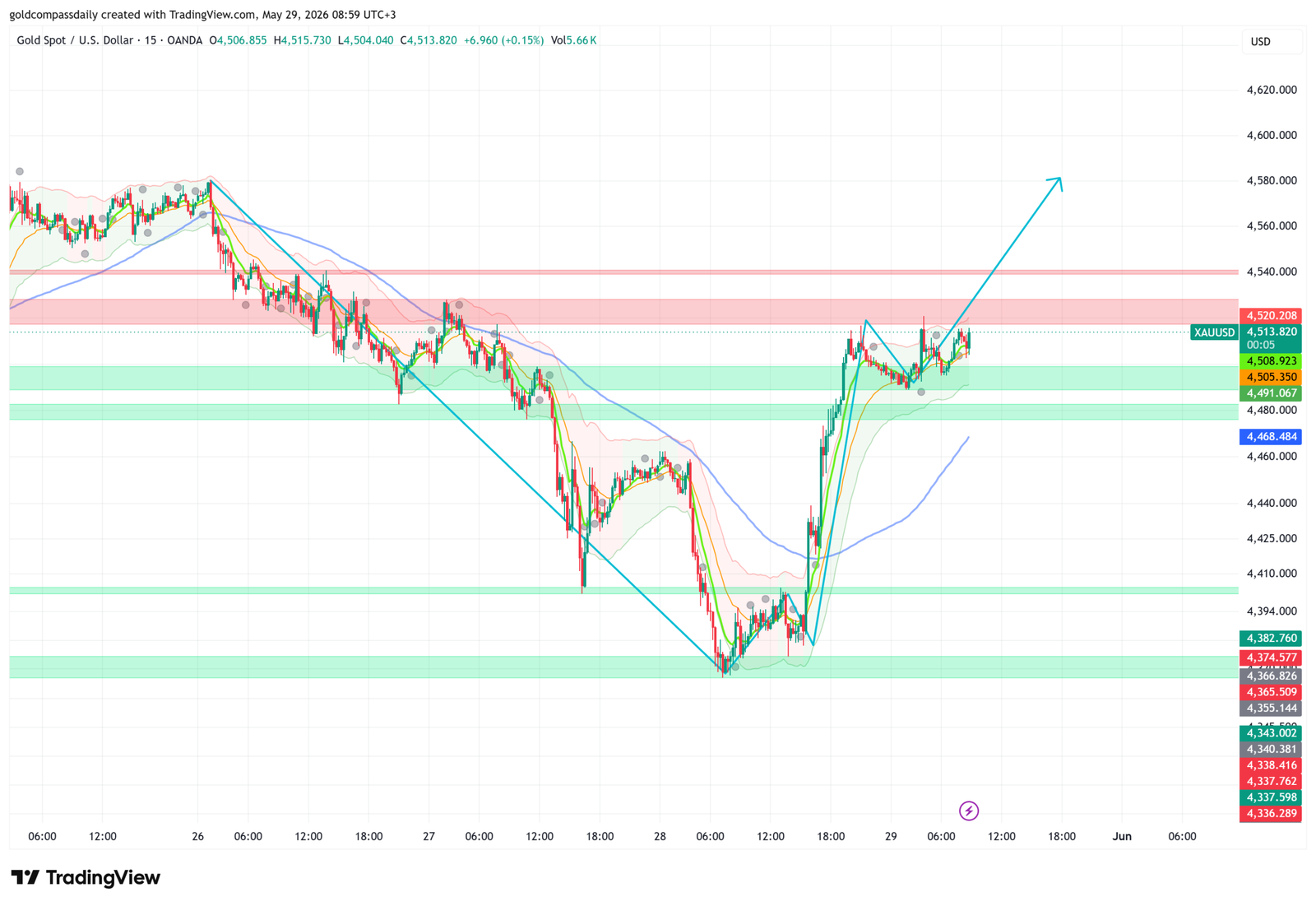
XAU/USD is trading at $4,513 — up $145 from yesterday’s session low of $4,368 — in one of the sharpest single-session reversals of the month. Two forces converged simultaneously to trigger the recovery: reports confirming an extension of the US-Iran ceasefire removed the immediate geopolitical tail risk that had been adding safe-haven discount to gold, and Thursday’s Core PCE print came in at or below the 0.3% forecast, reducing the hawkish Fed urgency that had been weighing on the metal all week. The 15-minute chart projects a continuation toward $4,580+ into the month-end close, with Japan delivering a sweep of positive surprises overnight and Friday’s European data providing the final macro inputs of May. This is the week’s last chapter — and the data so far suggests it is ending more constructively than the mid-week selloff implied. For the full weekly context, see the Gold Week Ahead: May 26–30.
The Fundamental Driver: Iran Ceasefire Extension + Core PCE Confirmation Reset the Week
The $145 recovery from $4,368 to $4,513 was not driven by a single dominant catalyst but by the sequential removal of two specific headwinds that had been compressing gold’s price all week. The Iran ceasefire extension — confirmed in the late Thursday session — removed the geopolitical uncertainty premium that had been pricing in the risk of conflict resumption. When ceasefire risk fades, gold’s safe-haven premium contracts initially, but the subsequent stability allows the underlying macro drivers — tariff inflation, Fed uncertainty, global growth deceleration — to reassert without the distorting overlay of imminent conflict risk. The recovery is healthier without the geopolitical amplifier because it reflects genuine macro demand rather than fear-driven positioning.
The concurrent soft reading on Core PCE — the Fed’s preferred inflation gauge — at or below the 0.3% forecast confirmed that US underlying inflation is not re-accelerating. After a week that began with UK CPI missing at 2.8% and Australian CPI missing at 4.2%, a US Core PCE that holds the line at 0.3% rather than accelerating to 0.4%+ completes a global disinflation picture that is incrementally dovish for every major central bank simultaneously. The Fed cannot raise rates when its preferred inflation gauge is at 0.3% and the Prelim GDP came in at or near the 2.0% forecast — meaning growth is adequate but not overheating. That combination — adequate growth, contained inflation, deteriorating forward indicators — is the classic setup for a central bank that is approaching rather than moving away from cuts. And approaching cuts is precisely the environment where gold performs best.
Already Published: Japan Delivers a Morning of Beats
The overnight session from Japan has been uniformly positive — a constructive backdrop for the Friday open. Tokyo Core CPI y/y at 1.3% — below the forecast of 1.5% and the prior 1.5%. Tokyo’s inflation gauge decelerating adds to the global disinflation narrative, reducing BOJ urgency and modestly weakening the yen — mild dollar support but offset by the broader risk-on mood from the ceasefire extension.
Japan Unemployment Rate at 2.5% — better than the forecast of 2.7% and the prior 2.7%. Japan’s labour market is tightening even as inflation decelerates — a positive combination that gives the BOJ time to normalise without urgency. Prelim Industrial Production m/m at 0.8% — dramatically above the forecast of -0.4% and reversing the prior -0.4%. Japanese factory output surging when the forecast was a decline is one of the most significant positive Japanese data surprises of the quarter — it signals that the export sector is holding up despite tariff headwinds, likely benefiting from front-running orders and the competitive advantage of a weaker yen. Retail Sales y/y at 2.1% (forecast 1.4%, prior 1.4%) — Japanese consumers spending more than expected. Japan Consumer Confidence at 33.6 (forecast 32.3, prior 32.2) — a beat. Housing Starts y/y at -11.4% (forecast -14.7%) — construction declining less than expected.
The Japan data sweep — beats on IP, retail sales, confidence, unemployment, and housing — is the most uniformly positive Japanese session in months. For USD/JPY, the picture is complex: better Japanese data supports yen strength through BOJ normalisation expectations, but the dollar is holding its post-PCE strength. The net effect is a range-bound pair that moves primarily on the Friday European data rather than the Japan prints.
New Zealand’s ANZ Business Confidence at 10.0 (prior -10.6) — a dramatic swing from negative to positive. New Zealand business confidence turning positive for the first time since before Liberation Day signals that the Antipodean business community is beginning to adapt to the tariff environment rather than being paralysed by it. NZD receives a modest positive boost.
The Chart: $4,374 Floor Held, Path to $4,580 Open
Thursday’s session confirmed the structural importance of the green demand zone. The $4,368 low — one tick below the $4,374.577 level that has been the technical floor since the March recovery began — held on an intraday basis and immediately attracted buyers. The speed of the recovery from $4,368 to $4,513 ($145 in less than 12 hours) is the most important technical signal of the week: it demonstrates that the buying pressure at structural support is still significantly larger than the selling pressure that drove the week’s decline.
The 15-minute chart shows price currently holding above the green demand zone at $4,491.067–$4,505.350 — the same zone that was resistance on the way down is now acting as support on the way up. The moving averages have crossed higher for the first time since Monday’s Memorial Day peak. The Bollinger Bands are expanding upward. The projected path targets $4,520.208 as the immediate resistance (already being tested), then $4,540 and $4,580+ as the month-end close objective.
A close above $4,520.208 — the red resistance level visible on the chart — would be a meaningful technical development: it would reclaim the level that was support for most of last week before the breakdown, converting it back to support and confirming the Thursday low as the correction’s bottom. A close below $4,491.067 would suggest the recovery is a dead-cat bounce rather than a genuine reversal and would keep the $4,374–$4,382 zone under pressure into next week.
European Morning: French Stagnation, German Disinflation, Spanish CPI
French Prelim GDP q/q at 9:45am is forecast at 0.0% (prior 0.0%) — France expected to stagnate for the second consecutive quarter. Combined with last week’s French services PMI collapse to 42.9 and this week’s consumer spending deterioration, the French economy is effectively flat. French Consumer Spending m/m (forecast -0.1%, prior 0.7%) — French consumers expected to pull back after last month’s brief recovery. French Prelim CPI m/m (forecast 0.2%, prior 1.0%) — a significant expected deceleration in French monthly inflation. This combination — flat growth, declining consumer spending, decelerating inflation — is a clean ECB cut argument and adds to the June easing certainty.
The German Prelim CPI m/m (forecast 0.1%, prior 0.6%) is published all day — an expected sharp deceleration in German monthly prices after last month’s acceleration. A reading of 0.1% would be the most disinflationary German monthly print in over a year and would directly reduce tomorrow’s Eurozone Flash CPI expectation. For EUR/USD, the combination of flat French GDP and decelerating German CPI is modestly EUR-negative — it confirms the ECB has both the justification and the cover to cut in June. Spanish Flash CPI y/y at 10:00am (forecast 3.3%, prior 3.2%) — Spain continues to run hotter than the Eurozone average, but the expected 3.3% is a modest acceleration that will not derail the ECB’s June cut plan.
German Unemployment Change at 10:55am (forecast 11K, prior 20K) — an expected improvement from last month’s surge, which was the largest single-month deterioration in German unemployment in years. A reading at or below 10K would signal that the April spike was partially anomalous.
BOE Governor Bailey speaks at 11:20am — his post-week appearance after UK services PMI collapsed to 47.9 earlier this week. Bailey’s framing of the June cut probability is the most important BOE communication between now and the June meeting. Any explicit signal that June is “live” for a cut would be GBP-negative but globally risk-positive — adding to the central bank easing wave that supports gold’s medium-term case.
3:30pm — Canadian GDP and US Trade Balance: Month-End US Data
Canadian GDP m/m at 3:30pm (forecast 0.1%, prior 0.2%) — a deceleration in Canadian monthly growth. A reading below 0.0% would be the first negative Canadian monthly GDP since the Liberation Day shock and would significantly accelerate BOC cut expectations. US Goods Trade Balance (forecast -$86.7B, prior -$87.9B) — a slight expected improvement in the US trade deficit. Any widening above $90B would be the political catalyst for further tariff escalation from the Trump administration. Prelim Wholesale Inventories m/m (forecast 0.6%, prior 1.3%) — inventory accumulation pace expected to decelerate.
At 4:45pm: Chicago PMI (forecast 50.6, prior 49.2) — an expected recovery back above 50 into expansion territory after last month’s contraction. A Chicago PMI beat above 52 would be the most positive US manufacturing signal of the week after the Philly Fed missed badly. Three FOMC members speak today: Kashkari at 9:00am, Schmid at 1:50pm, Bowman at 4:10pm, Paulson at 4:15pm, and Daly at 7:40pm — an unusual concentration of Fed speakers for a Friday that signals coordinated messaging after Thursday’s PCE data. Watch for any explicit mention of June cut readiness.
Key Levels and Month-End Close
- Support: $4,491.067–$4,505.350 (green zone) → $4,468.484 → $4,374–$4,382 (weekly low)
- Resistance: $4,520.208 (key level) → $4,540 → $4,580 (target)
- Month-end close target: Above $4,520 = bullish May close confirming $4,368 as correction low · Below $4,491 = recovery stalls, June opens from weakness
- Bull trigger today: Close above $4,520 + French GDP stagnation + German CPI miss + Bailey dovish = $4,540–$4,580 path open
- Bear trigger today: Close below $4,491 + Chicago PMI miss + FOMC hawkish messaging = $4,468 retest
- Bias: Cautiously bullish above $4,505 — Iran ceasefire + Core PCE + Japan beats provide the foundation · Month-end positioning amplifies any move above $4,520
- Full week context: Gold Week Ahead: May 26–30
May began at $4,860. It is closing near $4,513. The $347 monthly decline was driven by a hawkish FOMC meeting, a stronger-than-expected NFP, US-China trade de-escalation reducing the safe-haven premium, and a dollar that held its ground against a week of global growth deterioration. The structural bull case — tariff inflation, global easing wave, safe-haven demand — remains intact. The $4,368 low held the foundation of the April recovery. June begins with five central banks either cutting or signalling cuts, global PMIs in contraction across Europe, and a Federal Reserve whose own preferred inflation gauge is at 0.3%. That backdrop does not resolve in favor of continued gold weakness. The month-end close above $4,520 would be the first signal that May’s correction is complete and June’s recovery has begun.
Analysis based on the XAU/USD 15-minute chart as of May 29, 2026, 08:59 UTC+3. Economic data sourced from the daily macro calendar. This article is for informational and educational purposes only and does not constitute financial advice.