

How I Made $2,000,000 in the Stock Market by Nicolas Darvas is one of the most unusual success stories in trading literature — and one of the most instructive. A professional dancer with no formal financial training, Darvas developed a momentum-based trend-following system in the late 1950s that turned a modest stake into a multi-million-dollar fortune. For traders who distrust complexity and value discipline over theory, this book delivers a clear, replicable framework built from hard-won experience.
Book Overview
- Author: Nicolas Darvas — Hungarian-born professional dancer and self-taught investor who developed his trading system while touring internationally
- First published: 1960
- Best for: Beginner to Intermediate trader
- Core focus: Strategy, Technical Analysis, Trading Psychology
- Key takeaway: Price and volume alone — not tips, fundamentals, or broker advice — are sufficient to identify and ride explosive momentum stocks
- Rating: 4/5
What the Book Covers
Darvas opens with his early failures — the impulsive trades, the broker tips that cost him money, the speculative bets that went nowhere. These chapters are not filler. They establish a crucial argument: that conventional wisdom about the stock market is actively harmful to the private trader. Brokers have conflicting interests. Fundamentals lag price. Tips create noise. Darvas concludes that the only reliable signal is the market itself — specifically, what price and volume reveal about institutional accumulation and momentum.
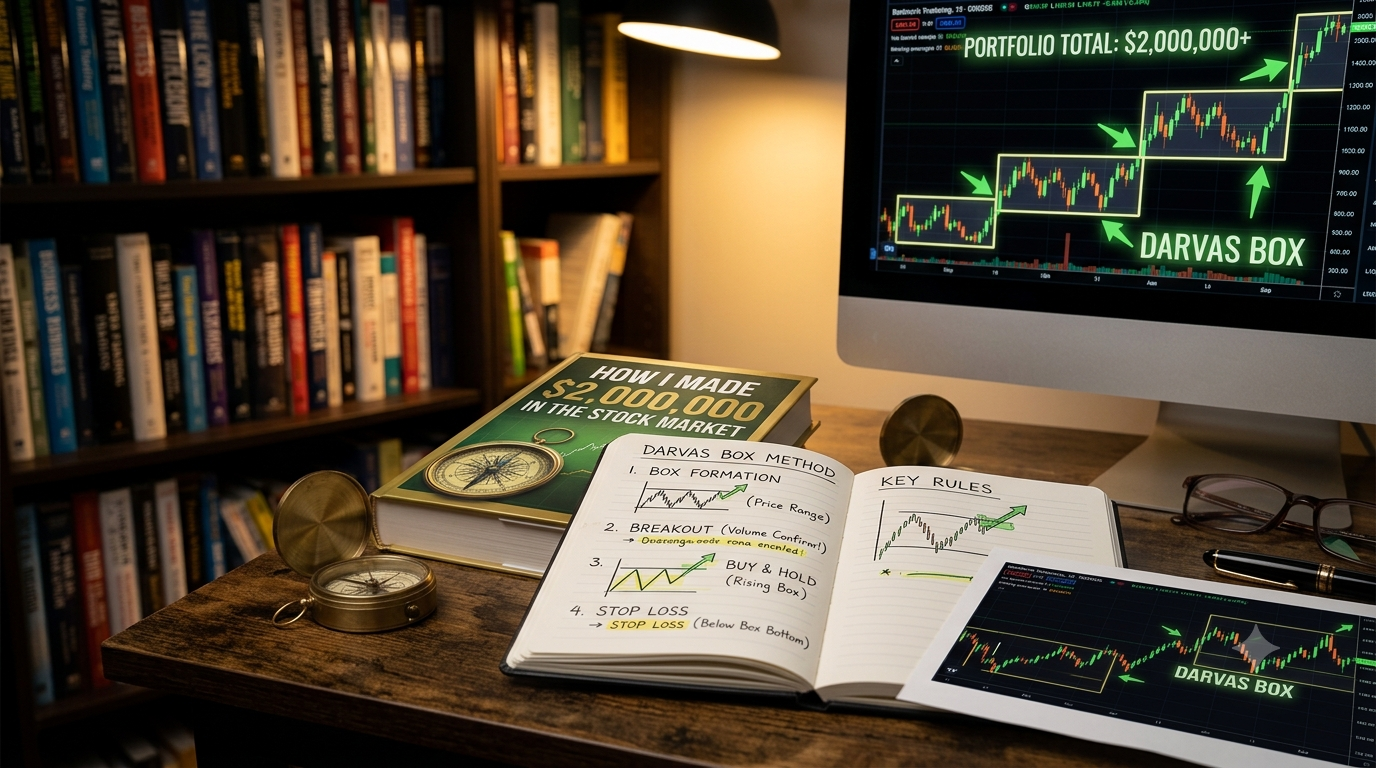
The book then traces his evolution toward the Darvas Box system: a method of identifying stocks breaking into new price ranges on high volume, entering at the breakout point, placing a tight stop just below the box floor, and pyramiding into winning positions while cutting losers immediately. The narrative is structured as a chronological account rather than a formal textbook, which makes it readable but also requires the trader to extract principles from story. Gold Compass Daily’s analysis finds that this format — while accessible — rewards active reading with a notebook rather than passive consumption.
Key Lessons for Traders
1. Let Price and Volume Do the Talking
Darvas abandoned fundamental analysis after repeated losses based on earnings reports and broker recommendations that bore no relationship to how stocks actually moved. His conclusion — that price action and volume are the only unambiguous signals — remains foundational to technical trading. A stock accumulating volume while consolidating in a tight range is communicating institutional interest far more reliably than any analyst report.
2. The Box System: Define the Range Before You Trade
The Darvas Box method requires identifying a price range — the “box” — where a stock consolidates after a strong move. The entry trigger is a breakout above the box ceiling on elevated volume. The stop is placed just below the box floor. This structure forces the trader to define their invalidation point before entering, which eliminates the most common source of retail losses: staying in a losing trade because no exit rule was set in advance. The method applies directly to any instrument that trends — equities, commodities, or currency pairs.
3. Cut Losses Without Negotiation
One of Darvas’s hardest-won lessons is that stops must be treated as firm rules, not suggestions. His early losses came partly from moving stops or waiting for a stock to “come back.” Once he committed to exiting immediately when price violated his box floor, his results stabilised. The book argues — and the evidence from his own account confirms — that the psychological discomfort of a stopped-out trade is vastly preferable to the catastrophic loss that follows hoping.
4. Pyramid Into Strength, Not Into Hope
Darvas added to positions only when a stock moved into a new, higher box — confirming that the trend was intact. He never averaged down into losing positions. This approach to position sizing is consistent with what the most successful trend-followers in later decades also discovered: the only mathematically defensible reason to increase exposure is confirmation that the trade is working, not the wish that it will work. Readers of the Gold Compass Daily trading books hub will recognise this principle as a recurring theme across elite trader profiles.
5. Eliminate Noise — Including Your Own Broker
Trading from hotel rooms across Europe and Asia using only weekly stock tables and telegrams, Darvas was structurally insulated from the real-time noise that destroys most traders. He could not overtrade. He could not react emotionally to intraday moves. He could not be talked out of positions by a broker with a conflicting commission motive. The lesson is deliberate: the more decision-making inputs a trader allows, the worse their outcomes. Simplification is not a shortcut — it is the edge.
What Gold Compass Daily Found Most Valuable
The single most valuable insight in the book — and the one most directly applicable to professional market analysis — is Darvas’s insistence on separating signal from story. Throughout the book, he demonstrates that stocks he bought based on logical narratives (strong earnings, favourable macro conditions, broker endorsements) consistently underperformed stocks that simply showed the right price-and-volume behaviour. Gold Compass Daily’s analysis finds this especially relevant for traders who consume heavy volumes of financial media: a compelling macro thesis or analyst upgrade is not a trade. A breakout on volume, with a clearly defined stop, is a trade. The discipline to act only on the latter — and ignore the former unless it coincides — is what distinguishes systematic traders from gamblers with a news feed.
Who Should Read This Book
Read this if:
This book is ideal for traders who are early in their development and have not yet committed to a single methodology. If a trader has experienced losses from acting on tips, analyst recommendations, or fundamental narratives that contradicted price behaviour, Darvas provides both a cautionary framework and a practical alternative. It is also well-suited to traders developing momentum or breakout strategies who want to understand the psychology behind systematic rule-following from a first-person account. Those who have already read Reminiscences of a Stock Operator or The Disciplined Trader will find Darvas a complementary case study in applied trend discipline.
Skip this if:
Advanced systematic traders or those already operating with a defined, backtested methodology will find limited new technical content here. The box system, while sound, is not described with the precision required to implement it directly from the text — readers seeking rigorous entry and exit rules with specific parameters will need to supplement Darvas with more technical literature. Traders focused exclusively on macro, fixed income, or options strategies will also find the book’s equity-specific framing less directly applicable.
Final Verdict
How I Made $2,000,000 in the Stock Market earns its place among the canonical trading texts not because of the dollar figure in its title, but because of what Darvas had to destroy before he could build a system that worked. Every failed approach — the tips, the fundamentals, the overtrading, the hope-based position management — mirrors the journey of most retail traders today. The Darvas Box method itself is elegant in its simplicity: define the range, enter the breakout, honour the stop, add only into strength. Traders should read this book early in their development, before bad habits calcify, and return to it periodically as a reminder that complexity is rarely the answer. For those building a systematic library, it pairs well with the trader profiles in Market Wizards, The New Market Wizards, Stock Market Wizards, Hedge Fund Market Wizards, and Unknown Market Wizards — all reviewed in the Gold Compass Daily essential trading books hub.
This review is for informational and educational purposes only and does not constitute financial advice.